01
Measurement without calibration
Models assume a measurement translates directly into a result and do not account for calibration, so answers look sound on paper but do not reflect what the instrument or assay reports.
Tests whether models can adapt and troubleshoot real wet-lab protocols like an expert scientist in the lab.
Mean score and 95% confidence interval for each model across all 149 tasks, graded by GPT-6 Luna.
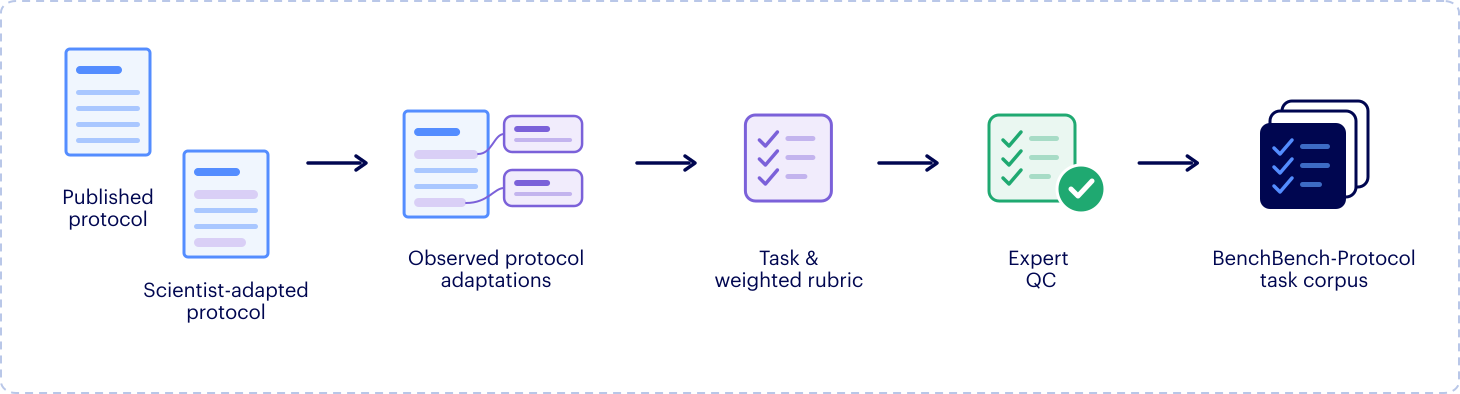
Each task comes from a real change a scientist made to a published protocol. That change becomes the question and its scoring rubric. Domain experts review every task, and only the strongest make the benchmark.
Examples of how frontier models fall short on wet-lab protocol tasks.
Models assume a measurement translates directly into a result and do not account for calibration, so answers look sound on paper but do not reflect what the instrument or assay reports.
Models treat a sample as pure despite visible evidence that it is not.
Models miss subtle changes in physical technique that can ruin an experiment.
Model inference plus web search, averaged across attempts.
We create every BenchBench benchmark with scientific experts, drawing on thousands of real-world experiments.
Explore more research from Benchling: 2026 Biotech AI Report