01
Primer pairs that can't work together
Each primer targets the right sequence, but the pair dimerizes or anneals too far apart to work together.
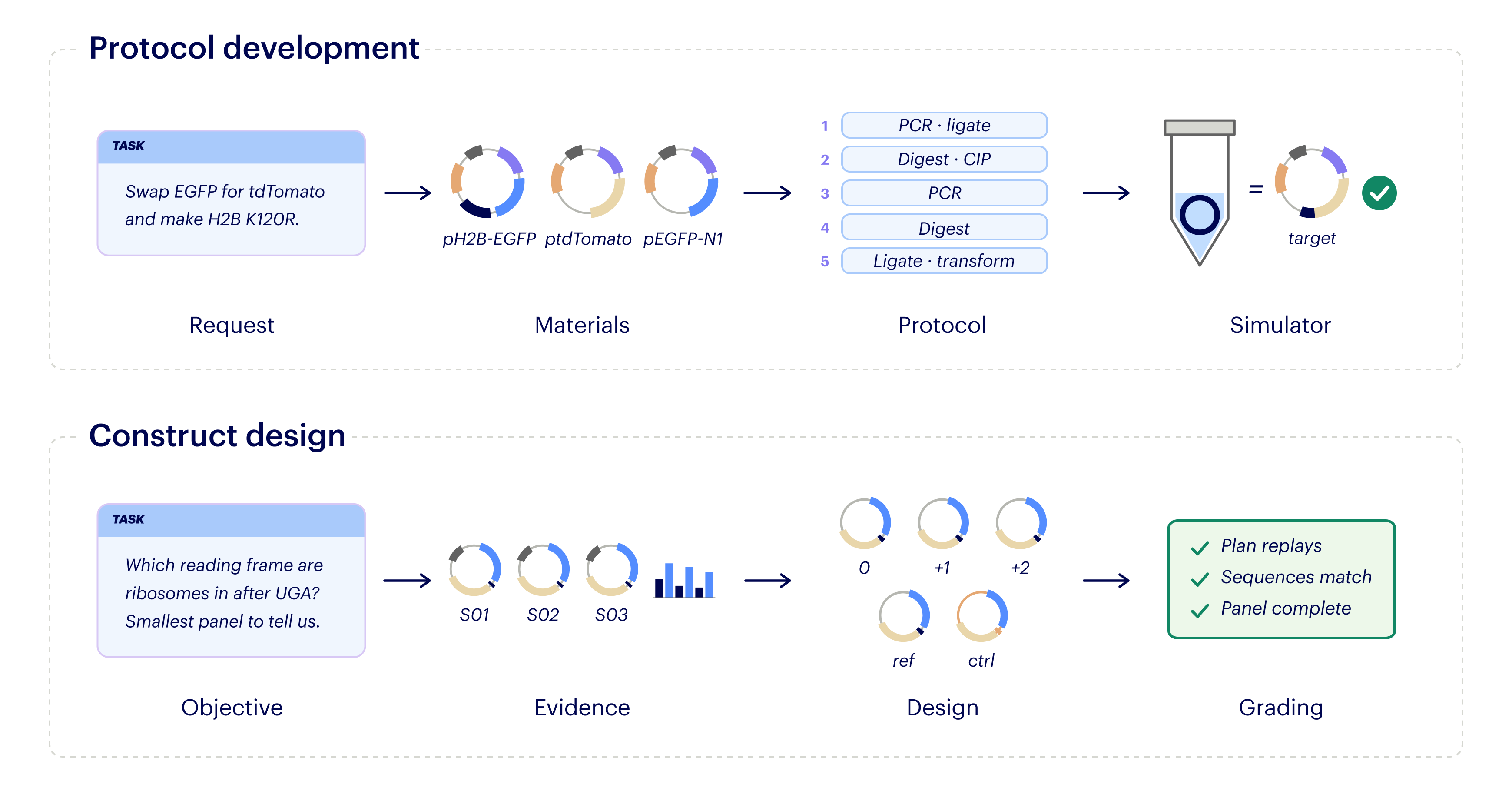
Tests whether models can reason through complex molecular cloning experiments, from construct design to protocol development.
Pass rate and 95% confidence interval across all 65 tasks.
Each task comes from real cloning work. Protocol development tasks are derived from notebooks created by contributors on Benchling. Construct design tasks come from published scientific studies.
Can you turn our pTCF7-luc prep, grown in an E. coli strain nobody recorded, into an NF-κB reporter by replacing everything between its BspEI site and the first StuI site downstream with the 5×NF-κB element? Both sites must stay intact, and every other base, including the minimal promoter, must stay exactly as it is.
The published measurements don’t tell us which reading frame ribosomes are in after they pass through the UGA codon. What is the smallest panel of constructs that would tell us which frame?
Models frequently miss a fifth construct, a control with the Firefly reading frame closed by a stop codon, which the experiment needs in order to separate readthrough from re-initiation.
Examples of how frontier models fall short on molecular cloning tasks.
Each primer targets the right sequence, but the pair dimerizes or anneals too far apart to work together.
Models skip dephosphorylation, treat blunt ends as directional, or cut at sites a Dam/Dcm host has blocked.
Models make the requested change but miss the second change or control the experiment needs.
Model inference, averaged across attempts.
We create every BenchBench benchmark with scientific experts, drawing on thousands of real-world experiments.
Explore more research from Benchling: 2026 Biotech AI Report