Benchling Biologics delivers no-code antibody format design and automated registration at scale
Two of the COVID monoclonal antibodies that reached patients during the pandemic were developed on Benchling. Both moved from sequence to human clinical trials in roughly five months. That pace was extraordinary then and now it's the baseline on molecules far more complex than the ones that came before.
Most R&D systems weren't built for this moment. Antibody R&D has moved from discovery to design, from finding molecules that bind to engineering molecules that perform. Bispecifics, multispecifics, and novel formats are now standard. AI is enabling structure prediction, property optimization, and de novo design from sequence. But the lack of native support for emerging formats and a way to structure the resulting data, leaves sequence and assay data fragmented and difficult to use for analysis or modeling at scale.
We first introduced Benchling Biologics last fall. With today's release, it's now the end-to-end platform for antibody R&D, giving teams the AI-ready data foundation they need to move faster.
Scientists can configure any antibody format without code, register proteins of any complexity, and capture metadata at the domain level. The data model is antibody-aware: proteins, chains, and domains are registered as linked components, with experimental context attached as it's generated. By the time a candidate reaches selection, it carries the full design-build-test-learn (DBTL) record behind it.
Here’s how it works across each stage of the DBTL loop
Discovery: Process sequencing data at scale
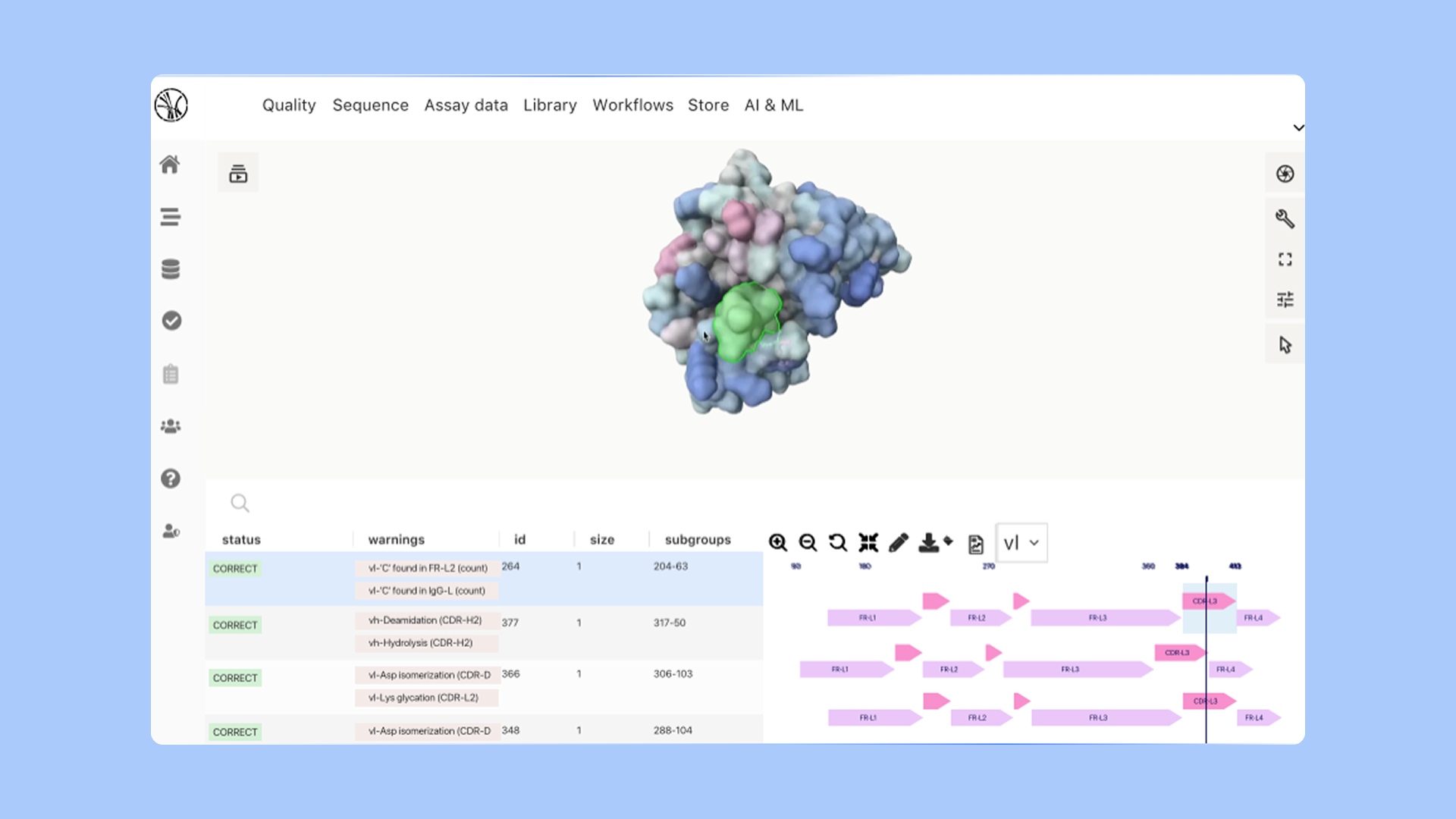
PipeBio by Benchling provides a no-code interface for antibody screening, supporting IgGs, sdAbs, scFvs, Fabs, bispecifics, TCRs, and peptides. Sequencing runs from discovery campaigns or in silico pipelines can return millions of sequences. Automating sequence processing, repertoire analytics, and early liability identification enables scientists to cluster candidates, assess developability, flag liabilities, and select hits without relying on dedicated bioinformatics support. Teams can pass selected hits directly into Benchling for registration while maintaining full traceability.
Design: Configure any format, same day
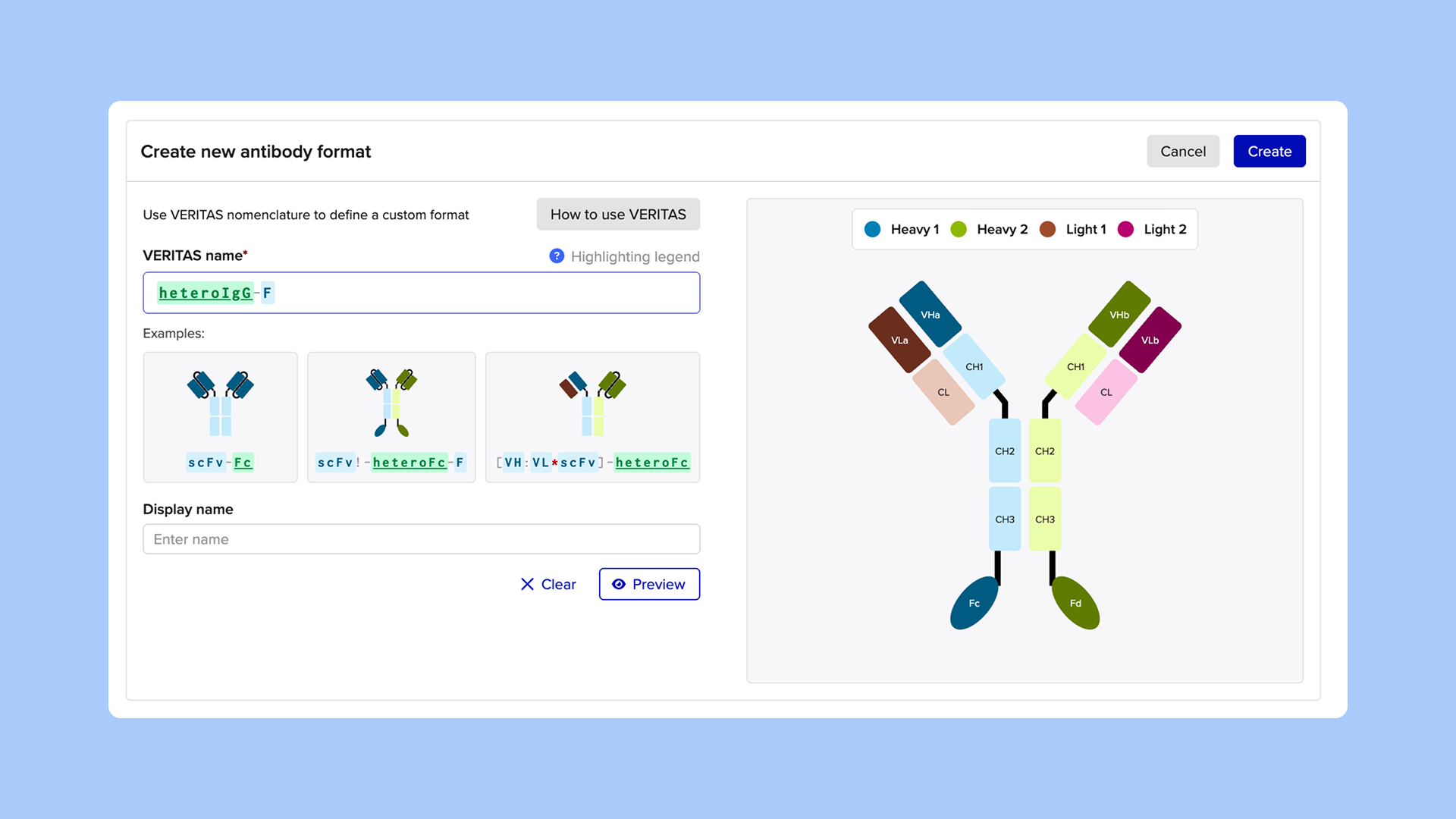
Scientists are evolving antibody formats faster than most systems can accommodate and existing tools aren’t keeping up. Adding a new format requires custom work and weeks of waiting. Now in Benchling Biologics, scientists can define new formats in minutes from modular building blocks and begin registering proteins of those formats immediately, condensing weeks of waiting to days.
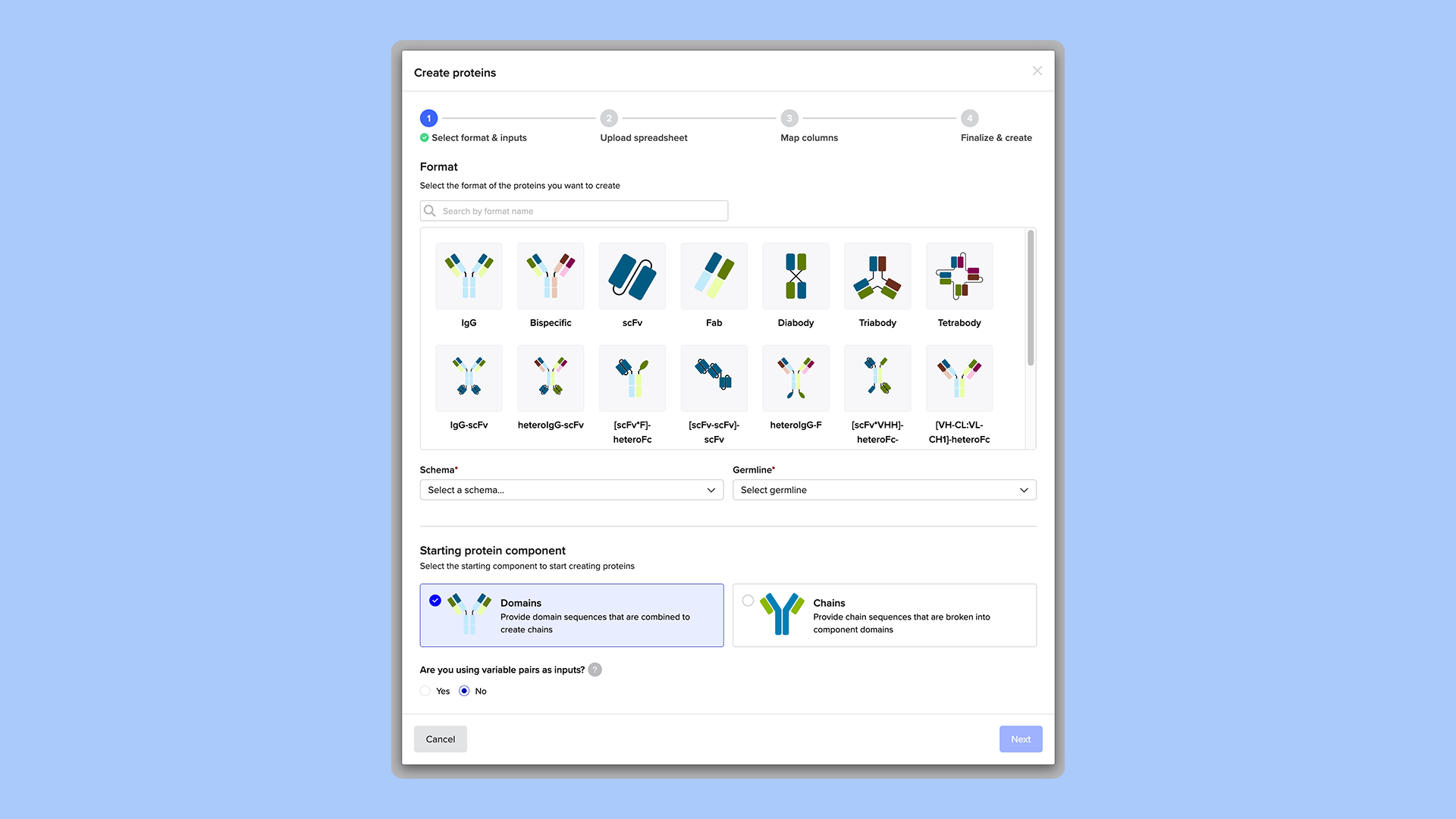
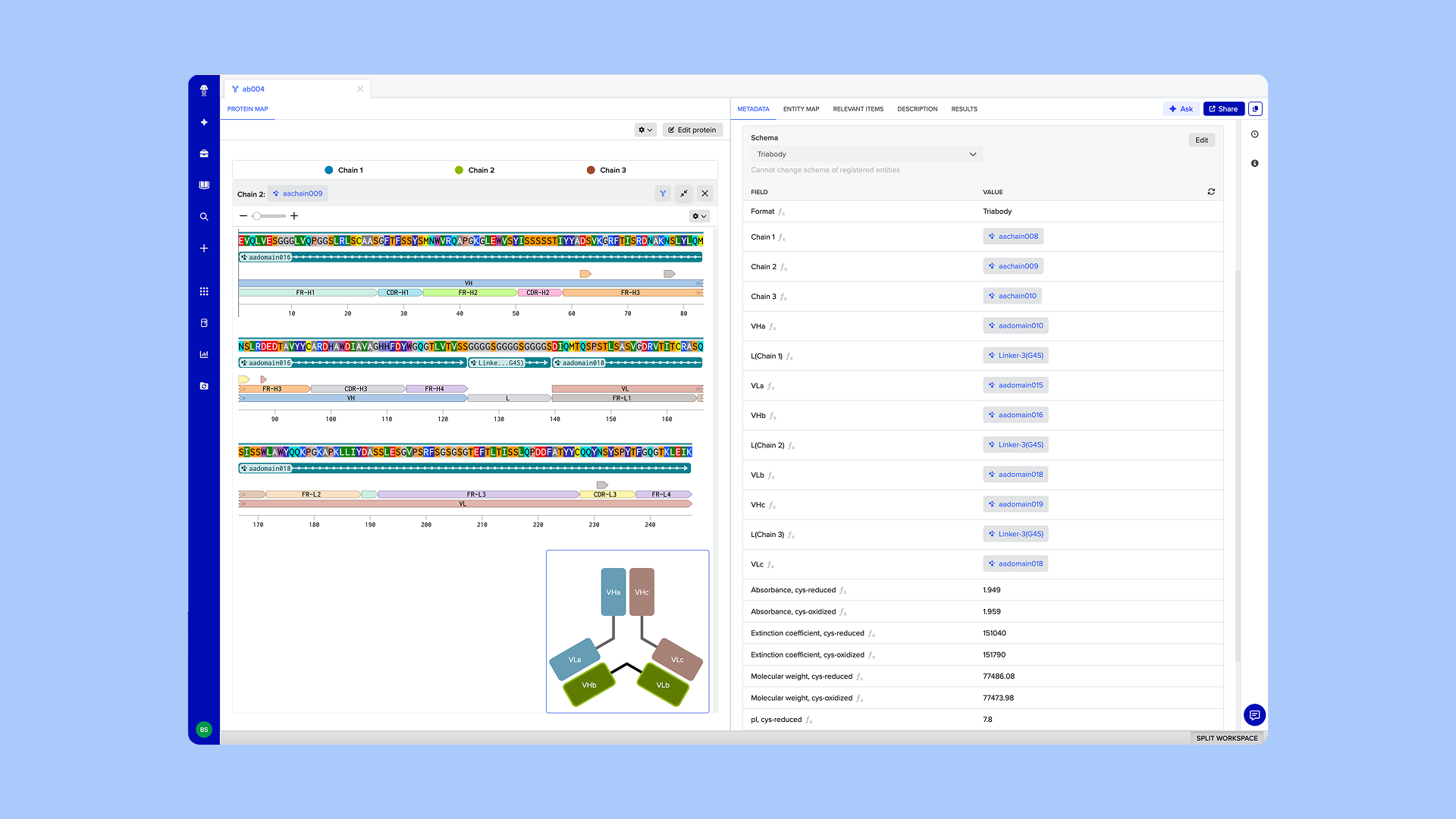
During registration, Benchling automatically characterizes and validates each entity, including CDR/FR regions, germline gene identification, liability detection, and format-aware validation. The system registers DNA sequences, amino acid sequences, chains, and domains as reusable components linked together. It also generates interactive, color-coded protein glyphs, with domains assembled hierarchically into chains, making complex multispecific formats easier to interpret.
The result is a step change in scientist time and data quality. Registering 2,000 bispecifics, a job that takes days in legacy systems, takes under an hour to set up and less than a day to run in Benchling. And every record comes back fully annotated, validated, and consistently structured, instead of the unstructured, unvalidated entries scientists are used to cleaning up after the fact. Computational teams get records they can actually use.
Build and Test: From bench to result, in one environment
Benchling Biologics gives teams a single, connected view of every antibody. Scientists use Benchling to capture how they produce proteins from start to finish, whether that is cloning, expression, or purification, so experimental context stays attached to the molecules that generated it.
For teams running on automated workcells, Benchling integrates directly with laboratory automation systems, including HighRes, passing experimental parameters automatically and returning analyzed results to the original experiment entry.
If any of this work is outsourced, scientists can order biological materials and assay services without leaving their workflow with Direct ordering. Ordering is available with Twist Bioscience for gene synthesis and antibody expression, Adaptyv for protein engineering and characterization services, and Ginkgo Bioworks for antibody developability screening. Each result returns tied to the originating design, making handoffs easy and speeding up validation cycles.
Learn: Closing the loop
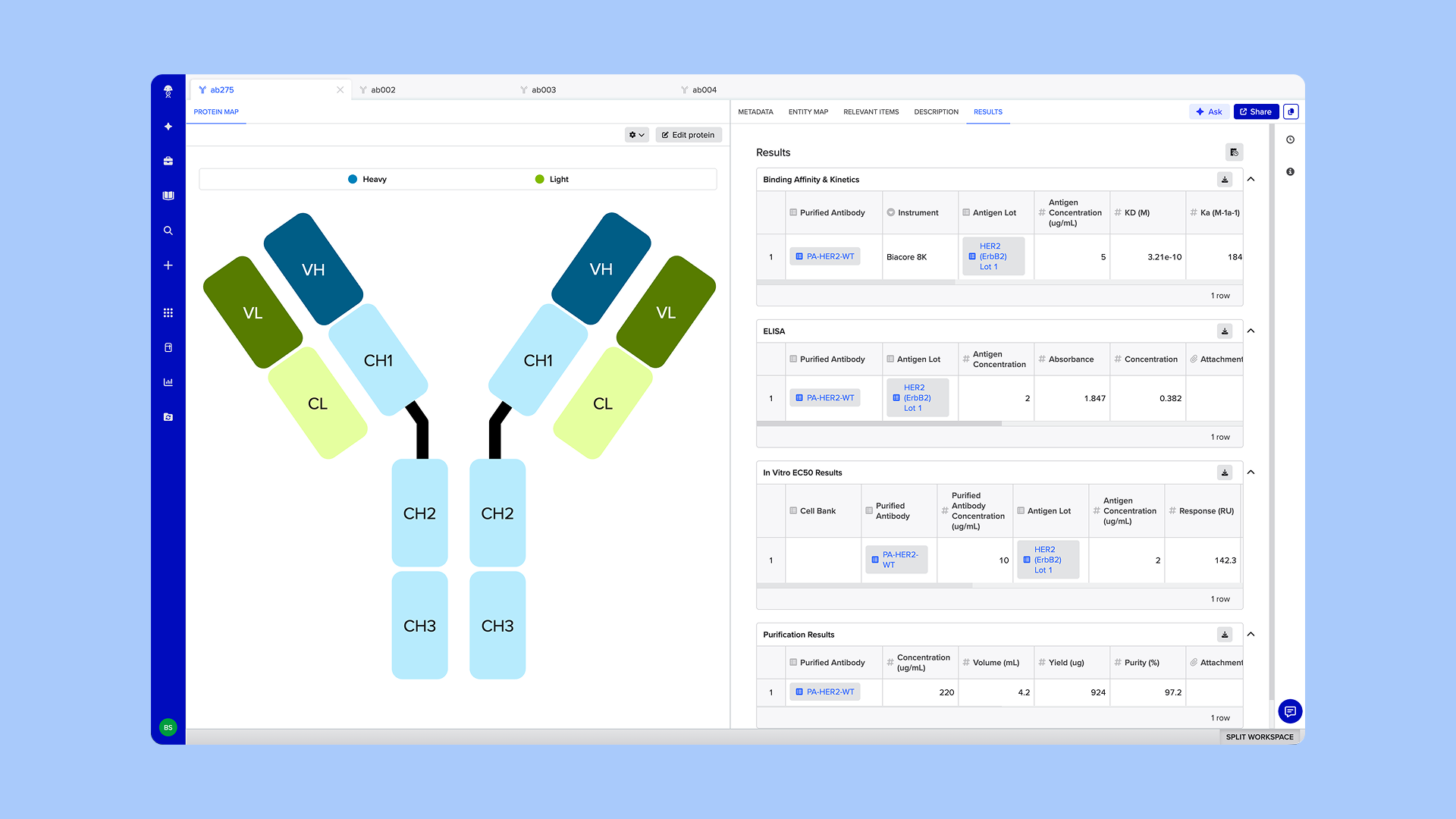
As experiments complete, structured assay data is immediately available and contextualized alongside antibodies. Sequences, samples, and results stay linked from first design through final candidate selection, giving discovery, engineering, and downstream development teams a shared, traceable record.
Benchling AI can summarize learnings across experiments and help teams explore options for the next design cycle. Computational teams can access external sequence and structural datasets through Benchling's MCP-based AI Connectors to feed directly into antibody design models, or integrate data with PipeBio to analyze sequence and assay data together.
Benchling Biologics is available today.
See it in action. Join us on June 11 for a live walkthrough of Benchling Biologics: configuring formats, registering antibodies at scale, and building the AI-ready data foundation antibody R&D teams need. Register for the webinar.