Blog post

Benchling Biologics gives antibody R&D teams a shared, structured foundation to design, register, and characterize proteins, connecting the wet and dry lab without switching tools or losing context.

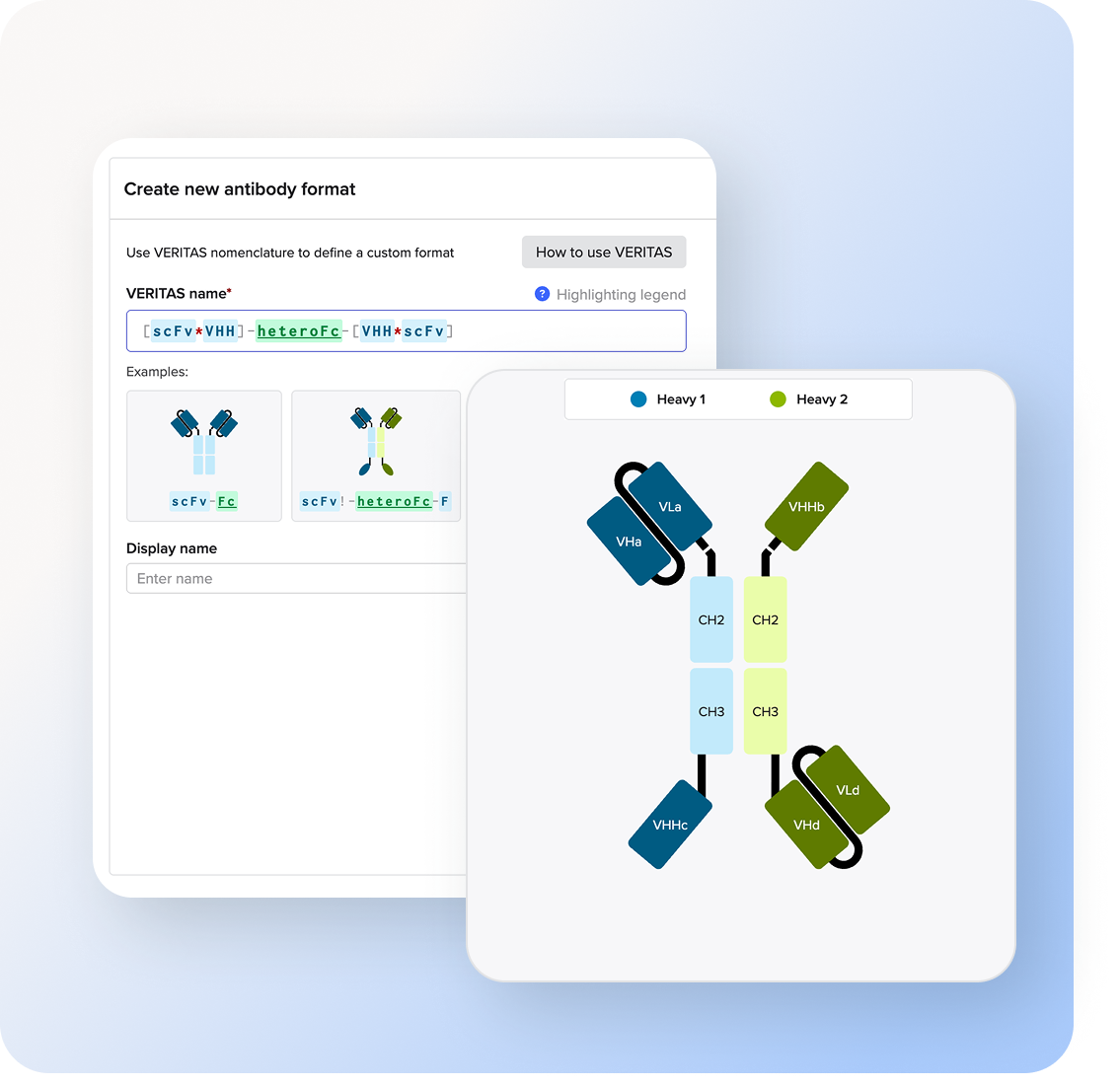
Configure antibody formats without code, including bispecifics, multispecifics, TCRs, and fusion proteins
Start capturing data the same day a format is defined
Add new formats as programs expand, without engineering support
Sequences, proteins, lots, and assay results live on one platform
Every relationship is visible, every component is traceable back to how it was made
Wet and dry lab teams work from the same experimental history
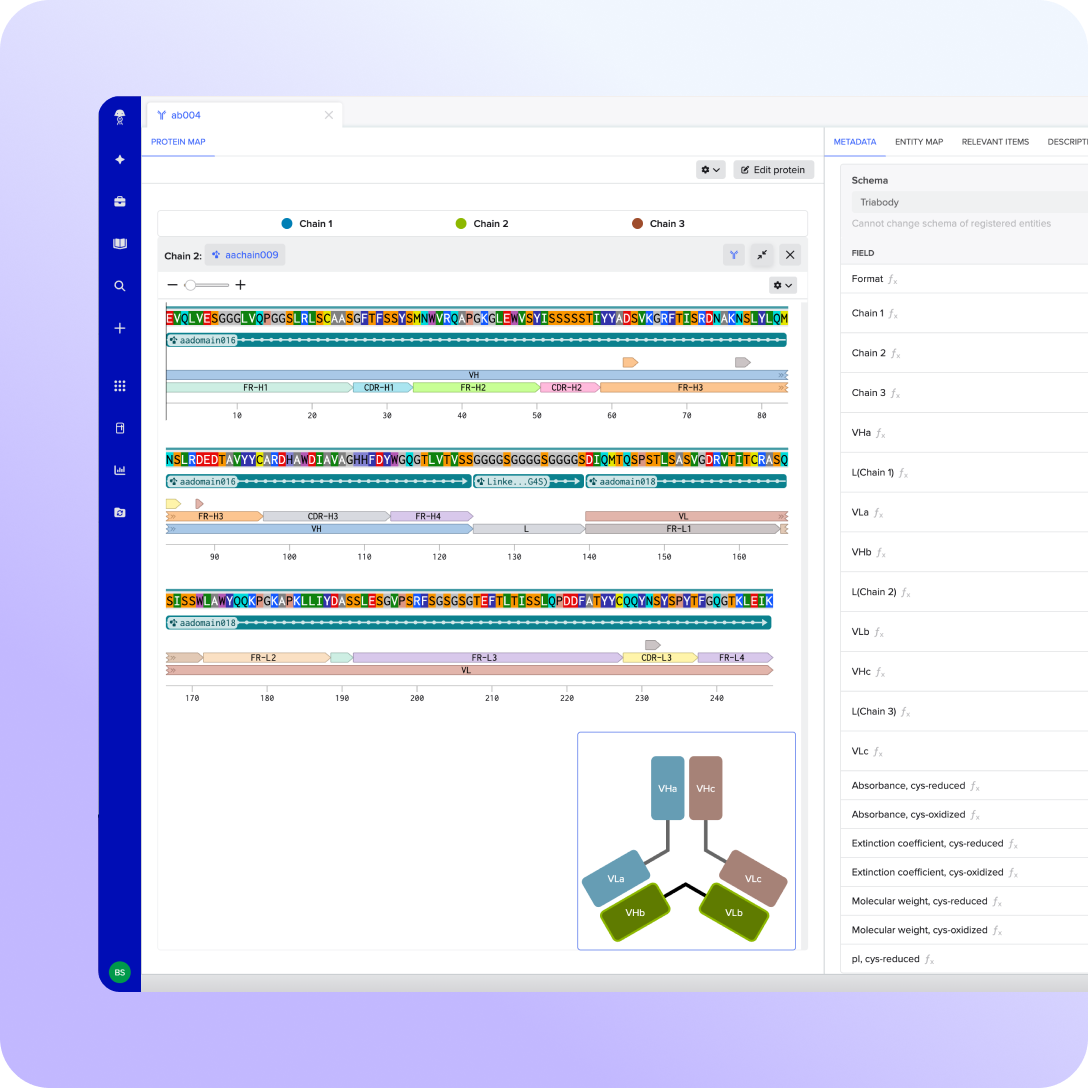
Automated annotation at registration captures CDRs, FRs, germline genes, liabilities, and mutations without a manual step
Computational teams pull a clean, structured dataset without a data preparation sprint
REST API and SQL warehouse access built in from the start
Configure any antibody format using VERITAS nomenclature. New formats are ready in minutes, not weeks. Color-coded protein glyphs give scientists a visual representation of each protein's architecture before a single sequence is registered.
At registration, Benchling annotates CDR and FR regions, detects mutations and liabilities, and identifies closest-related germline genes, automatically. Scientists review results rather than annotating rows.
Register up to 1,000 antibodies per run via spreadsheet upload. Format-aware validation catches errors at entry, not six weeks later.
Every domain, chain, and protein exists as a distinct, linked entity. Uniqueness constraints are enforced from domain to full protein. Every component is reusable and traceable across experiments and lots.
Assay results captured in Benchling Bioresearch link directly back to the proteins registered in Biologics. Wet and dry lab teams work from the same experimental history.
REST APIs and SQL warehouse access make the full structured dataset available for analysis and model training. Computational teams query across proteins, methods, and results without manual exports.

The timeline is a huge selling point for customers right now … It's a combination of a lot of processes that have improved. But Benchling really enabled that scaled work.
Research Group Lead, Invenra
Benchling supports any antibody format, including conventional mAbs, single-domain antibodies, bispecifics, multispecifics, fusion proteins, and TCRs. The no-code format designer uses VERITAS nomenclature so scientists configure new formats without engineering support. New formats can be added as programs expand, and proteins can be tracked alongside other modalities in a single Registry.
At registration, Benchling automatically runs CDR and FR annotation, identifies closest-related germline genes, detects liabilities, and flags mutations for every sequence. Scientists receive results by email and review what came back rather than annotating rows manually. Bulk registration supports up to 1,000 antibodies per run.
Biological context is captured at the point of registration, not applied after the fact. As scientists run experiments, they link characterization and assay data directly to proteins. 55% of biopharma organizations cite data quality as the primary reason AI pilots fail. Benchling addresses that at the source. Computational teams access the full structured dataset via REST API and SQL warehouse without manual exports.
PipeBio handles upstream sequence analysis: processing NGS and Sanger data, clustering candidates, screening liabilities, and scoring for developability. Hits move from PipeBio into Benchling Biologics with annotation intact. The two products work together as part of the Benchling platform for the full design-build-test-learn loop.
Bioresearch is the core platform for experiment design, wet lab data capture, and workflow management. Biologics adds the antibody-specific layer: a format-aware data model, no-code format configuration, automated sequence characterization, bulk registration, and lineage tracking built for complex protein formats. The two products work together. Sequences registered in Biologics link directly to experiments and assay results captured in Bioresearch.
Benchling is SOC 2 Type 2 certified, ISO 27001 compliant, and GDPR-ready. It supports 21 CFR Part 11 compliance with electronic signatures and full audit trails. Benchling does not train models on customer data. For details, visit the Benchling Security Center.