500 biotech companies are using Benchling AI, now generally available

Benchling AI is now generally available. Over the past year, it’s been put to use across 500 biotech companies, from AI-native startups to top-20 pharma, often spreading faster than we expected.
In one large organization that turned Benchling AI on in December, an SVP told us that within days, he was hearing scientists talk about it in meetings and the break room. Within weeks, hundreds were using it in their daily work to answer questions from years of data they’d captured but never fully unlocked.
Here are a few use cases that are driving the most adoption today.
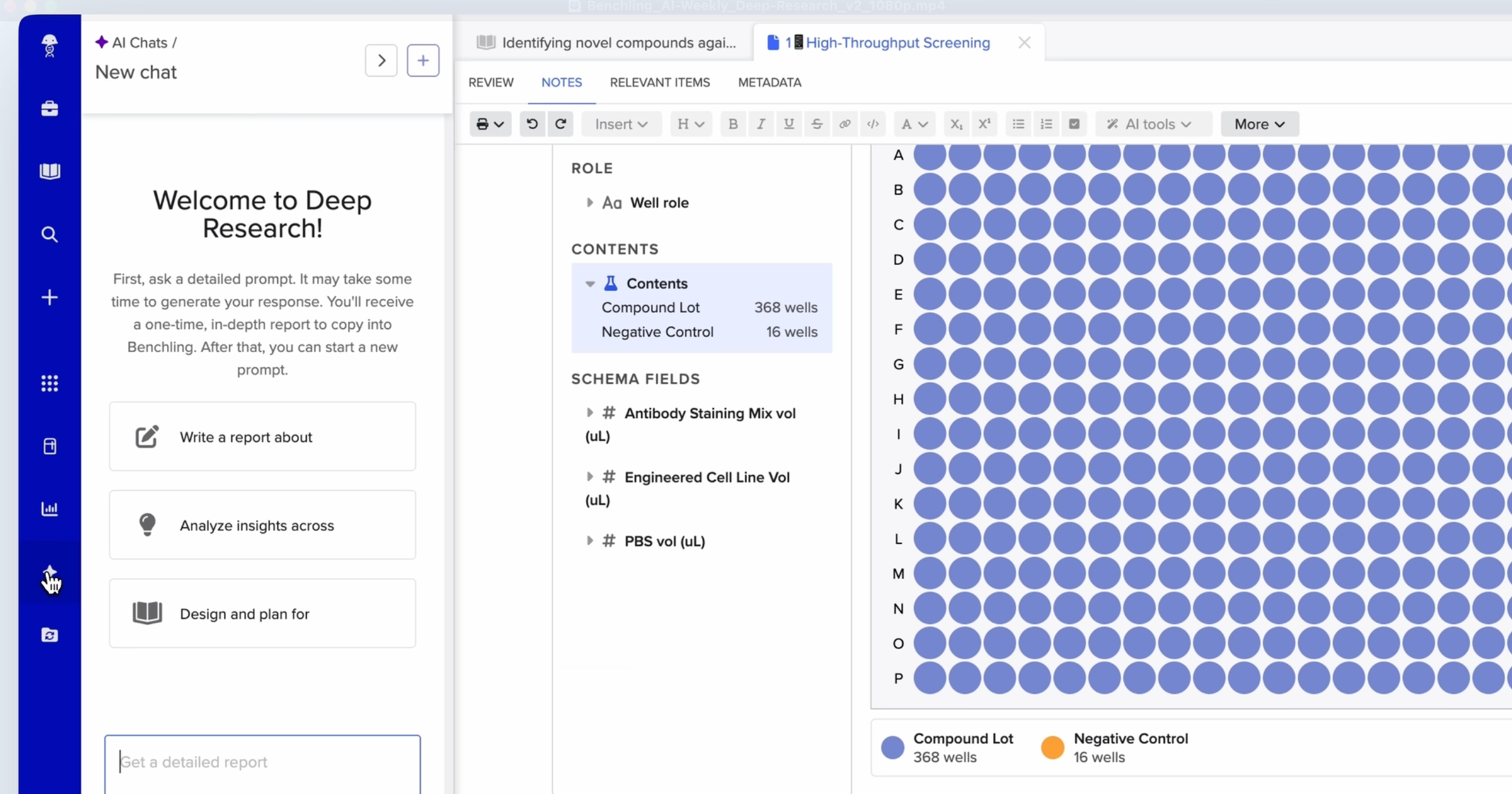
Report writing with Deep Research
Regulatory document preparation in biotech has traditionally been exhausting, manual work. Writers spend days pulling experiment numbers, cross-referencing lab notebooks, hunting for protocol details, and tracking down reagent lots and concentrations across multiple systems.
At Beam Therapeutics, regulatory writers now use Deep Research as a preparation assistant. Instead of that long, grinding slog, they use targeted prompts like: "Pull the experiment IDs for this study, exact procedures used, reagent lots and concentrations, and any deviations noted during execution."
Deep Research pulls all of this—experiment IDs, procedures, reagent details, and protocol references—directly from Benchling. Benchling's report writing skill brings this same capability to preclinical, process development, and screening reports, with built-in templates and full citation from day one. What used to consume days now takes a fraction of the time.
This shift lets regulatory writers focus their expertise where it actually creates value: narrative clarity, consistency across sections, and regulatory judgment. The tedious data-gathering is automated; the strategic thinking remains human.
Scientific models, zero friction
Scientists run AlphaFold, Chai-1, and Boltz-2 directly inside Benchling. Predictions run where experimental data already lives without needing to write scripts or manually move data.
This has changed who can use advanced models in everyday work. Individual scientists can run predictions themselves, accelerating their experiments while freeing computational teams to focus on building new models instead of running existing ones.
ArkeaBio's head of computational biology Lauren Fitch described her experience using scientific models in Benchling, "We are working on vaccine development, so the ability to quickly predict a 3D structure for an antigen, especially once they have made a recombinant or chimeric antigen with various tags, has helped our team iterate faster through antigen designs for screening."
Transforming legacy data with Compose
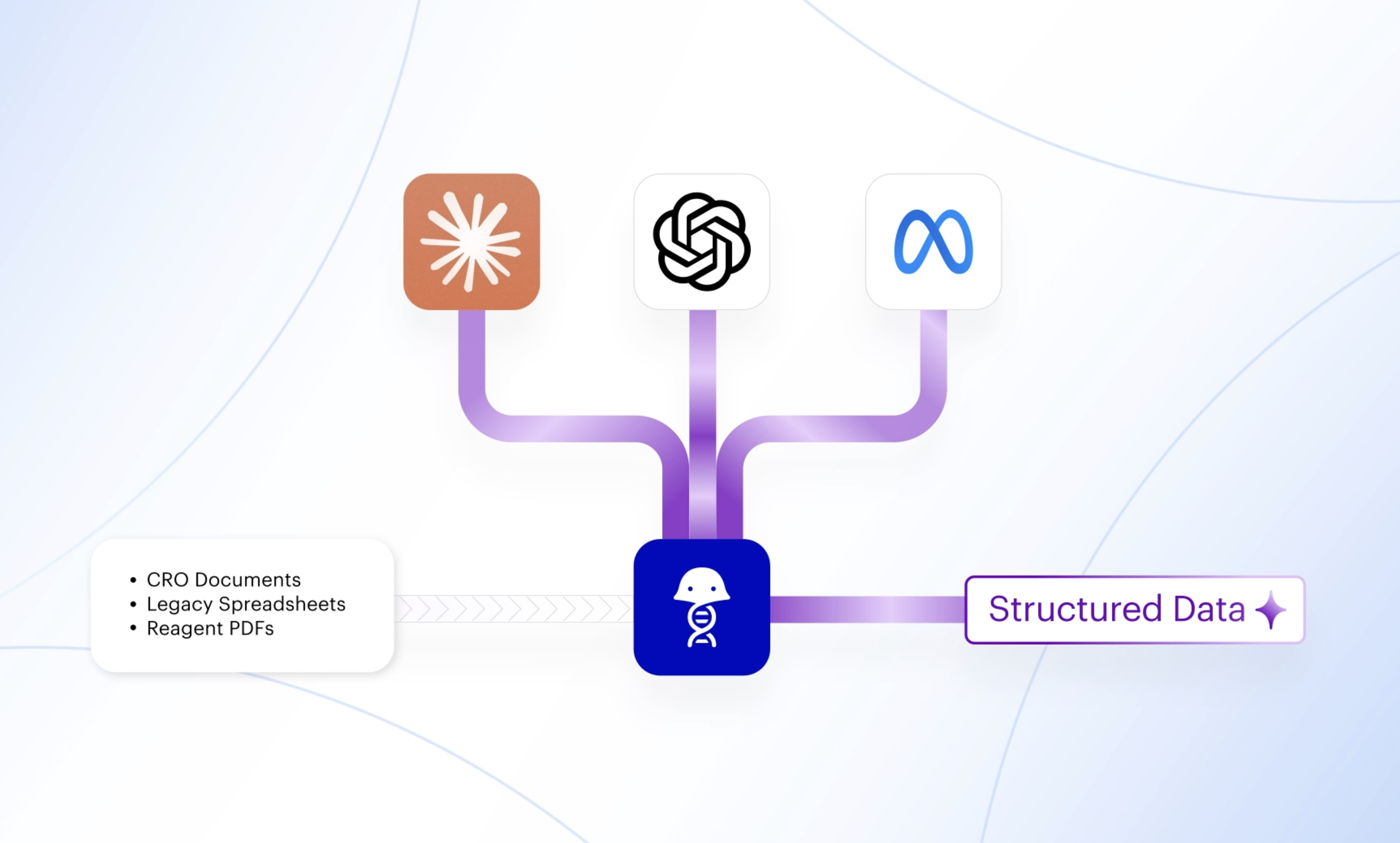
Compose Agent is being used where data is messiest and most painful. Teams import results directly from CROs, including large assay datasets that used to arrive as inconsistent spreadsheets or PDFs, and have them structured automatically into Benchling notebooks.
“It has saved many hours, but more importantly, many brain cells,” said a data scientist at Mammoth Biosciences processing complex preclinical data from CROs. “This is work I used to do late at night because it felt too small to justify the time. Now it takes about 10 minutes, and I don’t even need to think about it.”
Others are using it to tame high-volume internal assay data. Messy tables from fluorescence assays, plate reads, or instrument exports are automatically parsed and mapped into the right schema.
Compose is also being used to unlock historical data at scale. In one biotech, it’s migrating 20,000 legacy ELN entries into native Benchling notebooks with structured data. Years of experiments become searchable and queryable without months of manual cleanup.
Start using Benchling AI today
Benchling AI, now generally available, includes:
AI agents for automating scientific tasks, including Ask, Compose, Deep Research, and Data Entry, designed to take on work like data capture, protocol generation, and synthesis, directly inside Benchling.
Easy-to-use scientific models, including AlphaFold 2, Chai-1, and Boltz-2, making prediction accessible where science happens.
Built-in productivity tools, such as Notebook Check and SQL Writer to improve data quality, consistency, and speed.
For Benchling customers: Enable Benchling AI from your admin console and explore tips, prompts, and stories from scientists using AI every day in our AI Resources Hub.
For teams new to Benchling: Visit benchling.ai for an introductory experience, or get in touch to see how AI can embed inside your everyday work.