Benchling Automation: Closing the lab-in-a-loop
Today we're launching Benchling Automation, a unified solution that connects instrument data to scientific records. It works with the instruments and lab automation already in your lab, and the data platforms you use today, whether that’s Benchling or a different ELN/LIMS.
Across the industry, we’re seeing teams build “lab-in-the-loop” systems: AI and ML models propose candidates, automated labs execute experiments, and the resulting data flows back into models to guide the next iteration. Until now, the setup has been painful and slow, requiring hardware engineering, bespoke software integrations, and rebuilds every time there is a workflow change or new instrument.
Closing the loop also requires automating data extraction from proprietary instrument formats, handoffs to data science to run analyses, and decision making that might take weeks. Recent advances in AI make much of this dramatically easier to build and maintain, but only on top of a modern, flexible solution that can connect instruments, analyses, and scientific records into a single system.
An open ecosystem
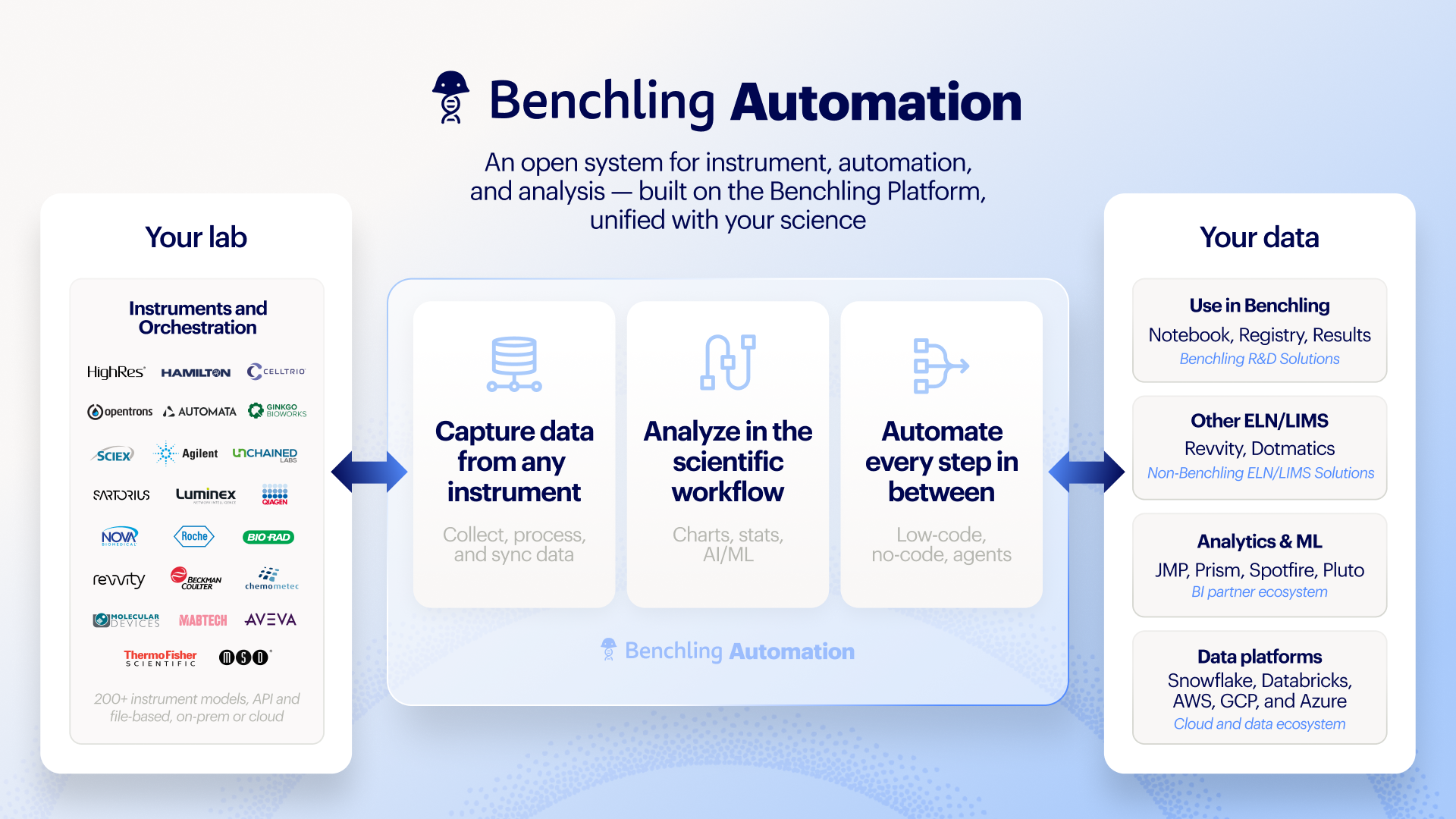
We believe in an open ecosystem and are excited to announce launch partners that cover the range of how scientists run experiments today: HighRes, Automata for workcell fleets, and Ginkgo Bioworks for autonomous labs; Celltrio for automated cell culture; and Opentrons and Hamilton for automated liquid handlers. Standard integrations with these partners ensure the workflows you design in Benchling execute natively on their workcells and bench instruments.
How it works
When a scientist designs an experiment, Benchling Automation dispatches the run to a workcell or instrument, and delivers raw data and analyzed results back into the scientist’s notebook entry. Analysis runs automatically. Results land in the scientific record, linked to the samples and experiments that generated them. See how this works with HighRes.
What you can do:
Pull data from 200+ instruments across file-based and API based systems (plate readers, liquid handlers, cell culture analyzers, qPCR systems) directly into Benchling, automatically linked to the samples and experiments that generated it.
Build, own, and modify the workflows that govern what happens when a run completes, without custom or bespoke integrations. Design the logic once, and it runs every time. When the process changes, update the reusable template in place instead of re-engineering it.
Write Python directly in Benchling for advanced workflows. This unlocks highly flexible, lab-specific data transformations and analysis logic that would otherwise require external tooling or manual intervention, keeping the full workflow within Benchling and preserving data traceability end to end.
Land charts, curve fits, and statistical outputs inside the scientific record where the experiment lives, with every result traceable back to its source sample.
Note: Benchling Connect and Benchling Advanced Analytics are being combined with major new generally available capabilities: custom code, automation designer, and new partner integrations.
Benchling Automation supports the following integrations at launch:
HighRes has spent more than two decades building hardware-independent workcells, and has developed an API-first, cloud-native orchestration system designed to coordinate complex workflows across multiple workcells.
Opentrons empowers scientists with accessible automation and AI-ready infrastructure that transforms variable experiments into defensible science, returning focus to hypothesis-driven discovery.
Celltrio delivers modular RoboCell automation platforms with standardized, configurable components that automate T-flask cell culture workflows from seeding through harvest, scaled to each customer’s process needs.
Automata builds instrument-agnostic workcells, with their LINQ software taking a cloud-ready, software-defined approach to workflow orchestration and protocol definition.
Ginkgo Bioworks offers a cloud lab service where customers can run experiments remotely on Ginkgo's autonomous lab. As programs scale, customers can deploy Ginkgo automation at their own site, providing a try before you buy path to their own autonomous lab.
Hamilton builds liquid handling instruments and integrated workcells, combining pipetting precision with modular, expandable deck configurations used across pharma R&D, clinical diagnostics, and biopharma QC environments.
Powering the AI Scientist
Benchling Automation is hardware-agnostic, working with the instruments and data formats labs already have to power wet lab execution that feeds the compounding loop of the AI Scientist. Every result lands in the scientific record, linked to the samples and experiment that generated it. Faster data capture and transfer are one piece of the value – the bigger value is a lab that gets smarter with every run.
Get started with Benchling Automation
Learn more about Benchling Automation and how it works with HighRes, or request a demo.