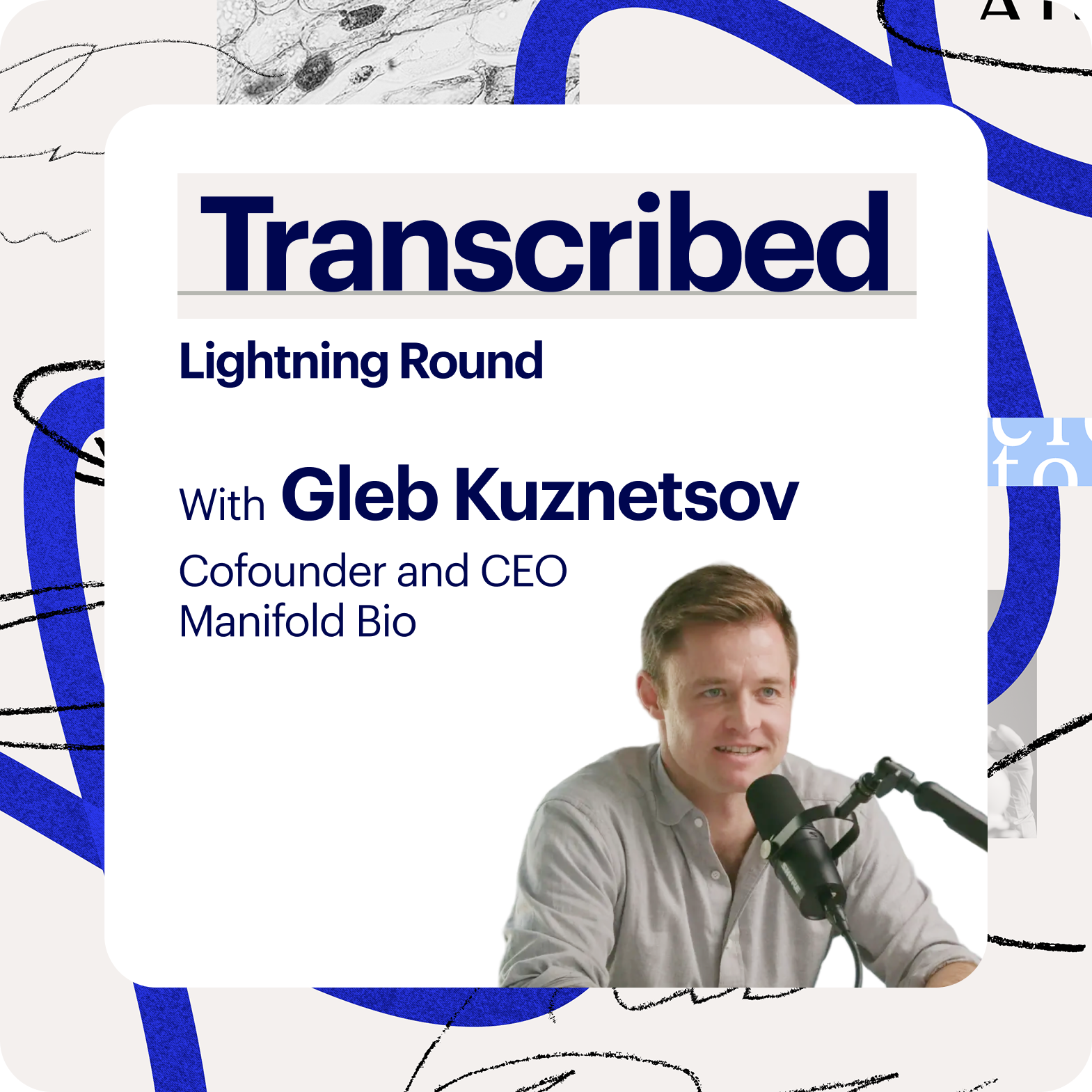


Gleb Kuznetsov left a career in tech to chase a bigger problem in biology. What began in George Church’s lab is now Manifold Bio, where Gleb is cofounder and CEO. At Manifold, he’s building a new approach to drug discovery — one that combines AI-guided design with large-scale in vivo testing — all to create targeted biologics at an unprecedented scale.
Gleb joined me to talk about ditching Google for grad school, what it takes to build a platform company, and where AI-driven drug discovery is headed. — Sajith Wickramasekara
* Editor’s note: The conversation has been edited for length and clarity.
Disrupting R&D’s biggest bottleneck
Sajith Wickramasekara: Can you tell us a little bit about Manifold Bio?
Gleb Kuznetsov: Manifold Bio is a platform therapeutics company. We’ve created a way to generate a very high scale of data at the in vivo stage of drug discovery. This fundamentally challenges the paradigm of how drug discovery can be done.
There's two parts of the company. There's the AI design side of things; we create our own antibodies and other molecules. Then there's molecular barcoding technology that lets us generate high-scale in vivo data. We put that together to create tissue-targeted drugs that go to specific places in the body.
Sajith: How do in vivo studies work, pre-Manifold technology?
Gleb: Fundamentally, a petri dish is not a person. To really understand what happens, you test it in an animal. You're testing one drug per animal, and using as few animals as possible. Even with unlimited money, you hit ethical limits on animal testing.
“With AI, you can generate millions of candidates, but you can only test a couple in vivo. It’s a bottleneck that felt like it wouldn’t be possible to break through.”
Sajith: With Manifold’s core technology, how many antibodies can you screen in a given animal?
Gleb: We are regularly doing over 100,000 antibody designs per single animal study. In fact, we recently did a study with 587,000 distinct antibody designs that went into a single non-human primate.
Previously, you’d want to reserve that stage for something that’s really mature. You’d want to make sure that's a good use of that stage.
Sajith: And NHP studies are really expensive. Companies can spend $1 million per NHP study.
Gleb: This scale fundamentally changes how we're doing things.
Leaving Google for academia
Sajith: You were a software engineer at Google before you ended up in George Church's lab. What made you go from a very comfortable life in tech to being a grad student?
Gleb: At Google, my starter project was to engineer a button. I felt like a cog, it was a little too small for me. I was very hungry as a 23-year-old, trying to figure out what I wanted to do.
Then there was an amazing moment. I got a butt dial from Adam Marblestone, who was in [a bioinformatics class at MIT] with me. It triggered memories of our projects together, and I kept thinking: could I start doing biology?
I asked Adam to connect me with folks in the lab. I can code pretty well — could I be useful? So people reached out, like Sri Kosuri, who’s now the CEO of Octant Bio; Marc Lajoie, who’s now CEO of Outpace Bio; and Dan Goodman, who’s now a professor at UPenn. I chatted with them and realized they’re doing something really interesting.
So I met with George and asked, “Is it crazy if I just show up in your lab in two weeks and start working?” And he said, “I don’t want to convince you to make a big move like that. But if you showed up, that would be great.”
Sajith: Wow, so you quit your job and moved to Cambridge?
Gleb: Basically. The first two years were as a research engineer. I was able to publish a few papers that helped me get into Harvard’s biophysics PhD program. After that, I started thinking about the applied aspects of what we do, and that ended up becoming Manifold.
“I just showed up and started working with people, being helpful from day one.”
The secret behind the Church Lab
Sajith: At this point, dozens of biotechs have come out of the Church Lab. What do you think is so special about George and the environment he creates?
Gleb: He's super smart and super kind. When you have the combination of those things in one person, you get creativity and resonance. People really trust George.
Even though he's involved in so many different things, people continue to come to him, share their ideas, and get those ideas amplified and augmented. That's super special.
On the environment side, it's interesting because it’s such a big, well-resourced lab. On one hand, you don't get a lot of George's attention per person. But if you have a question, he's absolutely there for you.
It creates this selection pressure for people who know what they want to do and how to ask for help. It creates this training ground for future professors and entrepreneurs, where you learn to be very proactive.
Sajith: Can you share any stories about his mentorship style?
Gleb: I remember in a lab meeting that a grad student was complaining about his other committee members telling him to do this and that. And George just had this one-liner, like “You're the captain of your ship. What do you think you should do?”
There was another classic Georgeism. You’d do an experiment and get it to go from 0% to 1% working. And George would say, 1% is tantalizingly close to 100%. That was a very powerful idea.
“If you can get from zero to one, then you've shown that it's possible, and now it's an engineering problem.”
For better or worse, George also says yes to a lot of things. That’s harder to do when starting a company — you have to learn how to say no. But there’s another George line: Think of it as an opportunity, not an obligation.
Sajith: I learned that three companies that came out of your lab bay alone: Manifold, Dyno, and Nabla Bio. As early machine learning adopters in bio, you and your labmates founded the first wave of AI-first biotechs. How did you know this is where the industry was heading?
Gleb: Looking back, everyone's aware of the AI exponential. But there was another exponential in the Church Lab: people figuring out how to turn protein engineering experiments into library multiplexed experiments.
If you can turn an experiment into a synthesis-and-sequencing problem, you harness this massively parallelized technology that's getting cheap fast. But turning experiments into this dark art of multiplexing requires a lot of apprenticeship and peer-to-peer knowledge.
So that is what was happening in that bay. We had me, [my co-founder] Pierce Ogden, Eric Kelsic, and Surge Biswas constantly helping each other debug experiments, brainstorm, and try new things.
“I don't know if any of us necessarily said that we're going to start a company, but we knew that we were building very powerful technology.“
Fast forward to 2016, and deep learning is starting to really catch on. We started combining these two technologies. Pierce and Eric are working on AAV capsids, which goes on to become Dyno Therapeutics. Pierce and I are starting to work on protein library experiments that become Manifold.
It took a long time of becoming deeply expert in these two technologies, as well as the confluence of these two exponentials.
The birth of Manifold
Sajith: How did the idea for Manifold first take shape? I'm guessing it's probably evolved since you started.
Gleb: The original idea was better ways to do antibody design discovery. We started designing all these experiments and generating data to build a true de novo binder model.
The feedback we kept getting was: it sounds cool, but how is it better? People kept saying, that's not the bottleneck. The real bottleneck is down the road at in vivo tests. You still pick your best couple molecules, and that’s where things fall over.
Sajith: So you were interested in widening the funnel even from the early days.
Gleb: Pierce was already thinking about in vivo screening, but for capsids for viruses. So we started thinking, could we unlock this for proteins?
Sajith: Can you talk more about your cofounder Pierce? It sounds like he helped with what eventually became Dyno Therapeutics too. Was there some fork in the road with him where he had to pick?
Gleb: Pierce was working with Eric on the capsid screening that would go into Dyno. He was also working with me on the protein engineering that would be the foundation of Manifold.
The protein world felt like a much bigger product space than AAV gene therapy. I think that was attractive to both of us. With the protein space, you can have proteins conjugated to proteins, oligos, or small molecules. There’s a prolific space of potential medicines one can create, and more degrees of freedom.
Sajith: It's probably pretty appealing to someone who's an inventor at heart.
Gleb: And also, he'd already solved DNA sequencing as a readout for AAV. But we were very keen on the concept of protein barcoding. I think it was the scientific challenge in addition to the big opportunity.
Sajith: You have a third cofounder, Shane Lofgren, who joined as the head of BD. Especially back then, having a BD person on the founding team wasn't super common. Why was it such a critical strategy for Manifold?
Gleb: Shane was really pivotal, as the first person really thinking deeply about our product. This was really key to making Manifold successful from a company-build perspective.
Before Shane, our product applications were really underbaked. Like, what was the connection between our platform and product?
I think it’s underestimated, especially for platform biotechs. If you truly think you have a lot of opportunities, you need to start thinking about which ones to work on first. What matches your platform, what matches your strategy, and what's going on in the outside world?
Betting the company on a pivot
Sajith: What were the dead ends or hard turns that really clarified your focus on the platform, product, and even the indications to go after?
Gleb: For us, there were a number of factors. One, what is your technology good at? Two, what could possibly be funded? Three, where is science and clinical medicine at today?
We'd articulated that getting medicines to specific places in the body was a good focus. We had oncology (in the sense of getting drugs to tumors), and penetrating the blood-brain barrier as problems to solve. But in 2020, people were still very nervous about neuroscience. There's a lot of failures, not a lot of investment. So it was on the “blue skies” slide in the deck.
Sajith: You eventually had to pivot the company from T-cell engagers to the blood-brain barrier, which was originally on the “blue sky” slide. That seems like a big “bet the company” situation.
Gleb: In a company's first couple years, a good product creates pull for your platform. So T-cell engagers were still a really good product pull and made sense for where the market was.
But then mid 2023, a lot of folks started asking us about brain shuttling. Clinical trials for some of these Alzheimer's drugs were starting to show interesting data. All of a sudden, there was interest in brain targets again.
We start doing our own pilot studies internally on brain shuttling and seeing interesting data in these screens. Then this really important moment happens in November of 2023.
Roche published amazing clinical data of a brain shuttle attached to an anti-amyloid beta antibody. In fact, it was a failed antibody, gantenerumab. With the brain shuttle, which facilitates crossing the blood-brain barrier, they saw remarkable fast clearance of plaques in Alzheimer's patients. That data was the shot heard around the world.
“Shuttling is now a real technology. A brain shuttle isn’t just a nice-to-have on your medicine — any biologic to the brain is going to need a brain shuttle to be a good drug.”
Pharma started to recognize this as well. Multiple times, I heard people saying “my jaws dropped when I saw that data.”
At the same time, the funding market was decaying. The bar for oncology data was increasing — more competitive. That forced companies toward betting the farm on an asset or two. Those forces made us wary of going down that path for oncology.
So we went to the board and said, we should really double down in this brain direction. We see pharma interest; that's going to be good off ramps for partnering. Oncology is a hairy space right now from a funding perspective.
This was the commitment we wanted to make, and we shifted the company. It turned out to be a very good decision.
Partnerships take time
Sajith: You now have a $55 million partnership with Roche, collaborating on next-generation blood-brain barrier shuttles for brain-targeted drugs. How did that come about?
Gleb: It's a super exciting partnership for us. It's the biggest AI bio platform deal in the last few years in this fairly quiet time.
Literally, we've been talking to Roche since we started the company. That shouldn’t be underestimated.
“Showing people a trajectory over time is the best way to build conviction.”
Most of the world, including Roche, had been working on the transferrin receptor for brain shuttling. It's got very good properties for certain applications, but there are limitations.
If you think in a more refined way about every different brain product, you realize different profiles would be desirable — more brain-specific, or expressed on certain neuron types. It becomes a richer product space.
Roche understands this. And we understood it — we were already building towards unlocking new receptors. So the deal is structured that we’re creating shuttles to new receptors.
We’re testing thousands of antibodies against every different receptor, and then we’ll license rights to a specific handful of named programs to Roche. We get to keep our shuttles and make them better, use them for our own programs, and use them for other partnerships.
“Together with Roche, we're potentially building some of the next great medicines that haven’t been possible before.“
What makes a true platform company
Sajith: The term “platform company” gets used a lot in biotech. How do you define a true platform company?
Gleb: The platformness of a company is defined by the breadth of the product space. How many products can you really create?
There's lowercase “p” platforms and uppercase “P” platforms. Lowercase “p” platform might be like a type of an architecture, like a type of T-cell engager.
But an uppercase “P” platform is something that has a prolific space. The ultimate platform back in the day, for example, was recombinant DNA as an industrialized technology. Suddenly, you just opened up natural proteins, and eventually engineered proteins like antibodies.
Manifold has this huge opportunity to be able to drive drugs to specific tissues. Today, what's been solved is delivery to the liver. Beyond that, it’s a very hard problem, especially for all the modalities that folks are interested in.
Sajith: So is your advice to entrepreneurs, if you're going to build a platform, don't pull too small of a platform?
Gleb: There’s value to be created in all sorts of ways. The size of your platform is what defines the strategy of the business that you can build. Meaning, how much partnering you can use in your strategy versus how much you have to reserve rights and maybe bet sooner on a few specific assets.
Sajith: It feels like the golden era of platform biotechs (like Genentech, Regeneron) was a long time ago. Today, the emphasis is on product over platform and investors are wary. What’s going to make the pendulum swing back in the other direction?
Gleb: It's definitely a challenge today. Platform companies typically need more capital upfront, and that's very tough in this biotech environment.
Steve Holtzman, the chair of our board, has written about this platform-product strategy dilemma over the years. Originally, he was the CBO of Millennium Pharmaceuticals, which was one of these uppercase “P” platform companies.
He likes to say that to build a therapeutics company, you need a lot of capital to build those medicines. You can either get that capital through raising equity at favorable terms, or through partnerships.
As long as you don't do too many partnerships that give away too many rights such that you have enough to grow the big value of the company, then you should be able to pull this off.
“For a platform company to work, you really need to have a lot of substrate for partnerships. And it has to be super differentiated and be able to speak to acute strategic needs when they arise.”
With Manifold, brain shuttling and brain delivery comes up as a really acute active need. We're positioned to seize on that momentum and build out a prolific brain franchise.
It’s still something that investors have to get comfortable with, that you’re not necessarily going to speed to a phase two — you’re laying the foundation. But if you’re right, you’re going to have a much bigger opportunity, in the limits.
Sajith: Do you think AI changes anything for platform companies?
Gleb: AI increases the pace at which these things can happen. AI can now generate ideas, both in terms of composition of matter, but also in terms of product space. Of course, you're working with AI for the ideas, and then you really have to stress test them. But that gives you a clue where to go.
You have to have an advantage of the data to guide the AI. And be able to test the outputs of the AI. But nonetheless, it's definitely accelerating things.
What actually attracts AI talent to biotech
Sajith: It's pretty hard to hire folks with machine learning and AI backgrounds today. How do you fill those roles and compete for talent?
Gleb: Folks have to be very passionate about the substrate that they're doing AI and ML on. There's a lot of exciting things you can do with AI today. But being able to manipulate atoms in a chemical context is super exciting. And knowing that if you do that right, you're making a medicine that could potentially cure someone.
Sajith: Are you screening for that?
Gleb: We just look for curiosity about the biology. It's almost self-selective.
The reality is we're not going to outcompete OpenAI on salary. Nonetheless, you get people who are really excited. Biology is very unique in that it's a place where you can create hypotheses with your AI algorithms, then test them at the scale of hundreds of thousands. Knowing you're accessing data that no one else has is also very addicting.
Sajith: It's not easy to find people with formal training in both AI and biology. How do you bridge that gap? Do you advise others to recruit from tech or upskill existing scientists?
Gleb: A lot of people in tech would not be willing to quit their jobs. Over the years, I've been introduced to dozens of people (friends of friends) who are disillusioned by building whatever social media app. They want to do biology and think it's super cool.
“I spent eight years in the academic world, learning the craft. And as I describe this path, I see a lot of people die inside because they realize this is not the quick fix to their existential boredom.”
But I've seen a few people who’ve done it. They leaned in and started really understanding the domain. Most of them jumped into a lab; I haven’t seen the direct-to-company path stick as well. You have to get really into the science to bridge that gap.
The compounding value of open source
Sajith: Manifold recently released mBER, which is a fully open AI tool for de novo design of epitope-specific antibodies. To validate, you ran the largest de novo antibody experiment to date: >1 million designs tested and measuring over >100 million interactions. That's huge. Why did you make it open source?
Gleb: It's only going to be a moat for so long. Others will inevitably figure this out. Chai came out with their closed model saying, we can now do de novo antibody design quite well; Nabla announced that they can do de novo design.
We’re thinking, what's special about Manifold? It's the data. We have this amazing model, but the data is what makes what we do special. And we want people to know we’re doing really interesting AI work.
It’s built on open source work to some extent. Why don't we open it up? It's partly a statement about what we think is important, which is the data moat. We’re doing some of the most innovative AI work, and maybe folks didn't fully appreciate that we're not just doing in vivo multiplexing.
When something becomes open source, it catalyzes something else becoming open source. AlphaFold was closed until OpenFold started appearing, then AlphaFold started to get more open. There are nice benefits to it.
Now people are switching to sharing what they have, which is really powerful. There'll be a lot of interesting dynamics over the coming years with companies choosing open versus closed, and figuring out how to capture value.
Sajith: Whenever a new technology like AI takes off, there's obviously a lot of debate about whether it's overhyped. What is tangibly different in biotech now versus a year or two ago?
Gleb: The AI technologies are more powerful than they've ever been. The ability to design a binder from scratch, combined with 10% accuracy, is insane. Some people are reporting even higher.
The other thing changing is the data. There's so much rich data being generated that is complex and bespoke in different ways: the data we’re generating in vivo at Manifold; complex mass spec data interrogating structures at a very small scale; single-cell data; and spatial data.
“There’s all this rich data coming out. Then immediately, that data becomes useful to iterate and train on top of models. The pace is really different than it was even five years ago.”
I think we're already seeing things that would have looked like magic a year ago.
Approaching zero-shot clinical design
Sajith: Any predictions of what we’ll see 12 months from now, or five years from now?
Gleb: 12 months from now, we’ll think of antibody design as a solved problem — getting an antibody to an epitope, maybe even being able to vary the affinity. We basically saw that recently with a few releases, and we're doing that internally as well.
“Five years from now, I think we're going to be taking a molecule that's basically ready for prime time, directly to a patient.”
I don't think we're going to be quite doing zero-shot clinical design, but I think we’ll see molecules that are basically good enough for that. Because at Manifold, we have molecules that we put in vivo and they look really good already.
Sajith: You're saying first-in-human in less than 12 months.
Gleb: Exactly. We’d have to evolve the confidence there, and maybe there's always going to be a little bit of testing before. But I think the spirit of it, the gap between design to going into a patient, is going to be very narrow.
It’ll be true for some applications, not all. There's going to be an edge for whoever can build the data bridge from the best AI capabilities to the AI that can actually design the molecule for that application.
There’s no shortcut to domain expertise
Sajith: Any advice to founders who are getting started today?
Take seriously getting the domain knowledge of whatever problem you want to get into.
It's one thing to come and throw AI at the wall. But, as we all have seen, when you use AI on something that you're deeply expert in, there’s this constant uncanny valley experience because you can see the flaws.
“Getting deeply expert in the domain is the key to inventing the key enabling piece that takes you from uncanny valley to really useful.“
You can take the creative output of the AI, but a human will probably still be doing the last mile — and that last mile is really valuable and often incredibly hard.