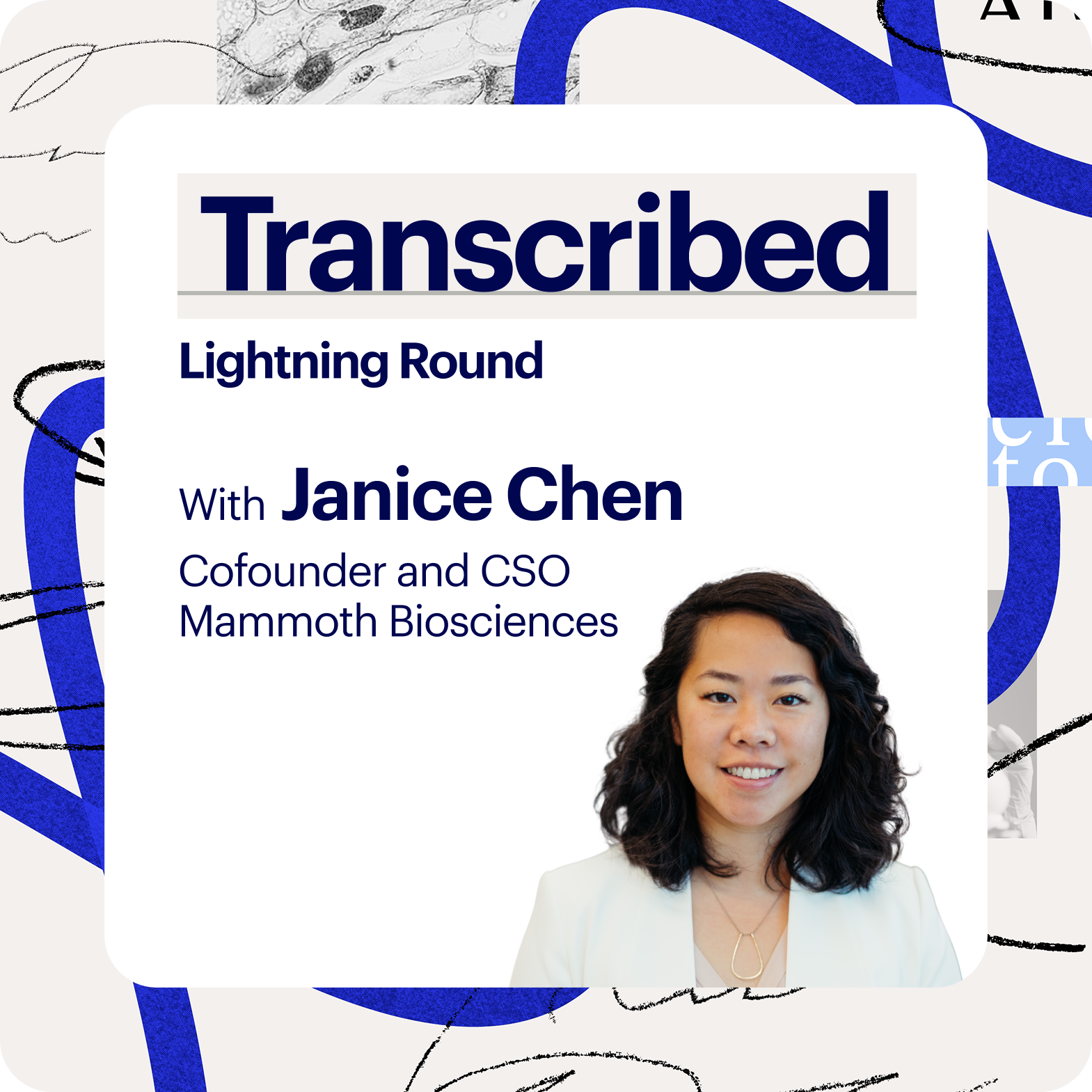


Janice Chen isn’t interested in building just another gene-editing company. After training in Jennifer Doudna’s lab, she cofounded Mammoth Biosciences with a broader vision for CRISPR — building a discovery platform meant to unlock new enzymes, push forward new gene therapies, and ultimately define the future of gene editing.
Janice joined me to talk about platform bets, proving real-world utility, and driving CRISPR’s next chapter. — Sajith Wickramasekara
* Editor’s note: The conversation has been edited for length and clarity.
More than just a gene editing company
Sajith Wickramasekara: Can you share Mammoth's founding story and the moment that you knew you had something special?
Janice Chen: Mammoth was founded in 2018, right after my cofounder Lucas Harrington and I finished grad school. We joined the Doudna Lab in 2014, just after Jennifer, Emmanuelle Charpentier, and others published the seminal CRISPR-Cas9 paper.
It was the Wild West in the field, with lots of unknowns. The Cas9 discovery demonstrated you could program CRISPR to target any DNA sequence. That unlocked tremendous potential, and everyone started to imagine what this tool could do.
Lucas and I sat next to each other in the lab, constantly collaborating, criticizing, and questioning each other. That was the genesis of how we began thinking about the technology.
Sajith: When in your PhD did you have the suspicion this could turn into a company or did you know from the beginning?
Janice: I had no intention of starting a company. In grad school, my goal was to understand this molecule, and think deeply about its mechanism.
But partnering with Lucas and others, we realized that CRISPR is an adaptive bacterial immune system. Tapping into its evolutionary history, we realized it was a gold mine of different enzymes that could be repurposed. That became the thesis for Mammoth: discover new systems, characterize them, and find new applications.
We were the first to show that certain DNA-targeting enzymes could be used for detection, which hinted to CRISPR diagnostics as a real-world commercial opportunity. Then we identified tiny Cas enzymes that many thought were non-functional. Ultimately, we demonstrated they could be used for CRISPR therapeutics. Those were our “aha” moments.
Fast forward to today, gene editing’s obviously become an incredibly successful scientific tool, but it's had a tougher road as a therapeutic.
Sajith: It definitely feels like we're in a trough of disillusionment when it comes to gene editing. Where do you see the field heading?
Janice: It's important to put this in context. The first demonstration of CRISPR gene editing was in 2012, just over a decade ago. We had a historic FDA approval just a couple of years ago, and many companies are in pivotal studies to show curative effects. From a scientific level, that's extraordinary.
“We can't ignore that gene editing’s gone through a rough period in recent years, but this is a reflection that new modalities take time to prove out.”
Safety is top-of-mind, especially after Intellia’s recent announcement of a patient death. It's a wake-up call and stark reminder that safety is a huge consideration for this technology.
It’s also a complex situation because our current healthcare system doesn't incentivize cures or prevention — even though that's where CRISPR technology is headed. These are new concepts that insurance companies don't know how to handle. Besides demonstrating the safety and efficacy of the technology, we also need to find ways to pay for these medicines and demonstrate value to society.
Acting early during COVID
Sajith: Mammoth is well known for receiving emergency use authorization for a CRISPR-based COVID test. Less people know that you pushed to develop an assay in days — before lockdowns or major outbreaks in the US, before we even called it COVID-19. What gave you the conviction that was the right priority?
Janice: At the time, there were cases in China, but fewer than 10 cases in the US. It was early days, but there was growing concern about this novel coronavirus.
In January 2020, a cruise ship docked in Oakland with an outbreak. These were some of the first cases in California. Our long-time collaborator Charles Chiu, an infectious disease physician at UCSF, received some of the first samples, with the mandate to detect and diagnose these patients. He asked if we wanted to help develop a new test. It was a no brainer.
“I think everyone was surprised at how fast we moved, but we felt it was the right thing — not just for the company, but for society. There was no COVID-19 test at the time.”
Sajith: Any learnings from the pandemic's “move fast” mindset that have continued to influence Mammoth over the years?
Janice: There was no time to delay decisions. The virus was spreading fast. The fact that we could contribute was extremely motivating.
Working on a problem that's bigger than your company, or even your field, was a lasting lesson for me. If you really want to drive for something big, you can move fast with the right people.
Inside the Doudna lab
Sajith: When you were in the Doudna Lab, it became increasingly plausible that Jennifer would get a Nobel Prize. How did that change the dynamics in the lab?
Janice: When the CRISPR-Cas9 paper was first published, everyone thought it was too early for her to get the Nobel Prize. Then it was clear that it was building momentum. But the Nobel wasn’t really the point. It was always about moving this technology forward.
The lab became highly recognized, which was an advantage. As grad students, we could basically email any collaborator, say we’re from the Doudna Lab, and every single person would respond. It opened a lot of doors.
It also shifted the core competency of the lab from biochemistry, molecular biology, and RNA biology to more translational work. It reflected the need for different types of scientific skills and ways of thinking about the problem.
Sajith: Both you and Lucas finished your PhDs in four years, which is pretty fast. Can you share any stories about Jennifer's management and leadership style?
Janice: Looking back, it was fast, but I just loved my time in the lab. Jennifer has always been a huge role model and mentor.
She attracted very talented people, and was very thoughtful about pairing junior students with senior grad students. Over time, we became the senior students training the next generation. It was a very scalable process.
Sajith: I'm always surprised by the number of labs that don’t pair students up to collaborate. It seems like an easy way to be a happier, more productive lab.
Janice: Totally. That’s how she had a lab of 30-40 people, by ensuring everyone could learn and grow.
As a leader, Jennifer also knew how to translate the science and data into a bigger story, which helped CRISPR become mainstream. I learned a lot from that.
Sajith: As the lab became very renowned, how did she maintain the culture internally?
Janice: She always had her priorities right. She cared deeply about the lab and the science that was being done.
“Despite how crazy her schedule was, Jennifer always found time to look at your data and help. When you sat with her, it was like nothing else mattered.”
Sajith: You've spoken before about how Jennifer encouraged you to start your own company because you weren’t shooting high enough. Can you tell that story?
Janice: My third year of grad school, I was looking at internship opportunities at Genentech and needed a recommendation letter to apply.
It was a summer internship, so I would’ve had to pause my work in the lab — without losing momentum when I returned. I had just published a paper, was working on another, and there was a clear line of sight to the next phase of my career.
She rightfully said, “This is going to slow you down. There's a lot more that you're capable of. Think about what you really want to do.”
And it wasn't because she wasn't supporting me. It was the opposite. She deeply supported and challenged me to shoot higher. So I took a step back and decided to focus on continuing this momentum.
Around that time, I started to have in-depth discussions with Trevor Martin, Lucas, and Jennifer about starting a company.
“If Jennifer hadn't challenged and course-corrected me, my trajectory could have been completely different.”
The benefit and curse of a platform company
Sajith: Mammoth's been described as the #1 holder of CRISPR IP. From the very beginning, you've invested in expanding the CRISPR toolbox, discovering new Cas enzymes with unique properties. How do you decide which are worth pursuing?
Janice: The benefit and curse of a platform company is that there are so many different dimensions to play with.
When we first started, every other CRISPR company had one platform and one specific focus area. That helps you move quickly, but true platform companies are built to survive the long term. That's always been our mindset.
“The best platform companies are ones that can prioritize and actually prove the platform with a product that has real-world utility. ”
It’s a balance. How far do you push one thing while keeping the rest simmering in the background?
Since the early days, we've always had two pillars: diagnostics, and therapeutics, which is our core focus today.
When we first started the company, there was interest in detecting microbes that corrode oil and gas systems. Real-time, on-site detection would be hugely valuable, and the path to proof-of-concept and commercialization was clear. Ultimately, we decided to focus on being a human healthcare company. We’re not ruling out environmental monitoring applications, but it’s on pause while we focus on healthcare.
Sajith: Now that you've announced Mammoth's first lead candidate, has the discovery engine slowed down at all?
Janice: Are we still scouring the universe for new CRISPR enzymes? No. But there's a lot of discovery around leveraging those core CRISPR scaffolds for different types of editing. The beauty of the platform is its multiple dimensions: the type of edit, the tissues you can target, and the biology you can go after.
There’s also the business development side. Having different ways of creating value gives you different ways to structure deals. We’ve been thoughtful about this throughout the company’s growth, because we cannot do everything ourselves.
Making it past the honeymoon stage of partnerships
Sajith: You have partnerships with Vertex, Bayer, and more recently Regeneron, who doesn’t do a lot of partnerships. What do you wish you knew about partnerships when you started?
Janice: Everyone sees partnerships as a huge validation — which they definitely are — but they’re also a trade. Early on, with nascent technology, you're probably trading more than you’d like. That's the reality, so it’s important to be thoughtful about those first partnerships.
“In hindsight, there are trades we might not have made. Regeneron was a much later deal, so we were very thoughtful about what we put on the table, what we got back, and the company’s long-term trajectory.”
Partnerships are also a long-term commitment. Things aren’t always going to work out as intended. There's always a honeymoon period at the start, but then it's a long road of making the science work, with ups and downs.
At the end of the day, I've personally loved the partnerships we've had. Regeneron, in particular, has been the most fun I’ve had scientifically — it almost brings me back to my grad school days. But these partnerships are complex and can create operational headaches, not just day-to-day but over the mid- and long-term.
“We talked to Regeneron for two years before the deal was announced. These are long-term discussions. You have to start early and continue building the relationship.”
It’s also nice to negotiate from a position of strength. We've actually said no to potential deals. We have to be disciplined, and can’t do deals for the sake of doing deals. We ask: Does this play to our strengths? Does it make sense for our strategy?
There's a lot of nuance, but we try to keep the door open. That's the beauty of the platform: there are many ways to apply the technology, and different ways to structure deals at each stage.
Sajith: Did having Jennifer on the founding team create any outsized expectations or pressure that was hard to manage?
Janice: Obviously Jennifer has been hugely impactful for the company. Who knows if we would’ve made the same progress without her — or had the opportunities we’ve had, coming from her lab. It's hard to decouple that.
As for pressure, not really. We've always stayed grounded in following the science and data — and really thinking about the positive impact we can have with CRISPR. People love to define a company by its scientific founders, but developing a drug or technology takes a huge amount of teamwork.
Where CRISPR goes next
Sajith: You’ve said that CRISPR will touch the full continuum of healthcare, from detection to treatment. Based on what you know today, where do you think it’ll have the biggest impact?
Janice: Early detection and prevention. The challenge is that our healthcare system incentivizes later-stage treatments and chronic care. If we could shift that equilibrium to early detection, that’d be much better for patients.
Sajith: How far are we from CRISPR-based diagnostics becoming as routine and available as a pregnancy test?
Janice: That's always been the dream. But no one’s fully cracked it. We came close during the pandemic, but we're still a ways off. We have to walk before we run.
Since shifting our company strategy, we're no longer developing and commercializing CRISPR diagnostics products ourselves. Instead, we’re enabling the ecosystem through our breadth of IP. We've announced a couple non-exclusive licensing deals that enable other companies to use our technology, combining it with their core competencies to bring products to market.
Sajith: Any hot takes for gene editing over the next decade?
Janice: My hope and dream, and I think it's achievable in 10 years, is that CRISPR eradicates certain rare monogenic diseases — in the same way that we've eradicated some infectious diseases. Again, it's just a matter of incentives and focused effort.
We all know the baby KJ story, but there are other diseases with small patient populations of <100 people, with a clear source of pathogenesis and no incentive for companies to develop cures. The administration is talking about changing those incentives, but we’ll see if that turns into action.
That’s my hope for the next 10 years. There will be ups and downs, but I'm optimistic.
Growing up in the lab
Sajith: Your father was finishing grad school while you were growing up, and you've shared that you and your siblings would play in the lab — even learning how to run gels. Did you always imagine becoming a scientist?
Janice: My dad was a PhD student at the University of Utah. He was a total lab rat, spending days, nights, and weekends in the lab. Instead of going home from school, I’d go to his lab and hang out.
I was probably in elementary school when I first picked up a pipette. I don’t think I went into science because of that, but having fun — and seeing how you could go from mixing clear liquids to having meaningful impact — is something that I attribute to those early days of seeing my dad in the lab.
Sajith: As a kid, you also played competitive chess, often as the only girl and youngest in the room. Your brother Nathan Chen is famously an Olympic gold medalist in figure skating. Can you tell us more about your childhood?
Janice: As a child of immigrants, you know how much your parents sacrifice. I'm deeply grateful for that. Being Chinese American adds another layer: You’re not really Chinese, and sometimes people don’t see you as American. It's a weird hybrid, but it almost forces you to define who you are and go after something that you care about.
My parents were very thoughtful about ensuring we had opportunities to try everything, and then let us pick our own paths. Education was the number one priority, we had to work hard, but also had the freedom to try different things. For me, having two young kids now, all those values are fundamental.
I started playing chess because my dad found a chess set at a yard sale and taught us. We did it because it's fun, and eventually, it became competitive. Playing chess has also been super informative for me — thinking several moves ahead, considering what's best not just for you but for your opponent. A lot of this strategic thinking applies to business too.
Sajith: Looking back, what do you wish you’d known when starting Mammoth? What advice would you give a grad student about to launch a company?
Janice: Sometimes it's good to be naive — you don't know what you don't know. Just go for it, and lead with first principles thinking.
Whatever you decide to do, make sure you step back and understand the bigger picture. Sometimes first-time founders can have blinders on, and think “I have this amazing technology, it’s going to save the world.” But you have to figure out whether this is something people really want and need.
Learning how to step back (and not drink your own Kool-Aid) is important, regardless of what you’re building.