5 data governance moves every biotech startup should make in the age of AI

Summary: Moving fast as a startup is great until your data becomes a mess you can't untangle. A lightweight governance approach now means cleaner data, better AI outputs, and less time fixing things later.
You only need three roles to run effective governance: a tenant admin, a registry admin, and a few super users who can champion adoption across teams.
A simple change request process built directly in Benchling keeps schema sprawl in check without adding bureaucratic overhead.
Benchling's Deep Research agent can audit your current state for you, flagging redundant templates, unused schemas, and permission issues so you know where to focus first.
If you work at a biotech startup, you probably wear multiple hats. Some days you’re a scientist. Other days, you’re an engineer, an IT admin, and the person everyone asks about Benchling. And if you’re moving fast (which you are), it’s easy to treat data governance like a nice-to-have.
But the faster you go, the harder it becomes to untangle data later. Without the right structure, you’ll hit a tipping point where it’s no longer clear what your data even means, or if you can trust it at all. And in an age where AI tools rely on clean, complete datasets to generate insights, data hygiene isn’t just important — it’s essential.

Flexibility without standards equals chaos. You don't need to sacrifice speed to build structure. You just need a lightweight approach.
Here are five data governance strategies any biotech startup can adopt to protect their most valuable asset: their R&D data.
1. Treat your data like your IP, because it is
Think of your R&D data the same way you think about your IND, your pitch deck, or your IP portfolio. It defines the value of your company. Inconsistent data — schemas that don’t align, template fields that change week to week, drop-down lists with duplicates — can slow you down and make your data unusable for real-time analysis or AI-driven tools.
Most startups begin with flexibility by necessity. You create what you need, when you need it, with whatever works. That might mean free-text fields, duplicative dropdowns, or custom schemas built by different teams. But as your team scales, that flexibility turns into friction.
One of the first warning signs is when new hires or admins start duplicating work: creating redundant schemas or templates simply because they can't find what's already there. When that happens, you end up spending more time fixing data than analyzing it.
The mindset shift: governance isn't about slowing down. It's about setting just enough structure now so you can keep moving fast later. Data is your most valuable asset. It's time to treat it that way.
2. Build a lean data governance council
You don’t need a committee. You just need clarity. Data governance works when three core roles are covered:
Tenant admin: Owns configuration migration, tenant-wide settings, and user management. This person understands how your system is wired, and how changes will impact the technical side of Benchling.
Registry admin: Knows the scientific context of the data. They ensure changes make sense biologically and don’t introduce scientific inconsistencies.
Super users or team leads: Advocates for day-to-day workflows and adoption. These folks help ensure new standards are actually followed.
These roles are essential to making informed, enforceable, and widely adopted decisions. The council can be as small as two or three people, and yes — one person can wear multiple hats.
Start by identifying who fills each role today, even if informally, and build from there.
3. Control change before change controls you
Uncontrolled change is the enemy of clean data. When every new field or dropdown option is added on a whim, it leads to fragmentation fast. And fragmented data is hard to trust, hard to query, and nearly impossible to automate.
You don’t need a complex workflow to manage change. A simple, required change request process that collects feedback directly in Benchling using a schema or form works well. Users submit changes in the system they already use. Admins triage requests with a consistent process. Read our data governance guide for step-by-step instructions on how to configure the form below.
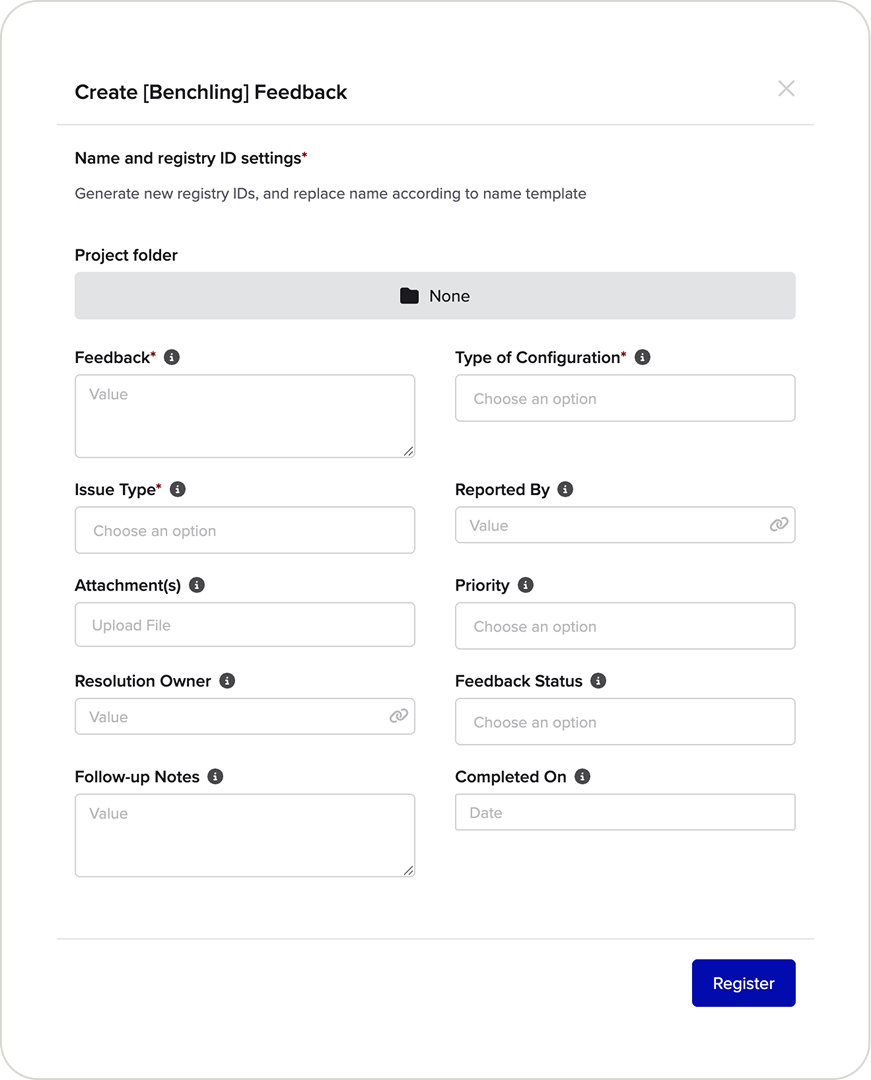
Use this framework to sort changes:
Reactive changes: User-driven requests, like adding new fields or templates.
Proactive changes: Admin-initiated improvements, often tied to new product features or optimizations.
This system helps you prioritize improvements and eliminate the "I do what I want" chaos that creeps into fast-growing orgs.
4. Communicate like it’s a product launch
Making a change is only half the job. If users don’t know it happened, they won’t use it. That’s why clear, ongoing communication is essential to good governance. Treat changes like internal product launches. Build excitement. Explain the why. Make adoption easy.
Recurring Lunch & Learn sessions are a simple way to drive adoption and scale training. Host them monthly, keep them short and relevant (30-60 minutes), and rotate topics based on user needs. Use these sessions to highlight new features, resolve recurring issues, or dig into best practices your team has developed.
The goal is to make enablement continuous, not just a one-time event during onboarding.
5. Use AI to audit your current state
Before you overhaul your system, it helps to know where you actually stand. Benchling’s Deep Research agent can do that legwork for you. (see example in appendix).
Instead of manually auditing your data model, permissions, and activity logs, Deep Research pulls from both structured and unstructured data in your Benchling environment to:
Identify commonly used and unused schemas
Flag redundant dropdowns or outdated templates
Pinpoint potential permission or security issues
Surface your most active super users
Recommend high-impact areas to clean up
Running this tool on your tenant gives you a clear, prioritized picture of where to focus without weeks of manual digging.
Not sure how? Our team has developed an example prompt that you can copy-paste into Deep Research to get you started.
Start small to scale data governance over time
Data governance doesn’t have to mean bureaucracy. It doesn’t need to slow you down. Done right, it’s a lightweight system that scales with your science, makes onboarding smoother, and unlocks the real value of your data, especially in the AI era.
Start small. Pick one of these tips and try it this month:
Identify your three key governance roles.
Set up a simple change request schema.
Plan your first Lunch & Learn.
Run a Deep Research audit to see where you stand.
You don't need to start from scratch. Our data governance guide for startups has everything you need to get started — with step-by-step examples and ready-to-use prompts.
Introducing lightweight structure today is the only way to make sure your time is spent on breakthrough science tomorrow.