Leading with intent: 5 lessons from women reshaping biotech

Who gets to lead in biotech? The answer still skews male. While women make up nearly half of the life sciences workforce, they hold fewer than 20% of executive roles at biotech companies. The gap reveals the truth about professional access and the unwritten rules of who gets to lead. But that is quickly changing. A new generation of leaders is redefining what it looks like to build a career in biotech, proving that you don't need to follow the playbook — you can write your own.
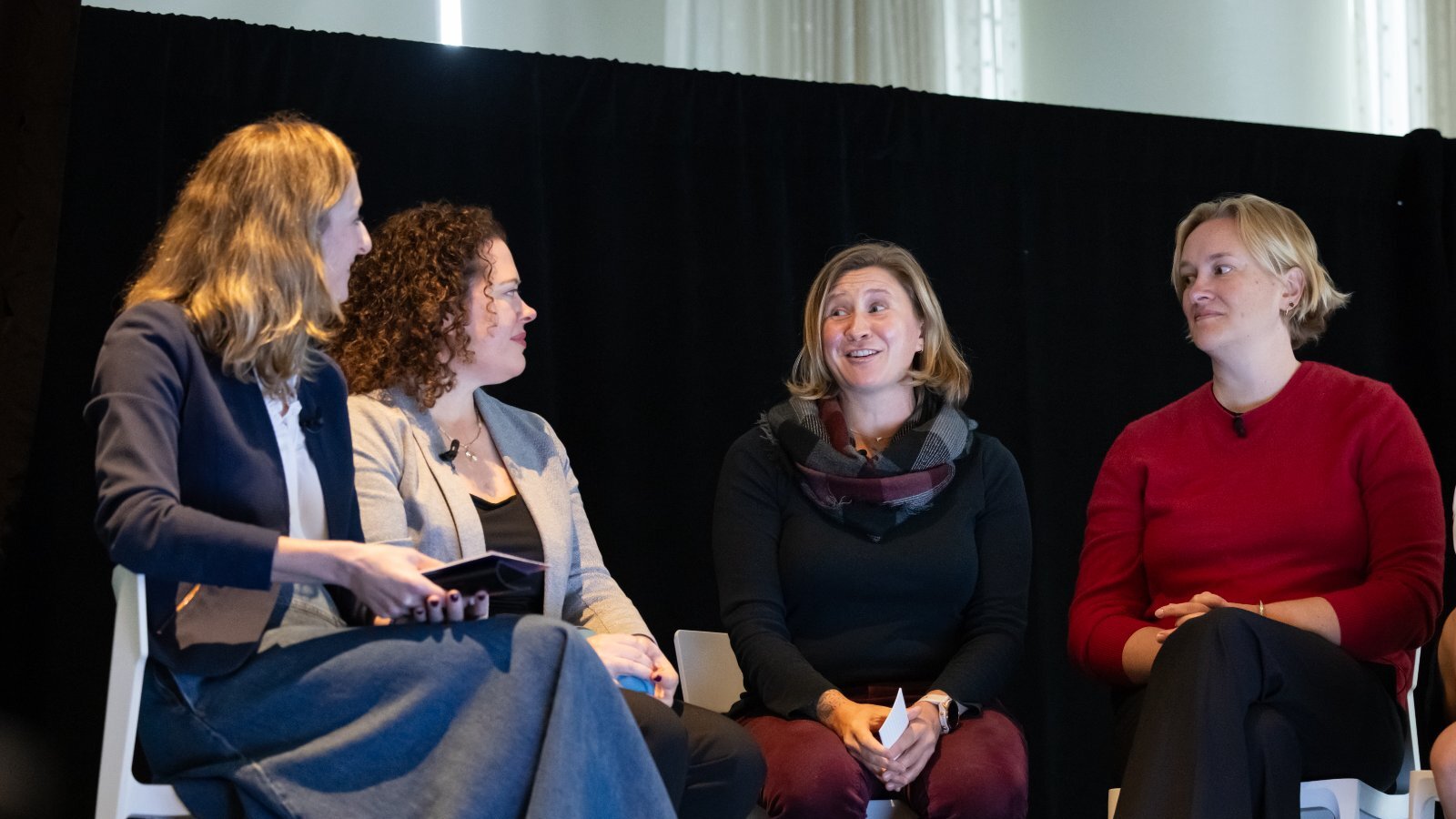
The panelists at our "Women in Biotech" session brought that message to life as they discussed the values that have shaped their careers. Whether it was developing a clear vision, building relationships, or driving operational excellence, they kept coming back to one idea. Innovation is only possible with intentional leadership.
Meet the panelists
Tara Barreira, Independent CMC consultant and former VP of Technical Operations
Kathryn Golden, VP of Technical Operations, Ottimo Pharma
Leah O’Brien, VP, Global Head of Digital Lab & Plant Operations, Sanofi
Moderated by Meritxell Orpinell, Head of CX EMEA, Benchling.
Lesson 1: Resilience is more than grit. It's pattern recognition.
None of these leaders mapped their careers in a straight line. Many didn’t even intend to work in science. What got them here wasn't a master plan but rather the ability to notice patterns, close gaps, and make bold moves.
O'Brien's career is a case in point. With a background in computer science, she kept pushing for bigger answers. "I was coding, and I wanted to know — who wrote these requirements? So I became a business analyst. Then I wanted to know why we were building this, so I moved into strategy." That drive led her to a leadership role spanning digital lab and plant operations at Sanofi.
“I would see what was missing from the team and then go get those skills,” said Golden. That instinct turned her from a reluctant science student into a senior technical leader responsible for getting new therapies to patients.
In 2025, resilience isn't just surviving obstacles. It's recognizing opportunity before others do and building the muscle to act on it.
Lesson 2: Relationships are a force multiplier
"Relationships are my superpower," said Barreira. "And I attribute that to spending ten years behind a bar in a kitchen and waiting tables in the service industry." Her background in hospitality taught her how to read people, defuse tension, and build trust across functions. Those same skills now shape her approach to CMC operations, where teams depend on each other for high-stakes decisions.
O'Brien brings a similar ethos rooted in her experience as a parent, including as a foster parent. "That sense of care and concern is part of who I am," she said. "So I care about the people I work with and my stakeholders at work too." She also emphasized the importance of creating space for others to grow. "As you progress, you have to delegate more. You can't hold it all yourself. I've had to unlearn managing all the details to give space for other people."
Strong relationships aren't nice-to-haves. They’re a leadership imperative. Especially in a time when technology moves faster than alignment. The best leaders aren’t the loudest in the room. They’re the ones who build trust across silos and keep teams moving together.
Lesson 3: Technical transformation is a people-first problem
AI was top of mind for every panelist as a critical tool. O'Brien offered a practical framework for navigating the tension between ambition and reality. "You need to have two brains running," she said. "One is the super futuristic: what's possible, what could we be doing. The other is practical — yeah, those AI models, but we don't have good data. You have to improve the baseline while you're dreaming of the future."
But change doesn’t just start with infrastructure. It starts with leadership. Real innovation in 2025 means aligning technology, people, and process. Leaders who can connect those dots are the ones shaping the future. Learn more how Benchling AI is helping scientists do just that.
Lesson 4: Scientific rigor is everyone's job
Science doesn’t run on assumptions. It runs on evidence. And maintaining that standard is a leadership challenge, not just a regulatory one.
Golden emphasized the importance of building a true quality culture. "You don't want quality to feel like the police," she said. "You want quality to be so important that it's never an afterthought. It's like the first thing."
"Documentation is a form of resistance," said Barreira. "It’s the difference between science and messing around." Too often, quality is treated as a box to check. But the most effective leaders embed it into culture. That means asking hard questions, checking your sources, and making sure teams feel supported in doing the same.
In fast-moving fields, the best leaders make sure that rigorous scientific data and documentation are the first thing they invest in.
Lesson 5: Leave with a bang
At the end of the session, someone asked how the panelists manage leadership, ambition, and caregiving. Barreira didn’t hesitate. "I leave loudly. I make a big ta-da." Modeling balance from the top down is an important part of creating a culture where everyone is encouraged to do their best work. And that means making it normal to step away and take care of your life outside the office.
Golden offered a reminder that applies well beyond work-life balance: give yourself and your team room to stumble. "Not only is failure okay," she said, "but sometimes you really need to mess up to learn well." Whether it's a dropped bioreactor or a missed deadline, the best leaders create space for learning alongside performance.
These leaders aren’t waiting for biotech to change. They’re showing what intentional leadership looks like and why it matters more than ever.
Curious how teams are putting these principles into practice? Explore Benchling customer stories.