Benchling now brings chemistry and biology together
Benchling is expanding its capabilities with chemistry to power scientific progress across all modalities in research and development. Today, we’re introducing Chemistry Reactions, a new capability for modeling single-step synthesis, alongside predictive models for small molecule R&D from Inductive Bio.
For more than a decade, Benchling has been strong at large molecule R&D. As research has evolved, therapeutic modalities are increasingly crossing the boundary between biology and chemistry. In addition, advances in AI create new opportunities to learn from data across the entire R&D organization.
This makes a connected, structured data foundation more important than ever. That’s why Benchling is bringing molecules and reactions together with experiments, biological results, and computational predictions, so teams work across modalities in one system, and put their scientific data to work with the help of AI.
Expanding Benchling for chemistry
Chemistry moves in a tight, iterative loop: decide what to make, determine how to make it, synthesize and characterize it, test it, learn, and repeat. But the data behind that loop often lives across disconnected tools, making it hard to understand how a molecule was made and performed, and what to do next.
Reactions is built on the same structured platform as the rest of Benchling, and is an important step in a broader effort to bring the foundational workflows chemists use every day onto the platform.
Chemists can search across reactions and notebook entries, while every molecule stays linked into the customer’s broader scientific record, connecting synthesis with the experiments, results, and other scientific context around it.
A chemist designing a new analog can search related molecules and past reactions, plan synthesis with automatically calculated stoichiometry, account for salts and solvates, and capture the resulting product in the same scientific record.
When that molecule moves into testing, its history stays connected. Teams trace how it was made, see its experimental and biological results, compare it with related chemistry, and carry those insights into the next design decision.
Other key use cases:
Plan synthesis with less manual work. Sketch single-step reactions directly or bring them in from existing reaction files, like ChemDraw, then automatically calculate stoichiometry and quantities as reaction conditions change.
Work with chemically meaningful forms. Use shared salt and solvate libraries and account for salt forms during reaction planning.
Learn from chemistry the team has already done. Find past reactions by chemical structure or similarity, then narrow results by reactants, products, solvents, catalysts, and reaction role.
Work with molecules alongside their synthesis history. Capture and find molecular structures in Benchling alongside the reactions in which they were made or used.
Keep the molecule’s story connected. Automatically link reactions to compounds, experiments, and biological results so synthesis history and downstream performance can be explored together.
Bringing predictions into the design cycle
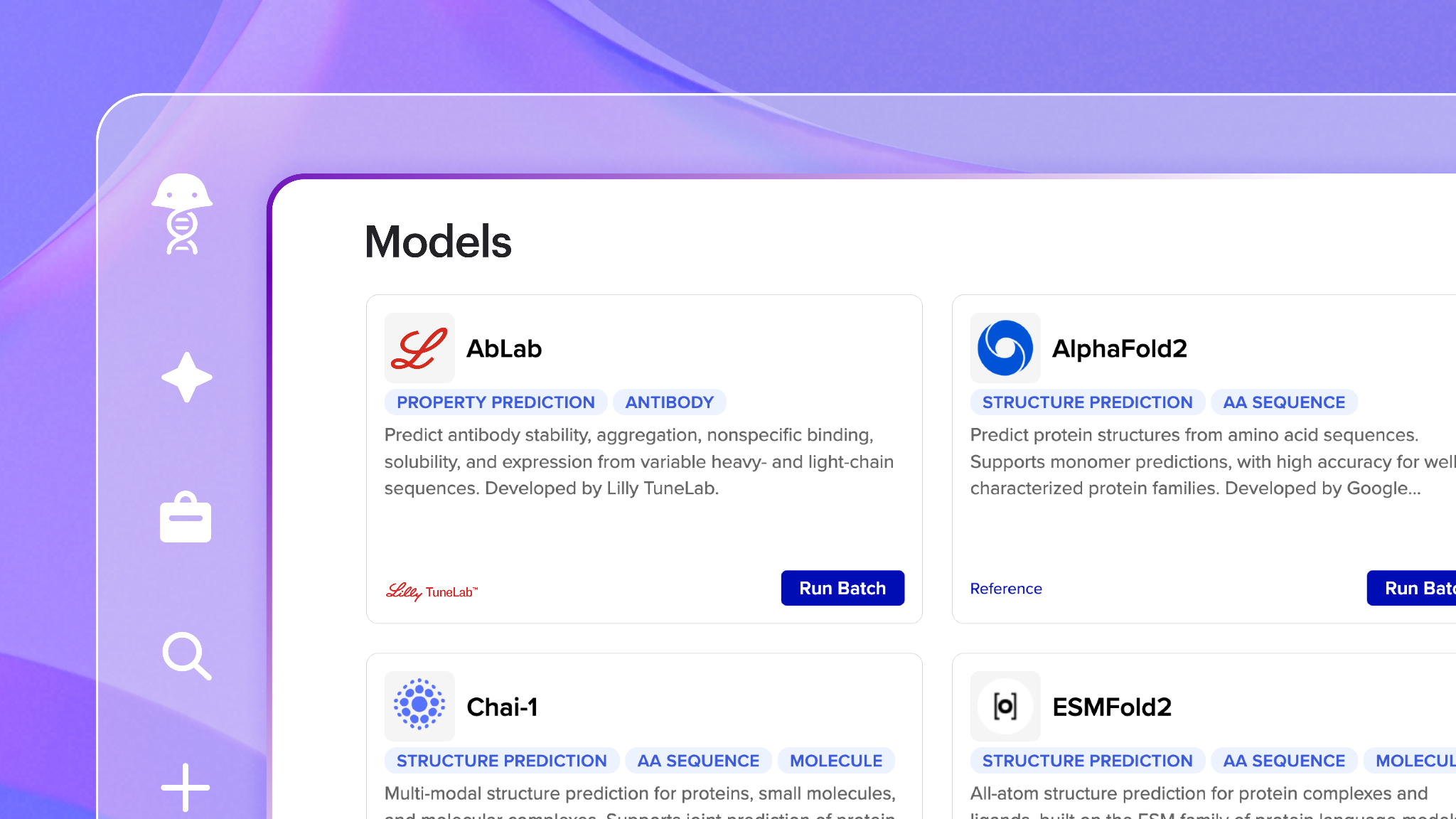
As we expand our support for small molecule R&D, we’re also bringing more chemistry-focused scientific models into the Benchling Model Hub with computational predictions in the decision-making loop, alongside the experimental data scientists already use.
Inductive Bio's ADMET prediction models enable any chemist using Benchling to predict the chemical and pharmacokinetic properties that determine whether a molecule can become a viable drug. Inductive Bio’s models are independently validated by three consecutive first-place performances in the OpenADMET blind prediction challenges.
Scientists can register proposed molecules in Benchling, run predictions before physical ADMET testing, and compare those predictions with experimental results from compounds they’ve already made. That combined evidence helps teams make better decisions about what to synthesize next and move through design cycles faster.
We’re just getting started
Reactions is an important step in our broader chemistry investment at Benchling. We’re building the system where chemistry and biology teams can work from the same connected scientific foundation, making experimental data easier to search, reuse, and put to work with AI.
Learn more about Benchling Chemistry:
Come find us at booth #203 at ACS Fall 2026 on August 23–27, 2026
Register for our ACS chemistry webinar on September 1, 2026
Got questions about Chemistry Reactions? Ask them live. Register for our AMA on Sep 16, 2026
Join us at Benchtalk in Boston or London
Chemistry is currently in limited availability. Request access here: benchling.com/chemistry-la-signup.