The ELN is dead, long live the ELN
Today we’re introducing the new Benchling AI, rebuilt inside the notebook where scientists already work.
Pharma first adopted electronic lab notebooks to protect intellectual property. In a first-to-invent patent system, they were evidence of who did what and when. These systems were clunky, on-premise, and expensive to stand up.
Ten years ago, we brought science online with an easy-to-use cloud notebook. Hundreds of thousands of scientists have adopted it. Then we moved past paper-on-glass. We brought together structured data, molecule registration, and analytics, so scientists could plan and run experiments.
It’s time for a third chapter of lab notebooks. AI can automate scientific toil and help scientists run better experiments, but it should fit into the way scientists already work: their notebook.
Meet the new Benchling AI. Open an experiment, describe what you need, and let it do the rest.
The notebook as an interface for intelligence
Imagine a scientist who just ran an ELISA assay.
The experiment is finished, but the work isn’t. Results need to be cleaned up, analyzed, copied into a notebook, and compared to historical runs to inform what to do next.
With Benchling AI, the scientist uploads the raw data and the notebook entry is generated for them, pulling in the right protocol, extracting structured results, and linking the relevant samples.
But the notebook is no longer just a place to document the past. It’s an interface for intelligence that helps decide what to do next.
The AI analyzes the results, flags an unexpected drop in potency, and compares against historical data to propose explanations. It then recommends follow-up experiments to move the project forward.
The scientist never leaves the notebook. The data, analysis, and recommendations are all in a single interface. AI becomes a natural part of scientific work rather than another tool to learn.
Skills are templates for AI
Benchling AI already understands your molecules, results, and experimental history. But every organization also has its own way of working: how data is captured, which statistical methods are preferred, and how reports are structured.
Think of a Skill as a notebook template for an agent. In the same way templates standardize work for scientists, Skills standardize work for AI.
Our out-of-the-box Skills provide expertise for common scientific tasks like report writing, data analysis, and data import. But similar to notebook templates, the real power comes in creating your own.
Create a Skill for a transfection experiment that knows how plasmid preps should be registered, how plates should be laid out, and how results should be analyzed, including embedded code.
Simply describe what you want, and Benchling AI can create or modify a Skill for you. Tasks go from just working once to becoming reliable and reusable across your organization.
Context makes connectors better
Scientific knowledge lives in many places. Past project decisions are buried in slide decks. Historical results live in data lakes. Relevant publications are scattered across the literature.
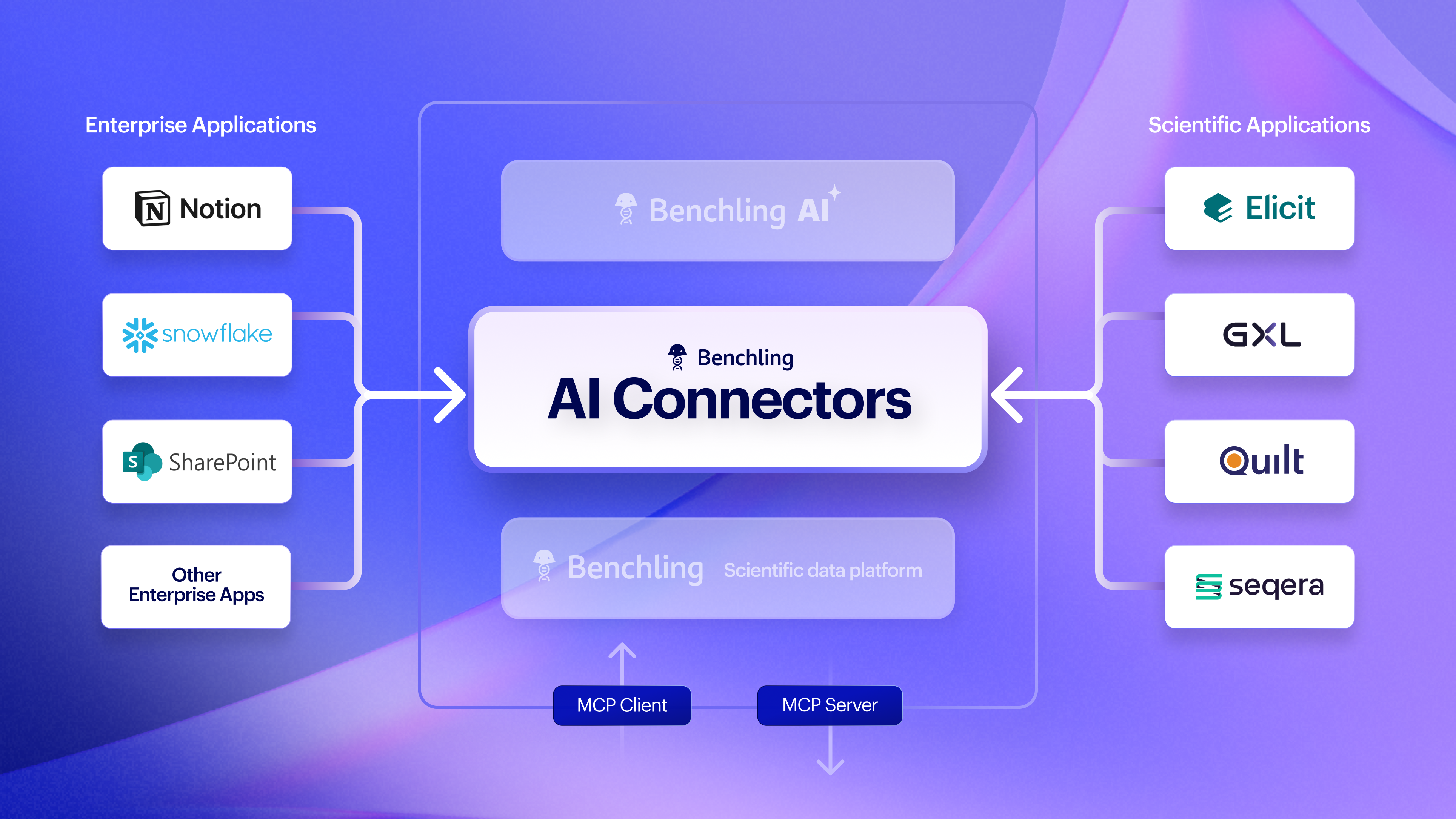
Benchling AI Connectors make that knowledge accessible directly in the notebook through out-of-the-box integrations with Sharepoint, Notion, Snowflake, and more. Custom MCPs allow connecting to virtually anything in your tech stack.
But the AI still needs to know where to look, especially since the same scientists who name their plates “Plate 1” and “Plate 2” probably also prompt AI with “why didn’t this work?” Benchling AI natively understands what a scientist is trying to do by pulling in the project, experiment, and samples they’re working on. It uses that context to help it find the right information across systems automatically.
The notebook gives AI its bearings so it can find knowledge from anywhere.
Try it today
The new Benchling AI is available to all customers to use: just open your notebook, or ask your administrator to activate AI if they haven’t.