Three ways AI is delivering value for in vivo research teams
AI first appeared on the agenda at the AALAS and FELASA conferences in the last few years, but it was always a conversation about potential. Today, that's changed. In vivo teams aren't just curious about AI anymore; they're putting it to work. At Benchling, the question we hear every day from companies, vivariums, and CROs has shifted from 'Could AI help us?' to 'How can we use it to get the most value?'"
In vivo research practices are evolving quickly to keep pace with new therapeutic modalities. Digitization has accelerated this shift, enabling teams to collect more data, faster. This data is fueling a new generation of intelligent tools. But fuel only matters if it's clean.
The biggest lesson of the last two years is a simple one. AI is only as good as the structured, connected data underneath it. The teams seeing real value are the ones who are prioritizing their data foundation first and reaping the benefits across study design, in-life capture, and analysis.
Here are three areas where we're seeing AI deliver actual day-to-day value for in vivo teams.
1. Turning CRO and legacy data from a bottleneck into an asset
Almost every in vivo program has a component that runs externally, from assays on samples to entire studies outsourced to a CRO. That data comes back in multiple formats including PDFs, Excel, Word, or PowerPoint documents, and someone has to manually restructure it before it can be aggregated, graphed, and compared. It's time-consuming, error-prone, and it quietly traps insights inside files that are difficult to query easily.
This was the pain point we first prototyped against, and it's now where AI is delivering some of the clearest wins. Benchling AI agents can now ingest a CRO data package directly. Results are linked back to the right study, animals, and test articles automatically with no manual re-entry or broken lineage between the outsourced result and the internal record.
The same approach applies to legacy data sitting in older systems. Instead of leaving years of historical studies stranded, teams can bring that data into a structured, searchable form and use that data to optimize the parameters for future experiments. This skill turns in vivo data from a silo into part of the connected R&D picture.
2. AI that saves scientists' time on reporting
Roughly half of a scientist's working week is lost to manual, logistical work such as data preparation, handling, and reporting rather than actively working on novel science. Reporting in particular is a perennial drain. It often involves pulling together a study report mid-study or at takedown, summarizing what worked and what didn't for managers and colleagues, and reformatting data for downstream needs.
This is exactly the kind of work AI is now taking on. Pointed at structured study data, AI can generate a topline study report in minutes, cutting down on what traditionally required an afternoon of copy-paste. It can take on specialist formatting tasks that historically required expensive consultancy hours or bolt-on competitor tooling. A key use case is checking data against regulatory submission standards like SEND. AI can now do the heavy lifting and the qualified scientist acts as the final approver.
Once a report exists, the same tools can translate it on demand. This is a major unlock for global teams who need the same study summary in more than one language. The pattern across all of these is the same. AI handles the repetitive heavy lifting, while the scientist focuses on the critical and specialized judgment only they can provide.
3. Anomaly detection and statistical analysis as a built-in safety net
Capturing data in a structured, objective way is hard, especially when several scientists collaborate on one dataset. It’s easy for errors to creep in, such as a tumor volume that jumps more than expected between measurements or a duplicate reading on the same date. They're often invisible until someone catches them in review, if they're caught at all.
AI helps teams validate the data. It can confirm whether there are anomalies in a study's tumor volume results or whether a liver sample was actually collected from every animal. It can also surface problems on completed studies and on studies still in progress, so issues get caught while there's still time to act.
The same structured foundation enables faster analysis. Because data lives in one platform, AI can run a full statistical workup: checking normality, applying the right test, and flagging when a headline p-value doesn't survive correction. This ensures results aren't over-interpreted. By employing this sort of analytical rigor, and making it available to every scientist regardless of their stats background, every result is traceable back to its source data. This protects study integrity, and it protects the animals — fewer undetected errors means fewer repeat experiments.
The thread that ties it together
None of these three findings are really about using AI in isolation. CRO or legacy data ingestion, automated reporting, and anomaly detection all depend on the same thing — governed, structured, connected data that an intelligent tool can read.
The truth is that free-text observations and proprietary, isolated data models are effectively invisible to the AI stack that R&D organizations are building.
In our experience, the teams getting the most value from AI are the ones who are treating their data foundation as the prerequisite, not an afterthought. That is the trend powering the next era of in vivo studies.
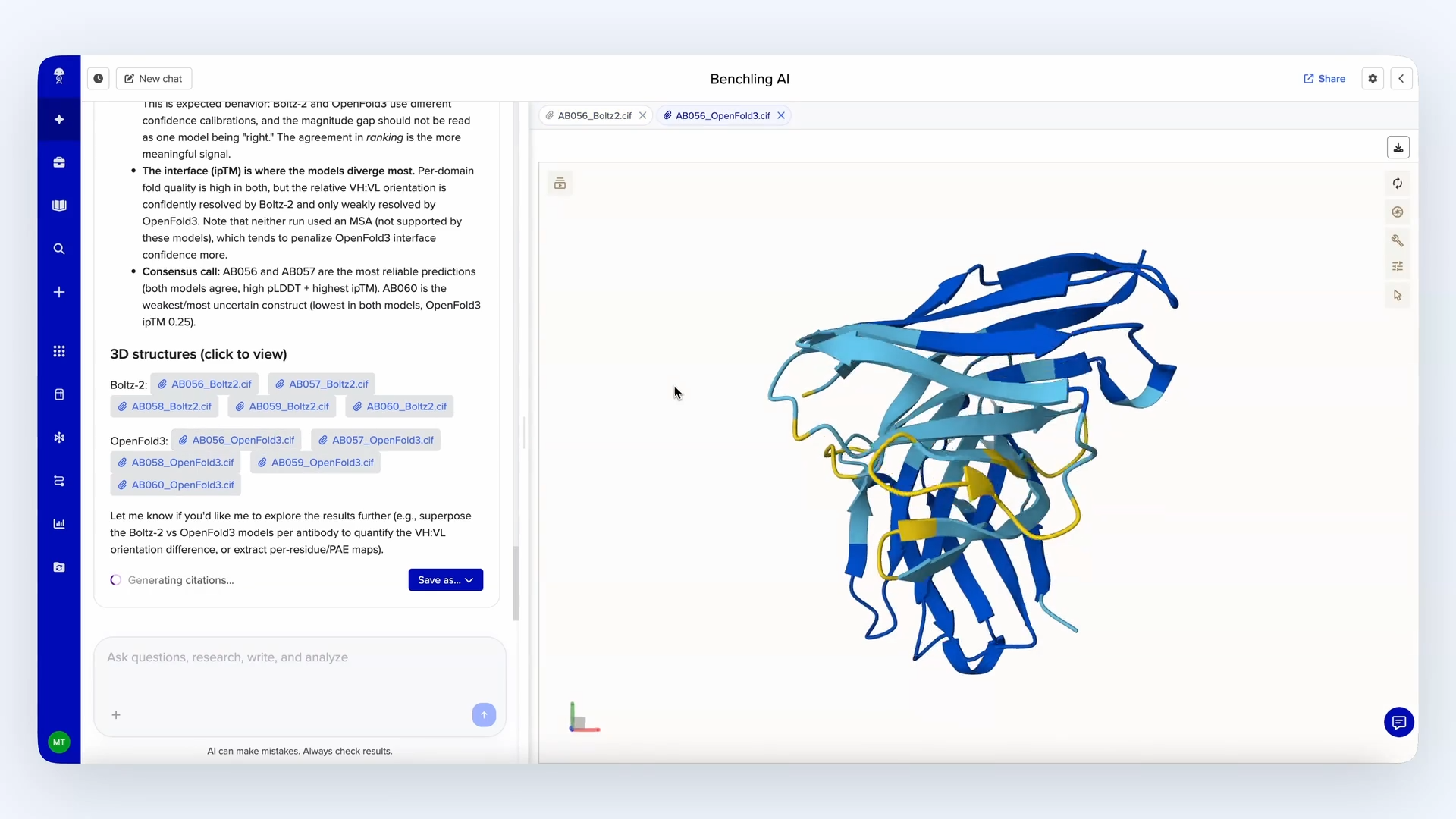
Benchling In Vivo is built for exactly this. It captures in-life data in a structured form, connects it across upstream and downstream teams, and ensures that information is ready for Benchling AI to turn into insight. It does all of this while also upholding the highest standards of 3Rs compliance and animal welfare.
See it live in Houston at AALAS 2026
We'll be back at the AALAS National Meeting in Houston, TX from October 25–29, 2026, and we'd love to continue these conversations in person. Here's where to find us:
Catch the talk. Join our Technical Trade presentation, AI-Assisted In Vivo Research: Real-World Applications, at 1:00pm on Sunday, October 25.
See it live. Stop by booth 1146 for hands-on demos of the AI tools mentioned in this post, such as CRO and legacy data ingestion, AI-assisted reporting, and anomaly detection and analysis.
Talk it through. Meet the people who build and use these tools every day, and explore where AI could fit into your own in vivo workflows.
Can’t wait? Learn more about how teams are moving faster with Benchling In Vivo and Benchling AI.
Request a demo to learn about how Benchling is helping in vivo teams optimize their work with AI.