Data sheet

AI-powered recipe design, experiment planning, batch execution, and analysis.
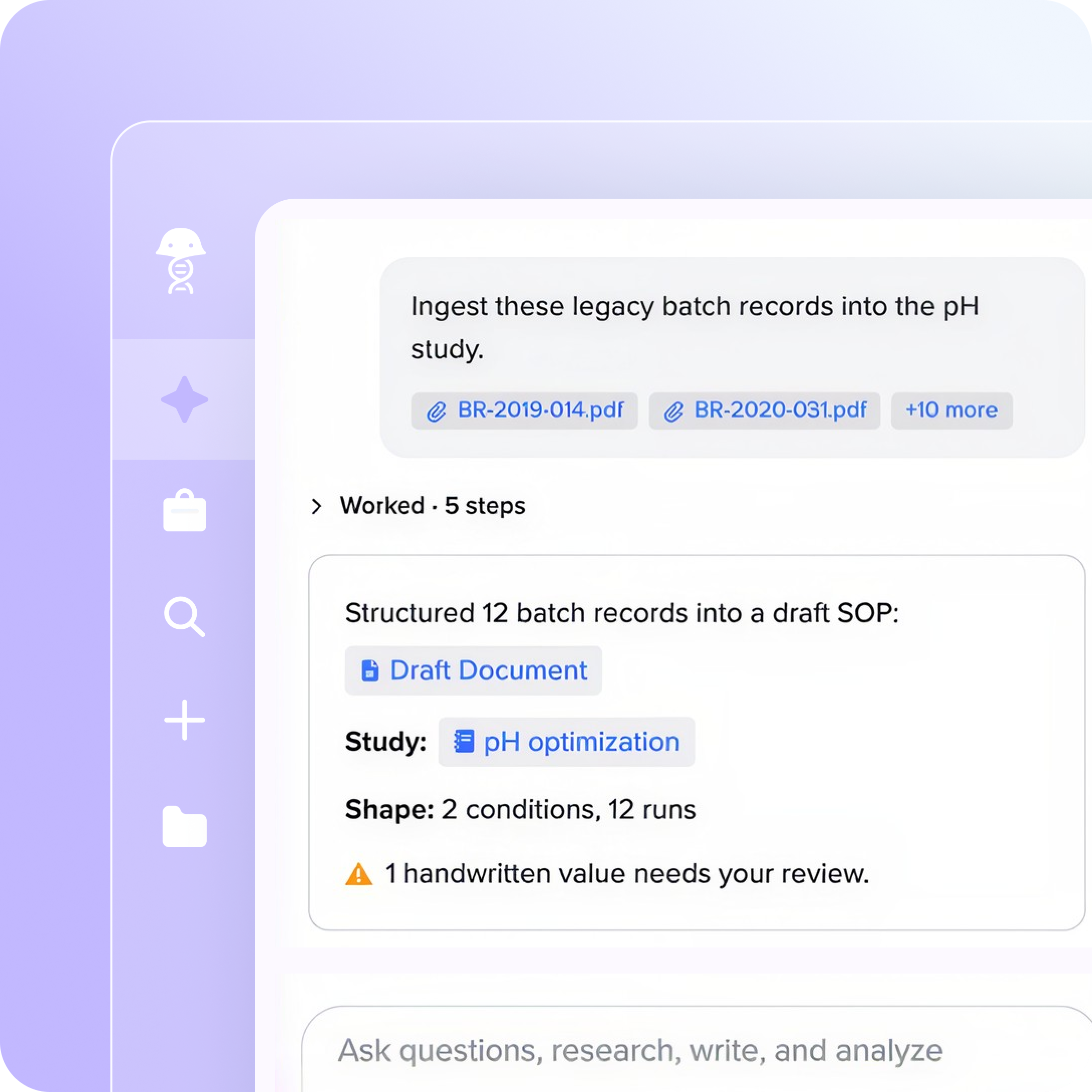
Ingest and structure historical and external data to build context for future programs with Decision Support
Query all study data in natural language alongside scientific context to make faster, better decisions
Draft optimized DOEs from past runs, ready for one-click team review and approval
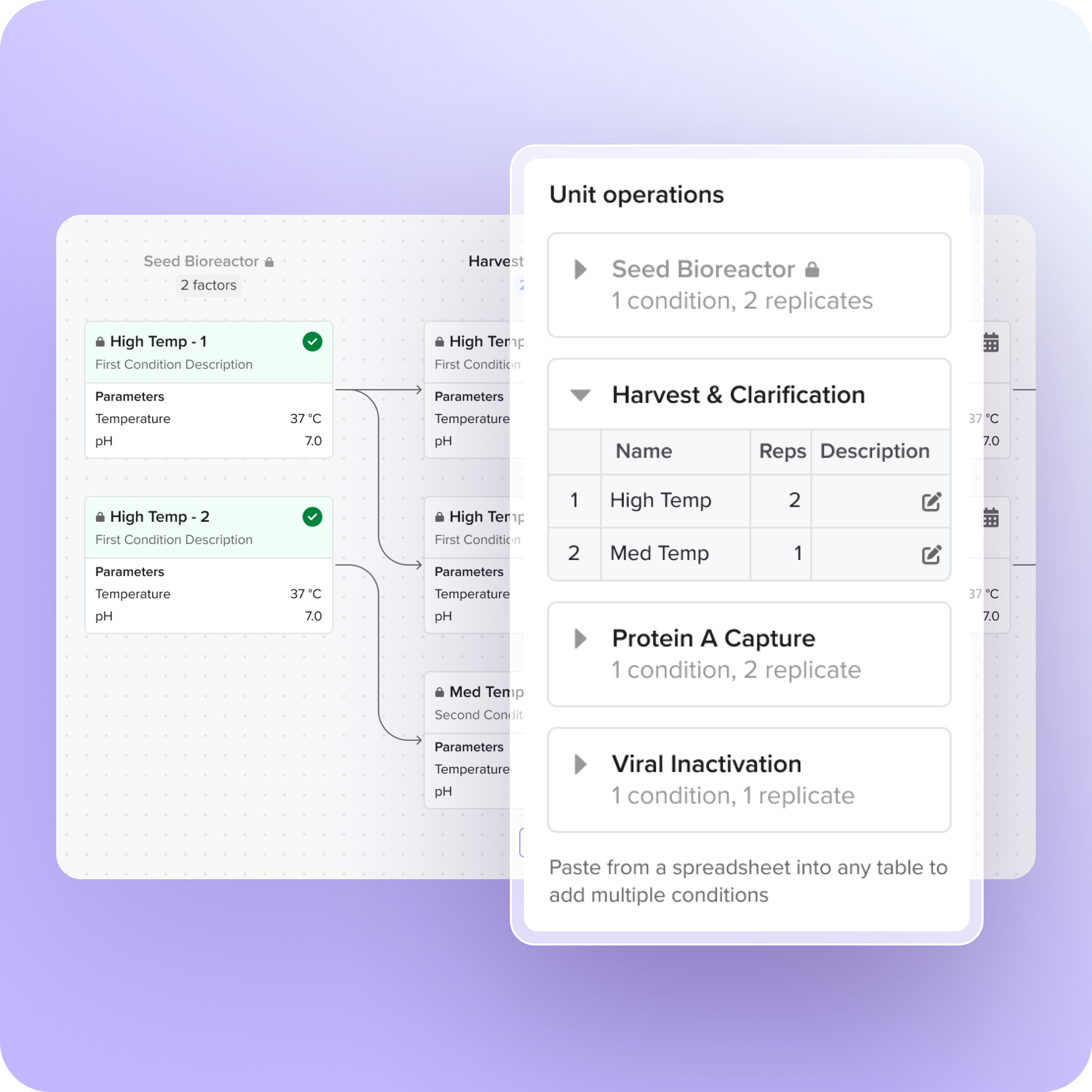
Drag-and-drop unit operations into a recipe to review the full experiment plan across all conditions, process parameters, and replicates
Split and pool material dynamically during live runs to adapt to mid-experiment changes
Draft structured scientific reports from study data automatically with a Benchling Agent
Collaborate across teams and programs with full context from experimental, process, and analytical data
Analyze refreshable time-series charts that update automatically from a complete, AI-ready dataset
Connect data science tools, data lakes, and AI/ML pipelines through APIs and connectors
Consolidate your R&D tech stack with a configurable platform that works across the entire product lifecycle
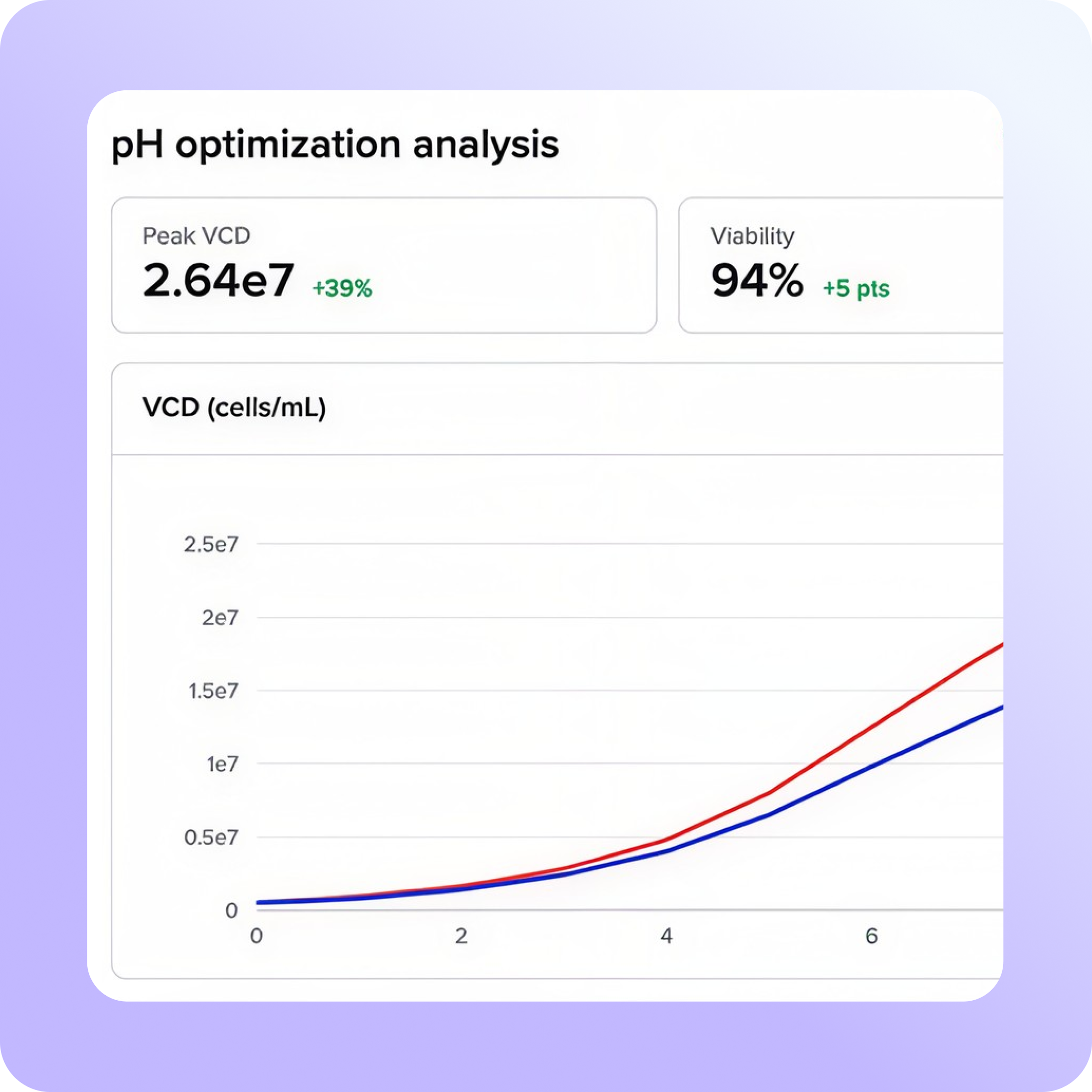

Build teams of agents guided by scientists that identify critical process parameters, uncover opportunities for optimization, and recommend the next DOE to accelerate development.
Use an intuitive drag-and-drop interface to sequence unit operations and configure process parameters in an ISA88-compatible model.
Design experiments by defining factors across process parameters to systematically explore conditions and optimize performance.
Move recipe designs into guided execution with instructions dynamically populated from the recipe definition and experiment plan for each run.
Visualize process data with full experimental context and traceability. Push structured data into third-party tools, data lakes, and AI/ML pipelines via APIs.
Natively connect, manage, and analyze high-throughput instrument and R&D data across your organization using Benchling Automation.
Built on the same platform as Benchling Research with shared data model, user provisioning, and data access. Consolidate your entire R&D tech stack in one place.

We’re committed to discovering, developing and delivering medicines for life-threatening diseases. By capturing structured data, Benchling empowers our scientists to ask challenging questions and uncover new insights.
Executive Dir., Pharmaceutical Dev & Manufacturing IS, Gilead
Benchling Development is built for process development (PD) scientists and engineers who need to design, execute, and analyze upstream and downstream bioprocesses. It supports the entire PD lifecycle from recipe design through tech transfer. Download the Development product brief for a full overview.
Benchling Research packages are designed for modality specific discovery-stage research with flexible, unstructured workflows. Development is purpose-built for process development with highly structured, ISA-88/ASM-compatible data models that support multi-factor experiments, guided batch execution, and data science readiness. Both products are built on the same platform and share a unified data model, making them fully compatible.
A Recipe is a visual, reusable process template that defines the sequence of unit operations, material inputs and outputs, process parameters, and equipment used at each stage. Recipes form the scientific blueprint for a bioprocess and power all downstream experiment planning, execution, and analysis. Read the full Development how-to guide in the help center.
Yes. Within a Study, you can define multiple Conditions (variations in process parameters) and Replicates. Benchling generates structured batch execution instructions dynamically so teams can run experiments in parallel. Experiment Optimization, part of Benchling AI, goes further by using ML and Bayesian methods to recommend the best next experimental conditions based on your existing results, helping PD teams iterate smarter and faster.
Development captures structured, traceable process data using the ISA-88 standard, making it easier to hand off documented process parameters to CMOs or internal teams. The structured data model reduces ambiguity and manual reformatting during tech transfer. Benchling AI can also help compile tech transfer summaries by pulling together key process parameters, deviations, and results from across your Benchling data in minutes.
Yes. Benchling Development includes out-of-the-box connectors to tools like JMP and Pluto, and you can feed data into data lakes and AI/ML pipelines via APIs. The unified data model maintains links between process and analytical data to eliminate silos. Benchling Insights and Experiment Optimization provide additional in-platform analytics without needing to export.
Yes. Benchling Automation can be used alongside Development to pull data from liquid handlers, bioreactors, plate readers, and other instruments directly into structured worksheets, eliminating manual transcription errors. Benchling AI can also convert unstructured instrument outputs, CRO reports, and legacy data files into clean, structured Benchling records.
Yes. Development is designed to support high-throughput process development including cell line development, fermentation, and upstream and downstream processing. Teams can track all parameters, conditions, and outcomes in a structured, searchable format.
Biopharmaceutical process development is the discipline of designing, optimizing, and scaling the manufacturing processes used to produce biological medicines, from early cell culture conditions through upstream and downstream processing. It sits between discovery research and commercial manufacturing, and the decisions made during process development directly affect product quality, yield, and the speed of tech transfer. Benchling Development is purpose-built for this stage, giving development teams a structured, data-rich environment to design experiments, capture results, and iterate faster.
Mammalian cell culture, including CHO-based antibody production and other biologics, requires careful tracking of culture conditions, feeding strategies, and analytical results across many experimental runs. Benchling Development lets teams design reusable Recipes that capture these parameters in a structured, ISA-88-compatible format, run parallel conditions within a Study, and automatically create visualizations and analysis. Experiment Optimization in Benchling AI can then recommend the next best culture conditions based on prior run data, closing the loop between data capture and experimental design.
CMC documentation, covering drug substance characterization, manufacturing process descriptions, and analytical methods, is one of the most documentation-intensive parts of biopharmaceutical development. Benchling helps by keeping all process parameters, experimental results, and protocol versions in one structured, audit-ready system, so teams are not reconstructing data from spreadsheets when it is time to prepare regulatory submissions. Benchling AI can further accelerate CMC package preparation by pulling together key process parameters, deviations, and analytical results across your Benchling data in minutes.
Yes. Benchling Development is designed to handle the structured, parameter-rich workflows involved in cell and gene therapy process development, including viral vector manufacturing steps, cell culture conditions, and downstream processing. Because it shares a unified data model with Benchling Research packages, upstream molecular biology and cell line development data flows seamlessly into process development workflows, eliminating manual handoffs between teams.