Behind the model: How Inductive’s Ben Birnbaum built ADMET models chemists trust
With Benchling’s head of scientific AI, Mihir Trivedi, and Inductive’s cofounder, Ben Birnbaum
Developing a promising small molecule is a balancing act. Improve one property and another can get worse: boost potency, and you may hurt clearance; improve clearance, and solubility can suffer. Inductive estimates that navigating these tradeoffs accounts for roughly half the time and cost of small molecule preclinical discovery.
Inductive builds AI models to help chemists make those decisions earlier and with more confidence. Founders Josh Haimson and Ben Birnbaum came to the problem after building the machine learning team at Flatiron Health, which Roche acquired in 2018. In conversations with medicinal chemists, they kept hearing the same frustration, that compound optimization felt like a game of whack-a-mole. Inductive came out of stealth in late 2023, and its ADMET models have since won the OpenADMET blind prediction challenge three times in a row.
With Inductive’s models now available in Benchling AI, Benchling’s Head of scientific AI, Mihir Trivedi, sat down with Ben to talk about the history of computational chemistry versus the newer wave of biologics modeling, how Inductive's pre-competitive data consortium works, and how agentic AI is changing what the company builds.
Mihir Trivedi: You and Josh built the ML org at Flatiron before it was acquired by Roche in 2018. What did that experience teach you about what makes ML actually useful inside a drug company?
Ben Birnbaum: One important lesson early on was about communication. I needed to speak about ML in a way that balanced my excitement for the tech with humility and respect for the creativity and expertise of our customers.
For context, Josh and I founded the ML Team at Flatiron to build tools to improve the curation of the clinical data Flatiron had access to. There was a lot of well-justified concern from our customers about whether using ML as part of the data curation process would introduce too much bias. To build comfort, we developed messaging that was upfront about the risk of bias, that explained how we measured and mitigated it, and that was careful to present a balanced perspective on what ML could and couldn’t do. This resonated a lot with our customers, and I don’t think we could’ve introduced ML at that time without this approach.
This experience prepared us well for Inductive, where we saw much of the same skepticism from chemists about how much ML could actually be helpful in drug discovery. This skepticism was well-placed. At the time there were a lot of groups making overblown claims about what ML could do for drug discovery that were not backed up by real impact. So Josh and I again made sure to talk about ML in a way that balanced how excited we were about it with humility and respect for the vast amounts of training and expertise that our customers had. I believe this is a big part of what led to some of the early success we had in getting enough buy-in from medicinal chemists for them to trial our models and see their impact for themselves.
Mihir: Many of us can relate to your idea of compound optimization as "whack-a-mole" — fix potency, break clearance, fix clearance, break solubility. Why has it been hard to solve this multi-parameter optimization? What do you think Inductive can do differently?
Ben: Compound optimization is fundamentally hard. You are trying to balance a dozen or more properties of small molecules that are hard to predict and often at odds with each other. For example, because small molecules often bind in hydrophobic pockets, increasing potency can require adding lipophilicity to a molecule. But that is also a surefire way to decrease solubility and increase metabolic clearance, reducing how much of your molecule makes it to the target in the first place.
At Inductive, our approach to multi-parameter optimization is to focus on predicted human dose as early as possible in the discovery process. Minimizing dose is the main objective of a lead optimization program, and we’ve shown that when you combine high-quality ADMET models with thoughtful mechanistic modeling, you can get enough of a picture of the relative dose between two compounds that you can make smarter decisions about how to trade off different properties. This is why our latest model, Beacon-2, is a single system that predicts human dose end-to-end.
Mihir: Small molecule discovery has decades of QSAR and physics-based modeling behind it; biologics modeling is comparatively new. Does that history help or hurt when you're trying to convince a medicinal chemist to trust a new ADMET model?
Ben: I think it can go either way, depending on how you approach it.
On the one hand, it’s helpful that it’s not a new idea to use in silico predictions about a molecule to guide decision-making. On the other hand, many of the early QSAR modeling approaches suffered from one of two problems: they were either models trained on global datasets that didn’t generalize well to chemical series outside of the training domain, or they were local-only models that didn’t become helpful until late in the program. As a result, many chemists have seen limited utility from ADMET modeling in the past, making it less likely for them to trust new models.
The good news is that our fine-tuned global models perform better than either of the global-only or local-only approaches (as we’ve published on with one of our early customers), and we provide customers with the ability to try our models on their programs before joining the consortium.
Mihir: Your Polaris/ASAP competition analysis found that adding external ADMET data meaningfully improved performance, while massive non-ADMET pretraining had a more mixed payoff so far. Does that validate the consortium thesis specifically, or say something broader about where chemistry ML still needs to mature?
Ben: Both. The fact that eight of the top ten entrants made use of additional ADMET data in that competition speaks to the additional generalization ability provided by including global ADMET datasets, and our consortium is a large, diverse, and rapidly growing dataset of high-quality ADMET data that is representative of modern small molecule discovery. But ADMET data is always going to be more expensive than the vast majority of data used in LLMs (i.e. text and images on the internet), so it would be a big unlock for the field if we could show scaling laws on a much cheaper pre-training dataset such as quantum calculations. But despite some preliminary suggestive results from academia, we haven’t really seen that play out in real drug programs yet.
Mihir: Walk us through how the consortium works. What does a partner contribute, what do they get back, where are the IP lines drawn?
Ben: When customers join our consortium, they give us a license to use their ADMET data to train the global models that are then fine-tuned to our customers’ datasets. They still own the underlying IP, and we ensure their data remains secure. In exchange, our customers get access to models trained on a dataset that is orders of magnitude bigger and more diverse than what they’d have access to otherwise.
Ultimately, this mechanism is what has allowed us to build the models that won three consecutive OpenADMET competitions against more than 750 competitors, including frontier labs and large pharmaceutical companies.
Mihir: Your dose projection work puts a number, and a confidence range, on how a compound will behave in patients. How do you see your customers quantify the benefit of trusting an in silico result over running the assay? How far off can predictions be before chemists don’t trust them anymore? How do you regain their trust?
Ben: Trust is earned through transparency. We provide chemists with the tools that they need to assess model performance themselves and decide to what extent they are comfortable relying on them.
As one concrete example, we provide dashboards that show the prospective performance of our predictions by showing, for each compound that was made, what our models predicted at that time. That way, chemists can view how well each model actually performed, stratified by program and series, and use that to guide how they use the models for decision making.
Mihir: Has agentic use changed what you build first — are you now designing for a model that calls other models and assembles an analysis, rather than for a chemist typing one question at a time?
Ben: Yes, like everyone these days, we need to think about how every tool we build will be used both by humans and by agents, whether that’s our own medicinal chemistry agent Indy or external agents like Claude or ChatGPT, which we recently integrated with. Concretely, that means building a lot of MCP wrappers and skills around our models and design tools.
Mihir: What's a claim in the world of AI and drug discovery you think is wrong, or at least premature?
Ben: I doubt that we will cure most human diseases in 5-10 years. Biology is complicated, and even if the technology was there, it’s hard to see how that would work from a regulatory perspective. That being said, the pace of AI is truly remarkable and I’d love to be wrong. I also deeply respect the ambition. There’s a lot to be said for the cliche “shoot for the moon, land among the stars.”
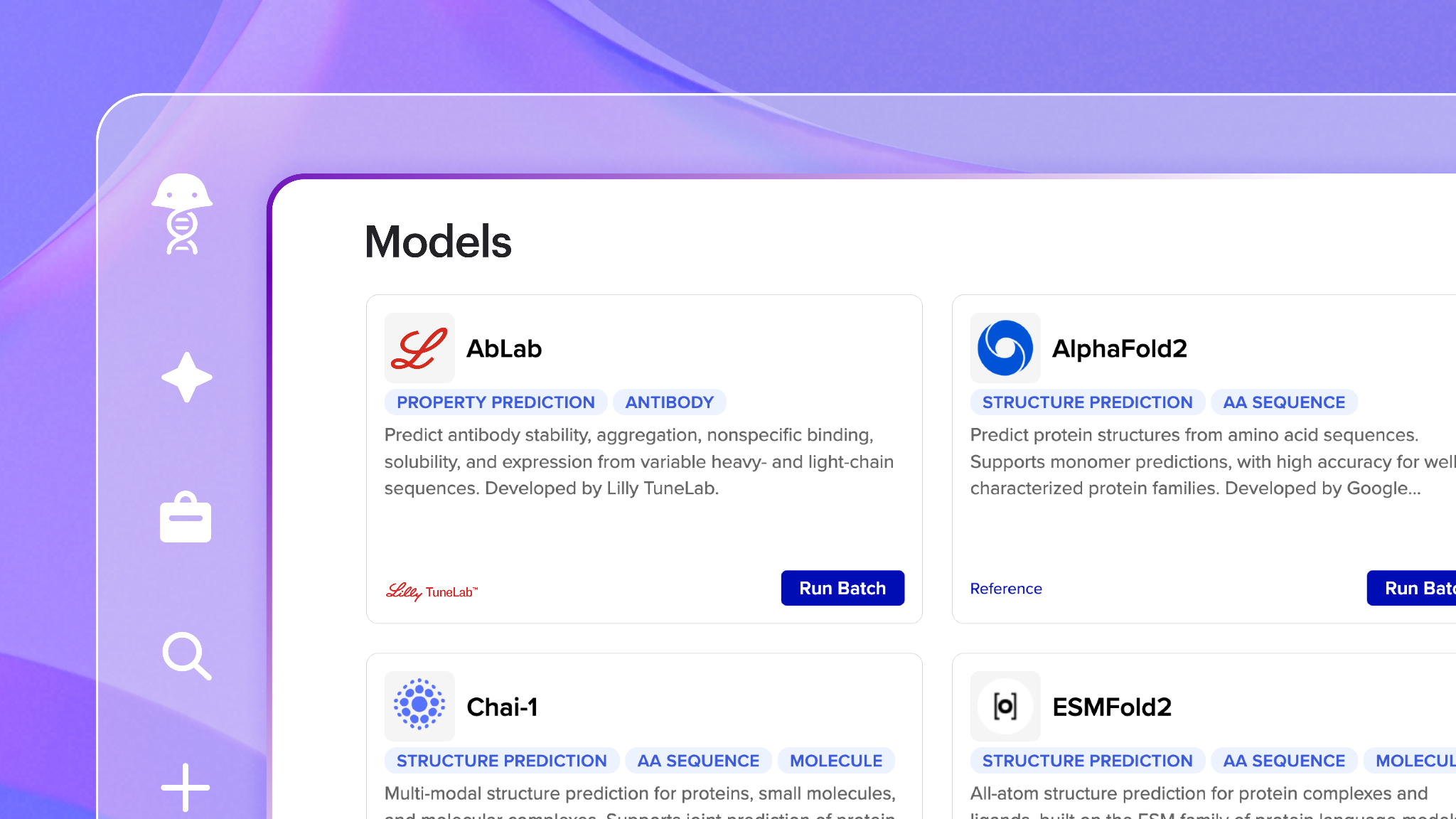
Bringing models like Inductive’s into Benchling connects computational predictions with the structured molecules, reactions, and experimental data scientists use to make decisions. Together with Benchling for Chemistry, this creates a more connected design-make-test-learn cycle, where predictions can help inform what scientists synthesize and experimental results can inform what they design next.
Use Inductive’s small molecule models today in Benchling’s Model Hub. Visit Benchling AI to learn more and use scientific models in your Benchling environment.