A blueprint for specialized intelligence
Frontier LLMs have learned from the world's published scientific knowledge. They haven't yet learned from the decades of experiments inside biopharma companies. We’re sharing our first research effort showing how every company can use that knowledge to surpass the frontier.
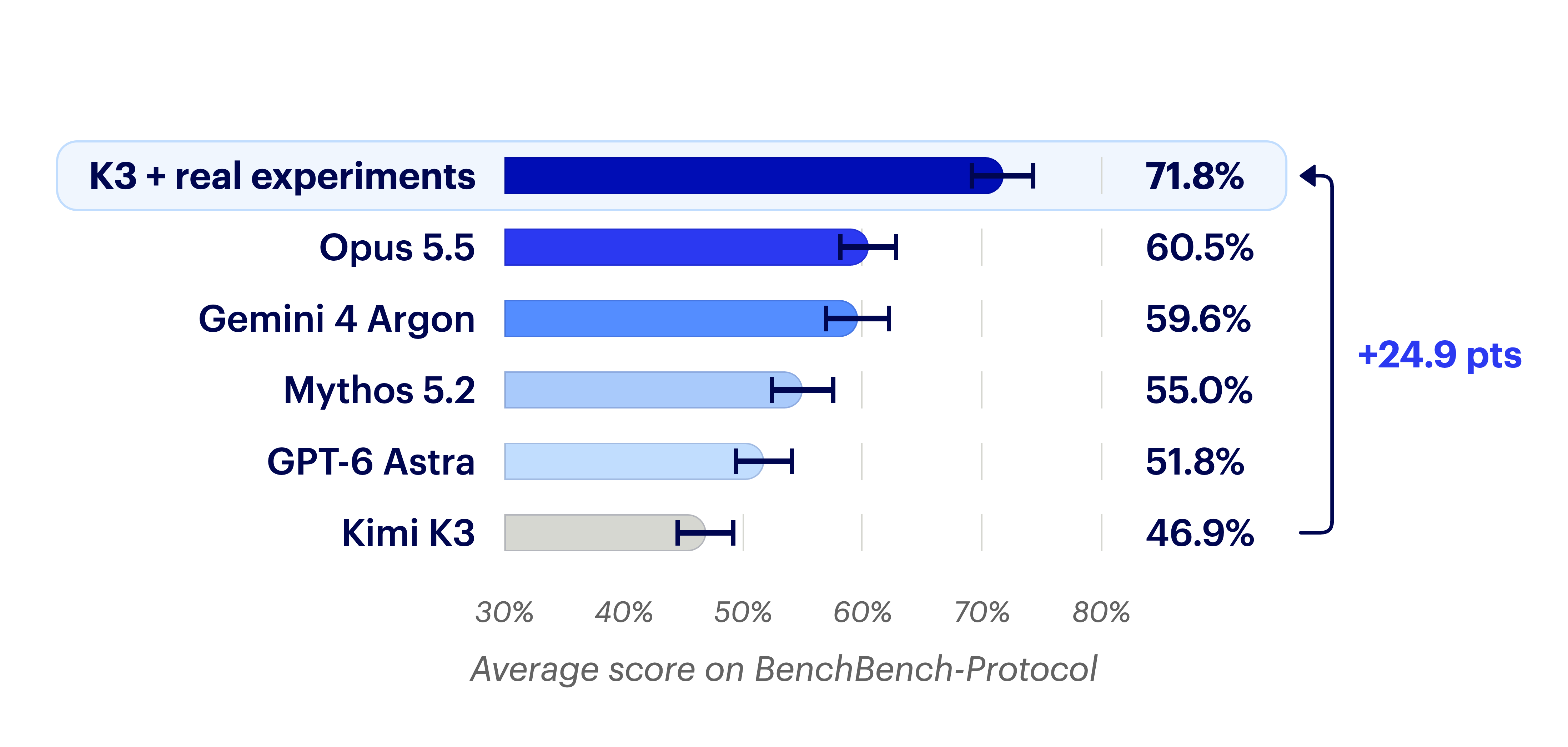
Working with Applied Compute and NVIDIA, we post-trained Kimi K3 on troubleshooting and optimization tasks from real experiments contributed by experts. The resulting model scored 71.8% on BenchBench-Protocol, our wet lab troubleshooting benchmark. It achieved state-of-the-art on this task: 11 points above the strongest frontier model and 25 points above the base K3 model.
We believe biopharma companies will increasingly complement off-the-shelf frontier AI with specialized models they train on their own scientific knowledge. Our research shows a blueprint for doing so, and highlights a critical challenge: turning real scientific work into high-quality training data.
Step 1: Identify decisions where proprietary data creates an advantage
Many tech companies are post-training models primarily to reduce costs. This shows up in areas like legal and sales, training small models to efficiently perform repetitive tasks. We believe the bigger opportunity for biopharma companies is not cost but performance. Their goal should be to surpass the frontier on scientific decisions that general-purpose models struggle with.
This opportunity exists because biopharma companies have so much unique data. A model can't learn to reason through the hardest drug development decisions from the public web alone. It needs to learn from real programs: what scientists tried, what worked, what failed, and why.
We chose protocol troubleshooting and optimization because scientists make these decisions every day, yet much of the relevant knowledge is absent from public data. Published protocols describe what ultimately worked, not the messy experimentation required to get there.
We're seeing companies pursue similar opportunities across R&D. They’re post-training models for assay design, experiment selection, candidate prioritization, and more. The challenge is turning thousands of past decisions into something a model can learn from.
Step 2: Turn scientific decisions into training tasks
Reinforcement learning has made LLMs dramatically better at coding. Give a model thousands of problems, a way to evaluate its answers, and it can learn better ways to reason.
The same opportunity exists in science, but building good training tasks is much harder. It's relatively straightforward to check whether code runs correctly. Evaluating whether a scientific decision reflects sound reasoning is far more difficult.
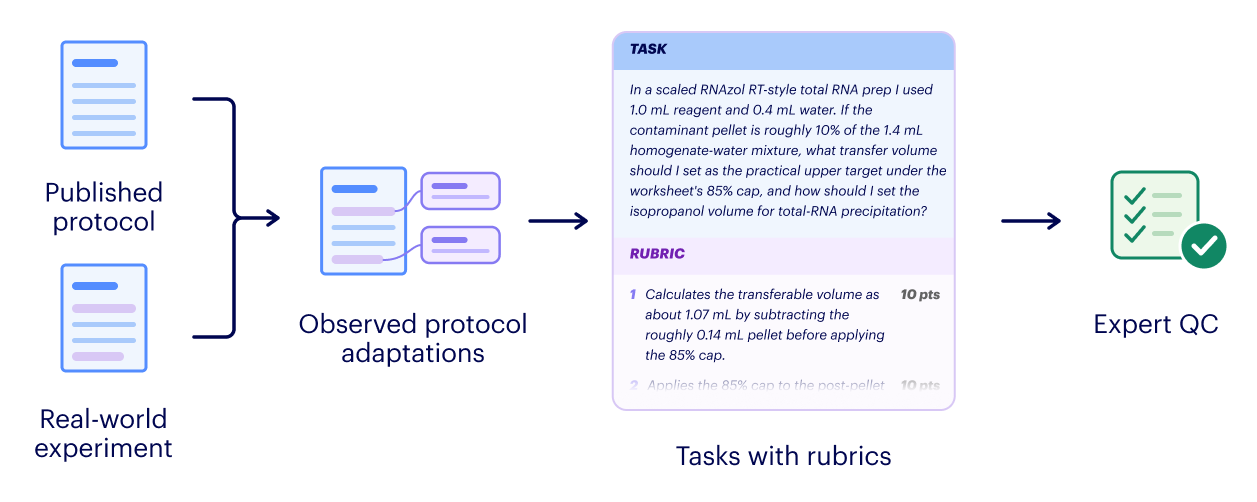
For this research, we started with real experiments contributed by scientific experts. We engineered tasks that captured the decisions scientists faced, then worked with those experts to develop rubrics that distinguish idiosyncratic choices from sound scientific reasoning. The result was 2,000 tasks capturing the tacit knowledge of wet lab work.
Creating high-quality training tasks is the biggest bottleneck to specialized intelligence today. This is particularly true for biopharma, where much of the industry’s historical knowledge is trapped in unstructured lab notebooks, study reports, and governance presentations.
Recent advances in AI have made it possible to extract data from these sources at unprecedented scale. Our Decision Support release last week demonstrates this: agents can turn unstructured archives into structured experimental data, linking historical decisions to the evidence behind them along the way. That creates the ideal substrate for building tasks that can be used to benchmark and train specialized models.
Step 3: Train models to surpass the frontier
Training your own LLM used to be prohibitively expensive and complex, but it’s become more attainable than ever. Recent open-weights models are much stronger starting points, with models like Kimi K3 getting closer to frontier performance on scientific tasks. Post-training infrastructure is also improving rapidly, making it possible to partner with experts rather than build the entire stack in-house.
We took that approach with Applied Compute and NVIDIA. Benchling brought the scientific data and domain knowledge of scientific tasks. Applied Compute and NVIDIA brought the infrastructure and training expertise. In just two weeks, we achieved a new state of the art on our benchmark: our post-trained Kimi K3 achieved 71.8% on BenchBench-Protocol, compared to 60.5% for the strongest frontier model (Opus 5.5) and 46.9% for the base Kimi K3 model.
We also wanted to see how far we could push a smaller, efficient model. We worked with Applied Compute to fine-tune NVIDIA’s Nemotron 3.5 Super VL. It scored 41.4% on BenchBench-Protocol, compared to 39.9% for the strongest smaller model (GPT-6 Luna) and 38% for the base Nemotron model.
In our initial tests, Benchling’s post-trained Nemotron model answered about four times faster than K3 and with roughly 50 times lower inference costs. We plan to continue improving its scientific performance.
We've shown that specialized models can surpass the frontier starting with one category of scientific work. Now we want to help biopharma companies achieve similar gains across other decisions using their own data.
Helping biopharma build specialized intelligence
We're introducing Specialized Intelligence to help companies develop models on their own scientific data. Our forward-deployed teams help identify high-value decisions, organize historical data, and build benchmarks to determine where existing models fall short. Together with training partners, we then post-train and evaluate specialized models.
This opportunity extends to scientific models, not just LLMs. Companies can bring decades of historical in vitro and in vivo studies. We can apply our agents to structure the data, fine-tune predictive models, and set up retraining loops as new results arrive.
A company's experimental history can become intelligence that compounds with every new result. If you're interested in building specialized models with us, reach out here.