Introducing Decision Support: Make every experiment count
R&D is a series of high-stakes decisions made with incomplete information. Which target to pursue, which molecule to advance, whether to keep going or stop. It takes years to find the answer, and the odds of success are low.
You can’t eliminate that uncertainty without running every possible experiment. But too often, decisions are made without drawing on experiments that have already been run. Thousands of historical experiments remain locked away in unstructured documents.
Today we’re introducing Benchling Decision Support. Drop in CRO study reports, legacy ELN entries, development reports, batch records, and more. Benchling AI turns them into structured data linked to molecules and conditions, so scientists can analyze results across experiments and build predictive models.
We've spent more than a decade modeling scientific data and experimental context. Recent advances in AI have made it possible to accurately structure scientific data at a scale that wasn't practical before. Decision Support brings all of that together. Thousands of agents can work in parallel, turning months or years of manual effort into days.
Regeneron turns nearly 1,000 historical reports into process insights
Regeneron’s process development team had nearly 1,000 historical reports documenting years of work developing and optimizing manufacturing processes. Hanne Bak, Senior Vice President, Product, Analytical and Process Development (PAPD), calls them “a repository of institutional scientific learning,” but the knowledge was painstaking to query from unstructured documents. In just a few weeks, Decision Support converted this into accurate, structured data, allowing scientists to compare performance across programs and investigate how process changes affect product quality.
We leveraged Benchling AI to ingest nearly 1,000 historical reports and saw 100% accuracy in natural language queries across the body of data, outperforming several approaches we had tried previously.
— Hanne Bak, SVP PAPD, Regeneron
Zymeworks unifies 23,000 experiments into a complete view of each molecule
Zymeworks develops multifunctional therapeutics for difficult-to-treat diseases. They had set up Benchling to capture structured data from new experiments, but over 23,000 legacy ELN entries remained difficult to access. Decision Support made these experiments queryable, including structured sample records that were linked across experiments. Scientists can now trace a molecule across historical synthesis, characterization, and efficacy experiments, alongside their ongoing research.
We had over 23,000 legacy IDBS experiments, all effectively locked in flat PDFs that we couldn’t query. Once the skills were configured, Benchling AI structured them in about three weeks, and our scientists can now search them alongside the rest of their work, with samples linked to our existing inventory, immediately saving us dozens of hours a week. It gives us confidence that our future experiments are building on data we can easily find.
— Jeff Wellhausen, Associate Director, R&D IT Business Partner, Zymeworks
How it works
Using historical data to inform decisions is still highly manual today. Scientists spend weeks searching through files and piecing together results into the right evidence. Some companies embark on structuring their historical data, but it often requires large teams of contractors and still misses important scientific context.
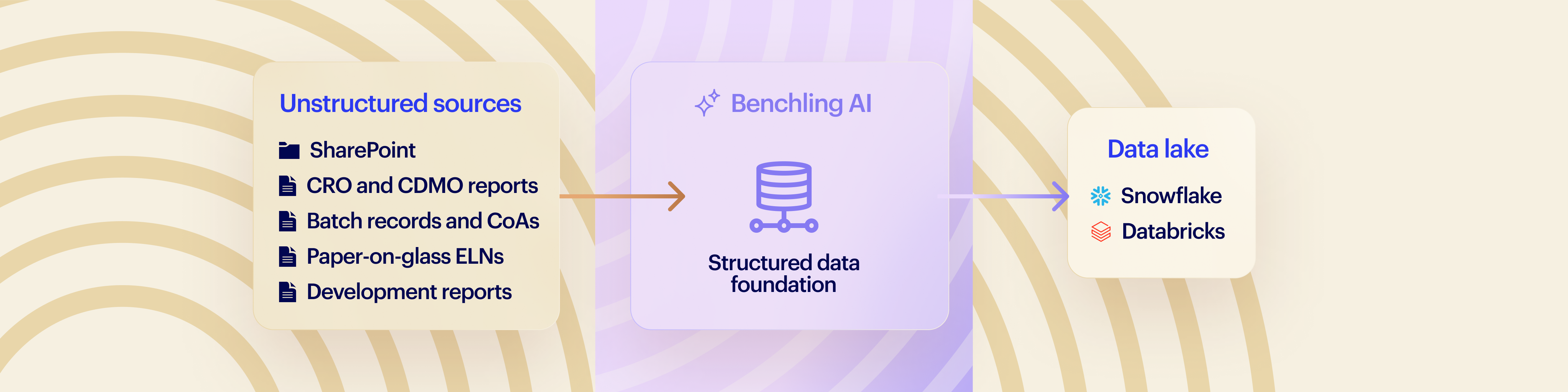
With Decision Support, teams can import thousands of historical documents, presentations, and data files. Benchling AI extracts results into the scientific data model they already use, automatically linking them to the right molecules, cell lines, and batches. Scientists can ask questions in Benchling ranging from simple lookups to complex analyses across studies. The data can also be sent to Snowflake and Databricks through Direct Data Share without custom ETL pipelines.
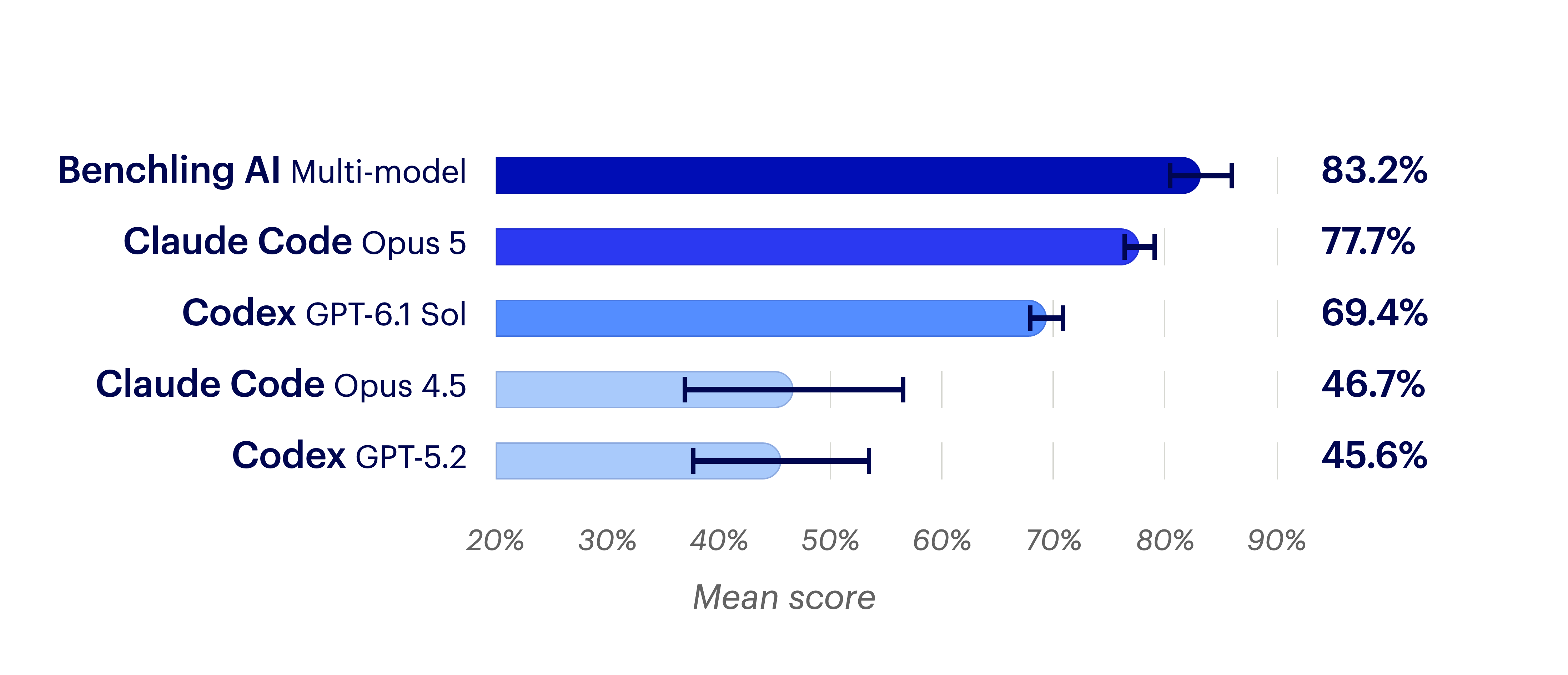
Accuracy of this process is critical. To test it, we built a benchmark using real scientific documents, from in vivo reports to batch records. AI agents have improved dramatically at this task over the last year. The latest models achieve over 80% accuracy, compared to just 50% for older models. The opportunity to make decades of historical research usable is very recent.
Get started
Anyone can drop a few files into Benchling AI to try it out. For large historical archives, our forward-deployed engineers can help plan and execute data transformations at scale. Get in touch with our team to get started.