Building agentic lab-in-the-loop for R&D with NVIDIA
Biotech companies are increasingly coming to us with an ambitious goal: building lab-in-the-loop systems where scientists and agents work together to design experiments, execute them, analyze results, and retrain models at scale. Making this a reality requires connecting two worlds that are often siloed: dry lab computation and wet lab experimentation. Biotech companies already have a wealth of proprietary data and scientific knowledge. Building specialized AI around that expertise can help ground lab-in-the-loop systems in how each organization does science, guiding decisions throughout the experimental cycle.
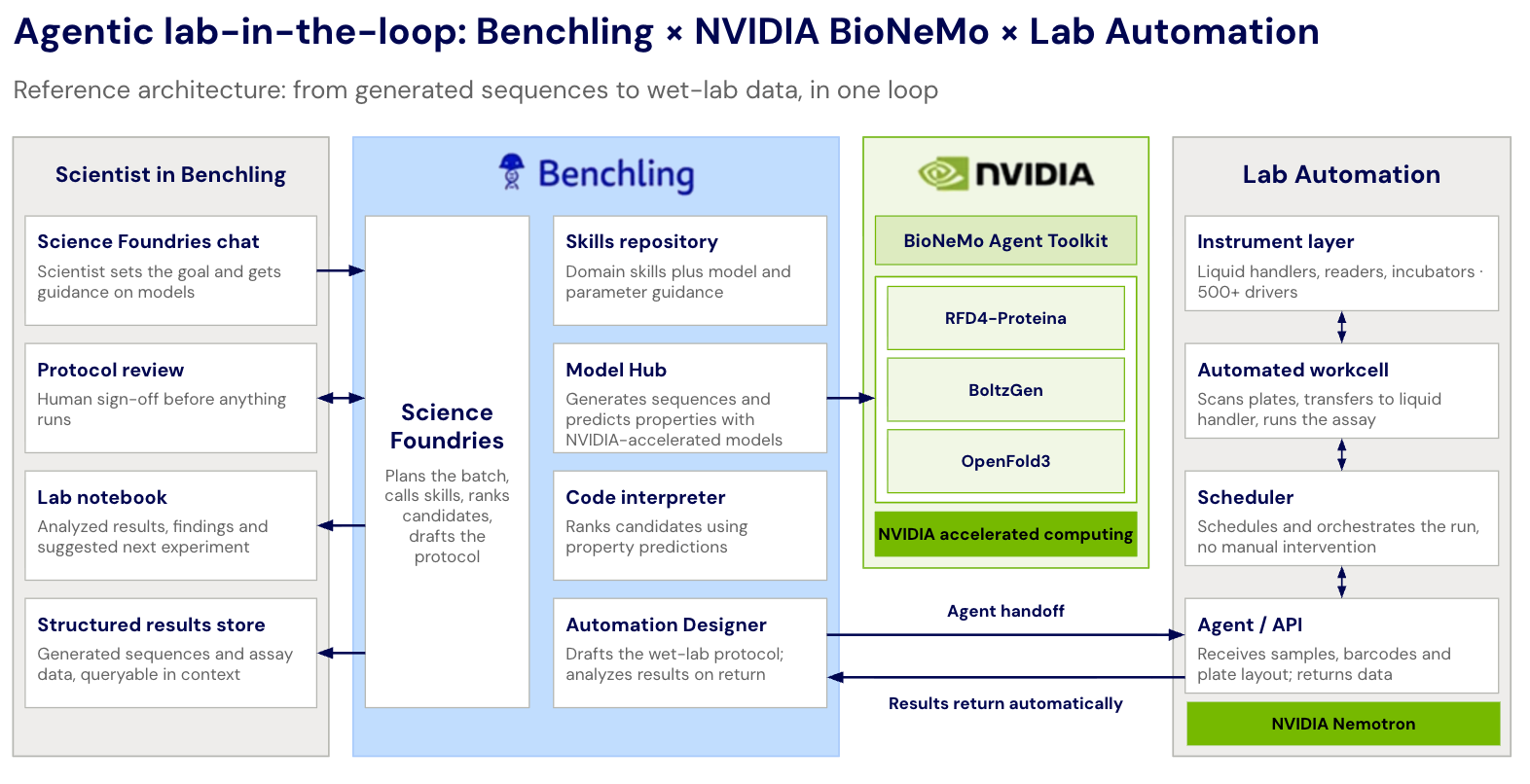
Our collaboration with NVIDIA focuses on building the infrastructure for agentic lab-in-the-loop. Benchling provides a foundation for scientific data and Science Foundries for scientists and agents to work together. NVIDIA provides accelerated computing, agent toolkits, and an expanding portfolio of open models.
Today, we're announcing two developments that bring us closer to this vision by expanding the tools for scientific design and specializing the reasoning that helps guide experimental decisions:
RFD4-Proteina: We’re bringing RFD4-Proteina to scientists and their agents through Benchling Model Hub. Developed jointly by NVIDIA and the UW Medicine Institute for Protein Design, this new NVIDIA BioNeMo™ open model combines programmable protein design with search capabilities.
Nemotron 3.5 Super VL: We’re post-training NVIDIA’s latest open model (LLM) in the Nemotron™ family, Nemotron 3.5 Super VL, on proprietary scientific data to help biopharma companies build and own specialized intelligence around their expertise.
Protein design for every scientist and their agents with RFD4-Proteina in Benchling
RFD4-Proteina is a new generative model that expands the frontier of protein design to increasingly complex biomolecular problems, helping scientists and agents search and refine candidates using molecular inputs, constraints, and scoring objectives. In testing reported in the research draft, it achieved higher computational design success rates and generation throughput than the evaluated baselines across protein binding, small-molecule binding, enzyme scaffolding, and DNA binding.
We partnered with NVIDIA to support RFD4-Proteina in Benchling’s Model Hub. Model Hub helps scientists run generative and predictive models while connecting molecule, prediction, and assay data across the wet lab and dry lab. Scientists can now call RFD4-Proteina on a new target, run property predictions like Lilly Tunelab to filter them, and register the results. Agents can orchestrate this entire process, making complex computation accessible to every scientist. Within Science Foundries, these models become tools agents can use toward a broader scientific goal, with predictions connected to the experimental record.
Teaching an open model to troubleshoot lab protocols with Nemotron 3.5
Nemotron 3.5 Super VL is a new LLM from NVIDIA combining agentic reasoning, tool use, and multimodal understanding. It’s open-weight, giving organizations flexibility and control to deploy anywhere and the ability to customize to their specific needs. It’s optimized for speed, delivering high throughput and token efficiency.
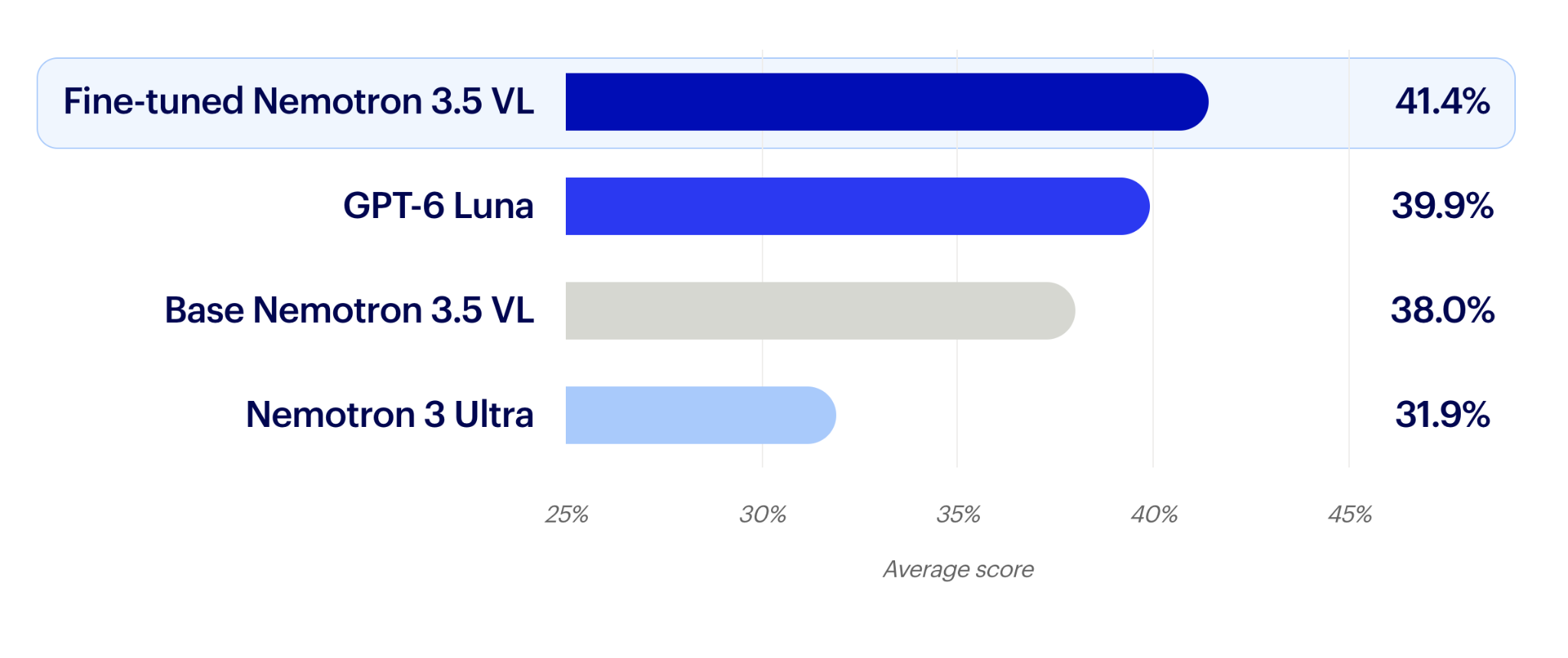
We’re seeing more biopharma companies who want LLMs and scientific models that can help scientists with real-world biology and program decision-making. Much of the knowledge needed for these decisions lives in proprietary protocols, experimental results, and scientific practices that are unavailable in public training data. We partnered with NVIDIA and Applied Compute to test how fine-tuning open models on an organization’s own proprietary scientific data, within its own secure environment, can improve scientific reasoning and close that gap.
We focused on debugging and optimizing protocols, a task where our benchmark shows frontier models have considerable room to improve. We created thousands of training tasks that capture how scientists adapt protocols in the lab. Post-training Nemotron 3.5 Super VL on this dataset improved performance beyond comparable closed models. It was also remarkably cost-efficient.
This work points to a path for life sciences companies to build and own specialized intelligence they can customize and improve over time, using it alongside frontier models and choosing the right model for each task.
Connecting scientific reasoning to experimental execution
The broader opportunity is to connect reasoning models such as Nemotron with specialized design and prediction tools inside Science Foundries—and carry that work into the physical lab. Benchling’s existing integration with HighRes and other lab automation providers connects supported experimental workflows to automated workcells and returns analyzed results to the scientific record. Scientists and agents can use that evidence to guide the next experiment, while structured results can contribute to datasets for future model improvement. This is the lab-in-the-loop our partnership is advancing, with scientists guiding key decisions throughout.
Get started
Ready to start? Here are three ways: