Here’s what we launched at Benchtalk 2026
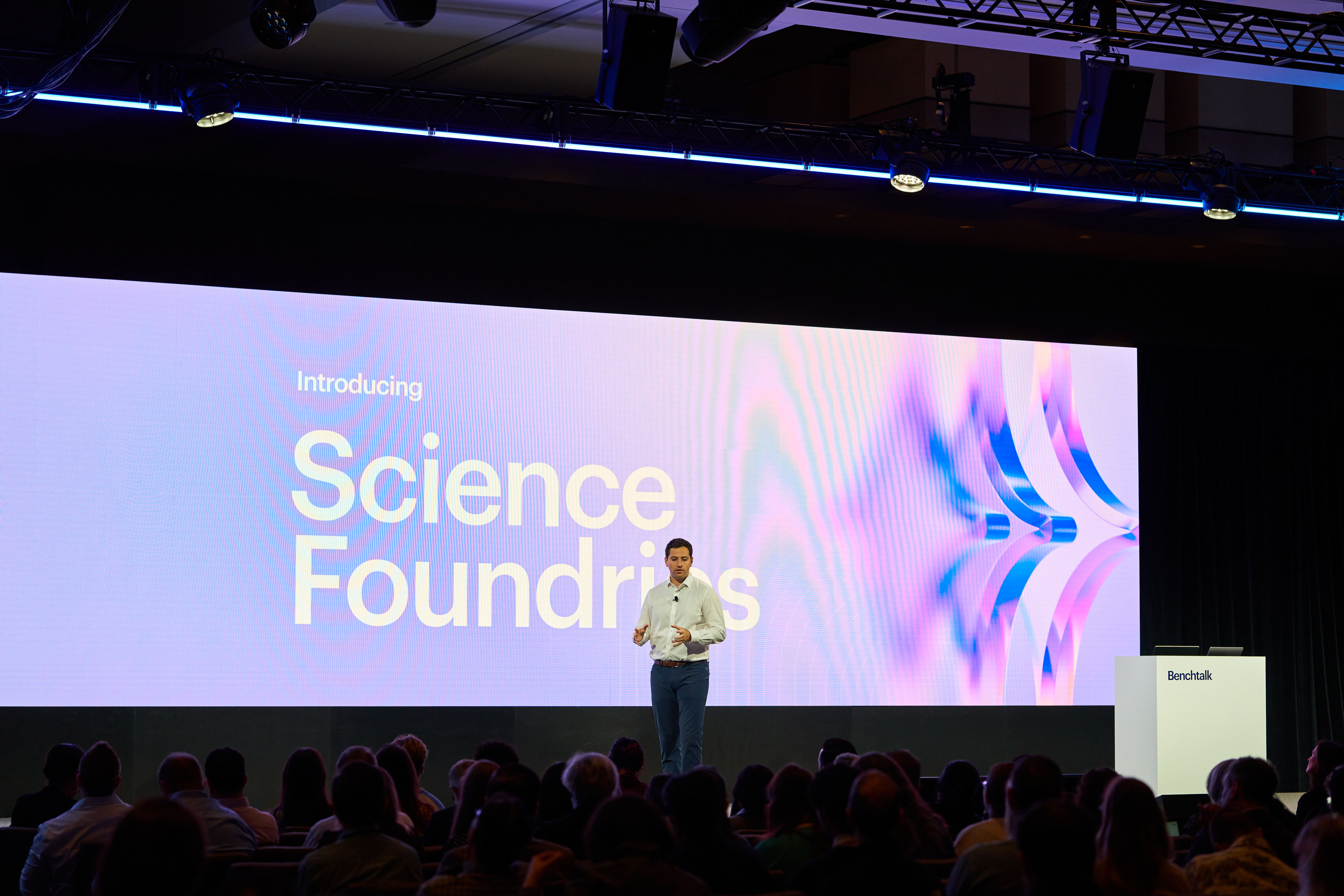
Benchtalk is Benchling’s annual conference, where new products launch, hands-on workshops bring them to life, and scientists and R&D leaders connect with each other.
AI is a once-in-a-generation chance to change how medicines get made, and rebuilding biotech for the AI era means rethinking how R&D works. We’ve spent fourteen years on the groundwork, moving R&D teams from paper notebooks and scattered files into structured, connected systems. A year ago, we showed early AI products. Today, agents and models are redefining what work looks like in the lab.
Here’s a preview of what we announced:
Science Foundries: Build Foundries across R&D where teams of agents work alongside scientists to automate full scientific workflows.
Benchling Model Hub: Access scientific models in the same system as your data, including ADMET prediction, Lilly TuneLab, and Boltz.
Benchling Voice: Speak data into Benchling, ask a protocol question, or get guidance mid-experiment, hands-free.
Benchling Biologics: Now generally available, with new ways to register antibodies and a first look at antibody-drug conjugates and peptides.
Benchling Chemistry: Now generally available, with structured, AI-ready small molecule workflows in the same platform as biology.
Benchling Development: A first look at agent-proposed runs, split and pool capabilities, and analytical testing that stays in one record.
Benchling In Vivo: Agents that flag trends and data-quality problems while a study is running.
Benchling Automation: Build automation templates by chatting with AI, plus new plate-based workflows built for scale.
Developer Platform: The v3 REST API is generally available, plus a look at vibe coding and the new Benchling Directory.
Benchling AI brings a full program team to every scientist
Most AI so far has delivered incremental gains, with agents automating a specific task to make each step faster. However, the larger opportunity lies in redesigning workflows entirely, so scientists, agents, models, and data work as one system that gets better with each cycle.
At Benchtalk, we introduced Science Foundries, our new product where teams of agents work alongside scientists to accelerate processes across R&D. In a recombinant protein foundry, for example, a Benchling Agent drafts the cloning design, another orders from a CRO and calls on Benchling Automation to run the instruments, and an Analysis Agent writes the report, with a scientist signing off at every critical decision.
Science Foundries are now in preview for customers. We’re also building foundries with customers across target validation, screening, method development, and biologics production. Any Benchling customer can build a Science Foundry today, or you can book time with a specialist to learn more. Read the full story on Science Foundries.
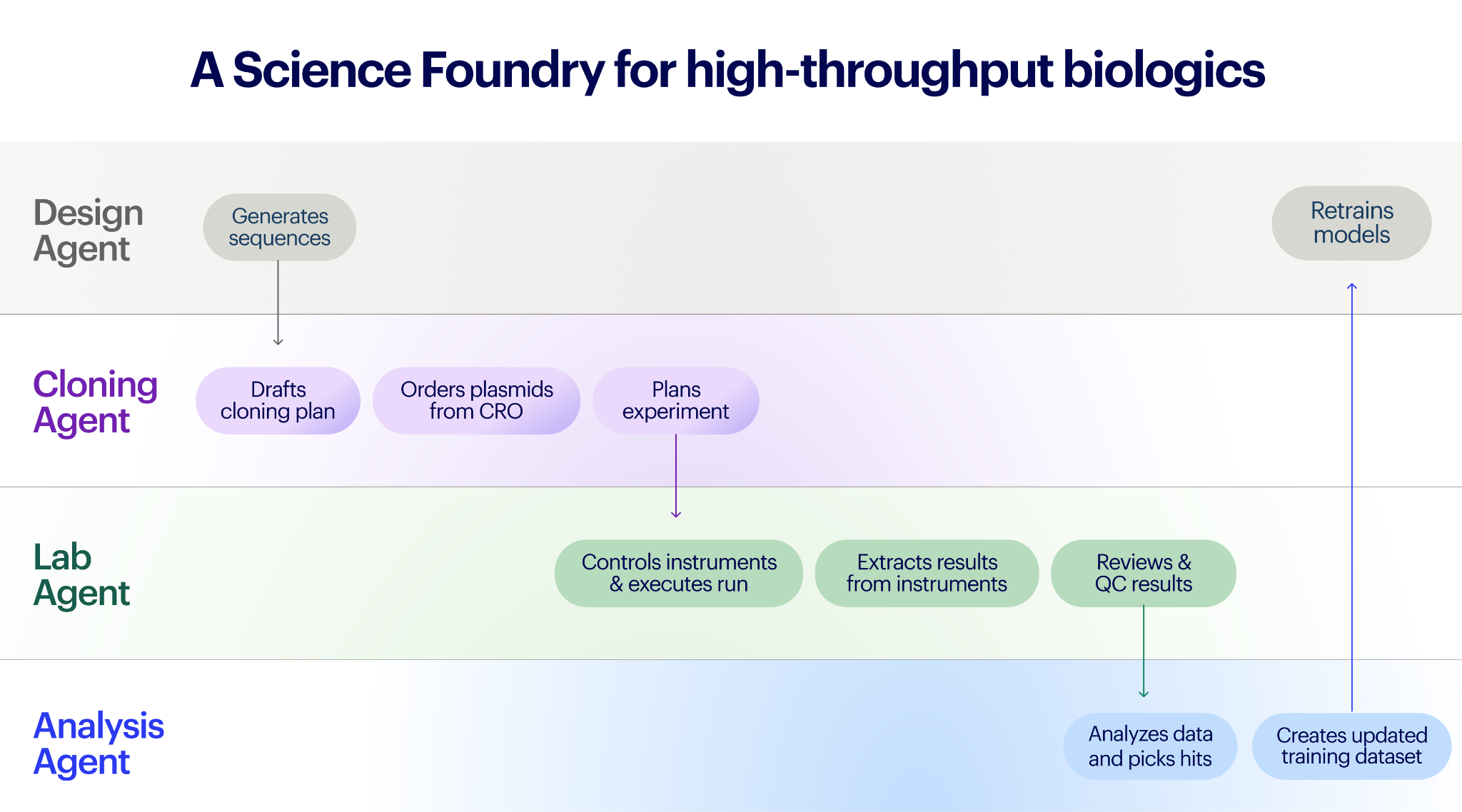
A Science Foundry for recombinant protein production has a team of agents running every step, calling on Benchling Automation to connect to instrument data, with scientists reviewing and approving critical decisions.
None of this works without models to call on, and Model Hub now gives scientists more to work with than ever:
Structure prediction: Models including AlphaFold 2, Chai-1, Boltz-2, OpenFold 2, OpenFold 3, and Protenix are available directly in Model Hub.
Property prediction for chemistry: ADMET models from Inductive Bio help chemists evaluate molecules before they’re synthesized.
Lilly TuneLab: Proprietary developability models trained on decades of Eli Lilly’s R&D.
DeepSP: An open source model for property prediction.
Boltz: Available through a secure API connected to Benchling.
Bring your own model: Support for running your own models in Benchling is coming soon.
Every model in Model Hub can also be called by a Science Foundry as one step in a larger workflow. Learn more about Model Hub.
Furthering our goal of bringing intelligence to the lab, we also introduced Benchling Voice, letting scientists speak structured and unstructured data directly into Benchling, ask a question about a protocol, or get guidance mid-experiment — hands-free, so no one has to wait until an experiment wraps to catch up on notes.
Biologics and Chemistry bring structure to both sides of hybrid modalities
Faster antibody registration in Benchling Biologics
Benchling Biologics is an antibody-aware data model that keeps each molecule structured and AI-ready from the moment it’s registered, in any format a team configures without code. Antibody formats are multiplying faster than legacy tools can model them, and Benchling Biologics tackles that gap at registration. An agent classifies and migrates existing antibody data into those formats, and every sequence links to its experiments and assay results. Wet lab and dry lab teams work from the same record, and agents can interrogate a whole campaign in context.
The same record is where hybrid modalities are headed. Antibody-drug conjugates and peptides sit between biology and chemistry, and Benchling is previewing evolving support for both, building toward one record that holds a molecule’s biology and chemistry. That structure trains and fine-tunes models and gives agents the context to act on your science, so each foundry cycle starts from what the last one taught. Dive deeper into Benchling Biologics.
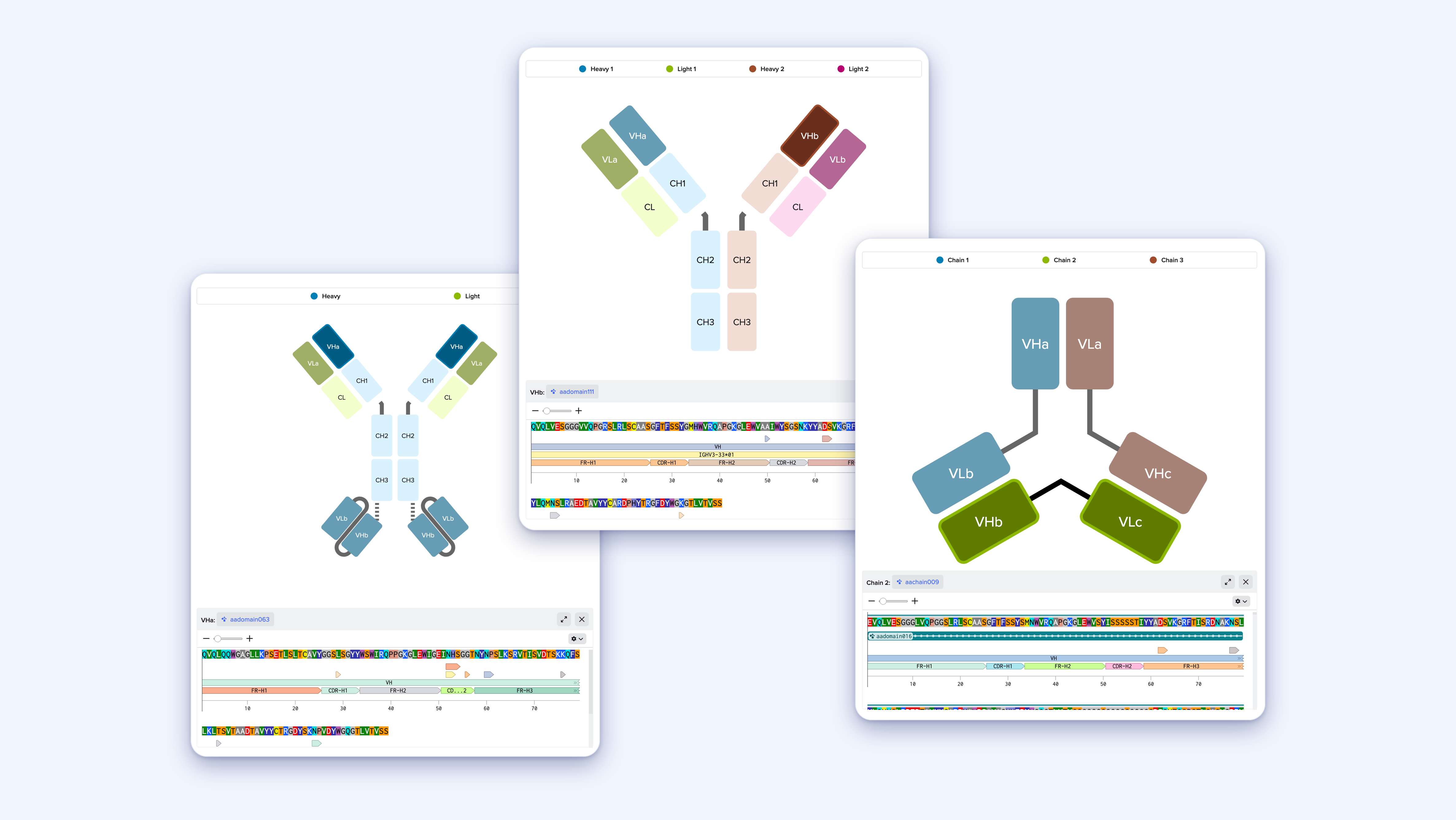
Benchling Chemistry is now generally available
Benchling Chemistry brings structured, AI-ready data to small molecules from the moment of capture, including these updates:
Structured reaction capture:
Chemists design single-step reactions visually, and Benchling calculates stoichiometry and quantities automatically.
Chemically aware data model:
Shared salt and solvate libraries and linked molecule lots keep chemistry data consistent across projects.
Reaction search:
Scientists search past reactions by structure, substructure, or similarity and filter by each molecule’s reaction role.
Predictive models and agents:
Chemists run ADMET predictions through Model Hub, and agents search reaction history and help enter notebook data.
Molecules, reactions, and biological results share one scientific record instead of living in separate systems that don’t talk to each other. Explore our new capabilities with Benchling Chemistry.
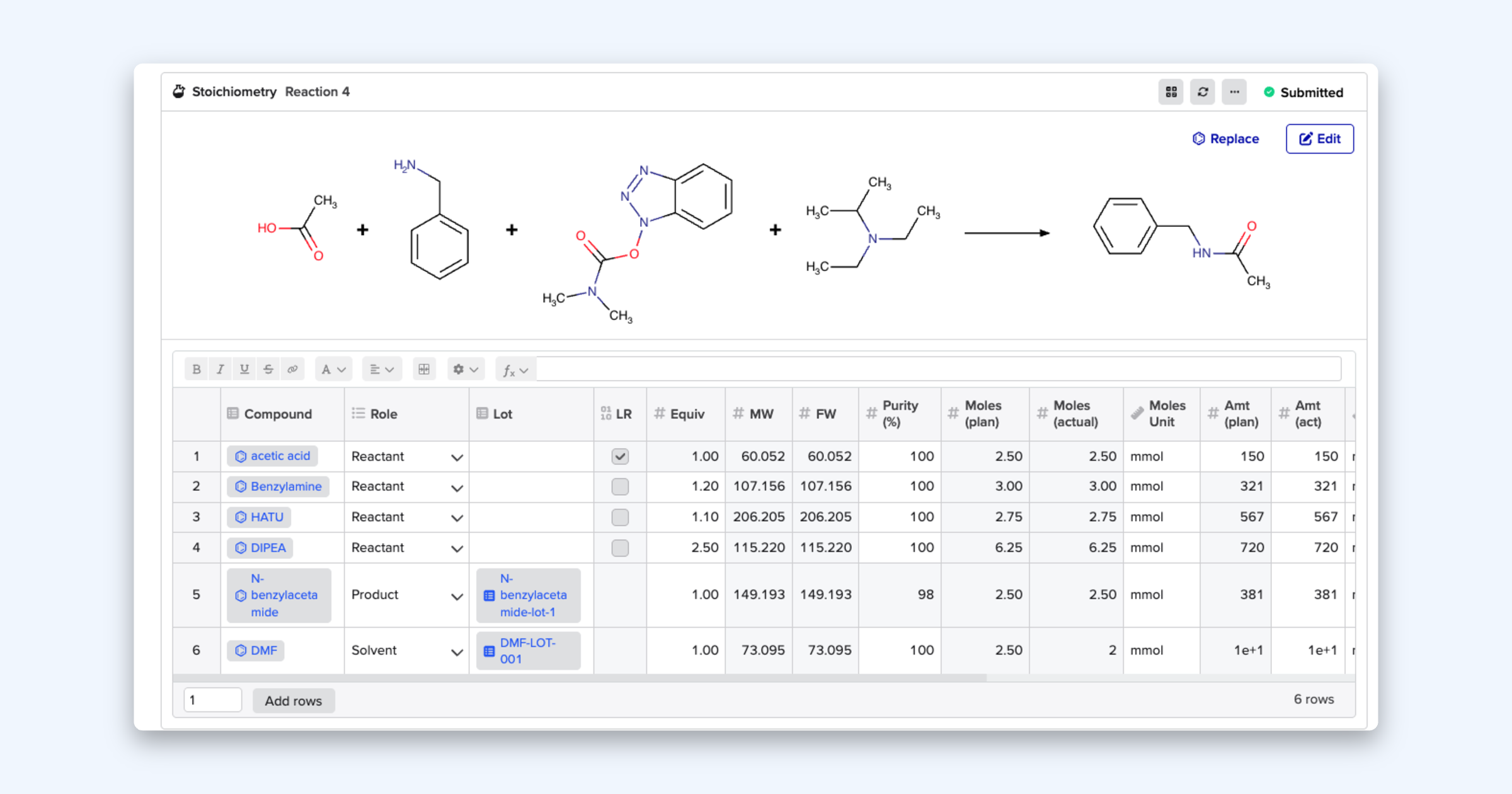
A Benchling Chemistry reaction entry shows an amide coupling with its stoichiometry table, including compound roles, lots, equivalents, and planned and actual amounts.
Benchling In Vivo Agents help you catch problems earlier
The same need for structured data applies while a study is in progress. With Benchling In Vivo, agents flag trends and data-quality problems as data is entered. Structured data also pays off across programs. A top 20 biopharma used Benchling AI to narrow 20 candidate mouse oncology models to two by drawing on structured data from an acquired company, saving eight months of redundant animal studies. Four new developments to Benchling In Vivo improve your visibility into what’s happening with your science:
Pulse Agent: Flags trends and anomalies across measurements, observations, and dosing automatically.
Connected devices: Balances, calipers, and ID scanners write straight into data tables and sampling sheets.
Multiplayer data tables: Scientists see who’s active in a study and jump straight to their work.
Study Health Check Agent: Scores data quality and flags what needs attention early.
Explore three ways AI is delivering value for in vivo teams.
Get more from every run with scientific intelligence embedded into Benchling Development
A design only matters once it can be built at scale, and that’s where process development picks up. Teams carry years of legacy and external data they can’t easily reuse, so each new study risks repeating work already done. At Benchtalk, we showed Benchling Development turning that history into a structured scientific memory, with an agent that proposes the next run from your objective and the history you choose to include.
Once a run is underway, our new split and pool capability gives process teams a visual, drag-and-drop way to design high-throughput experiments. You can split a sample across a large batch of conditions, adjust mid-run without losing data, and track full sample lineage through every split and pool.
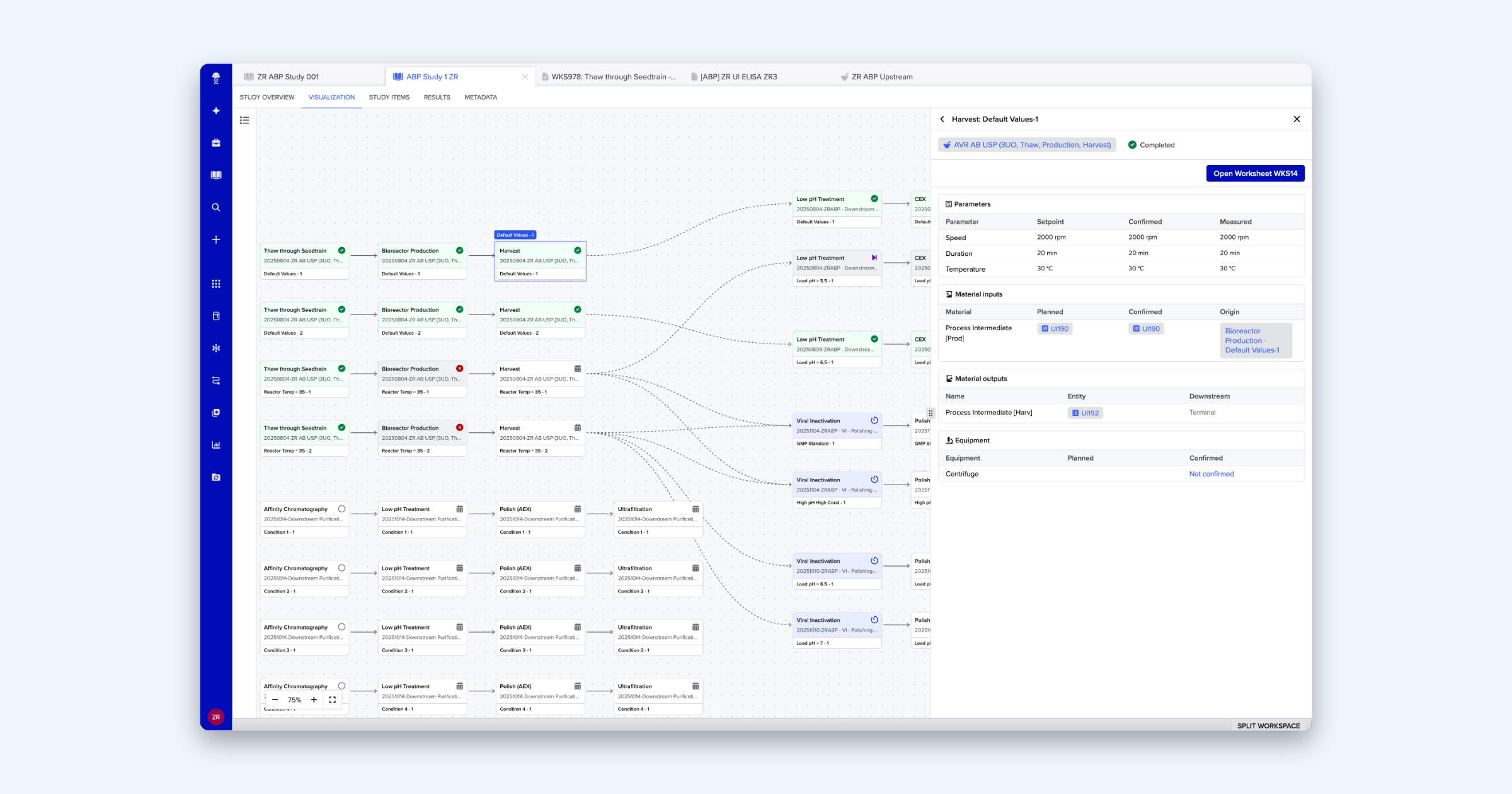
A Benchling Development study view maps each process step from seed train through polishing, with setpoints, measured values, materials, and equipment for the selected harvest step.
That lineage matters most when a run reaches analytical testing, where the back-and-forth over samples and results slows everyone down. A new analytical sciences module keeps the whole request cycle inside Benchling, from the initial assay request through validated results landing back in the original batch record. Analytical teams get their own workspace to manage queues and protocol execution along the way. Explore Benchling Development.
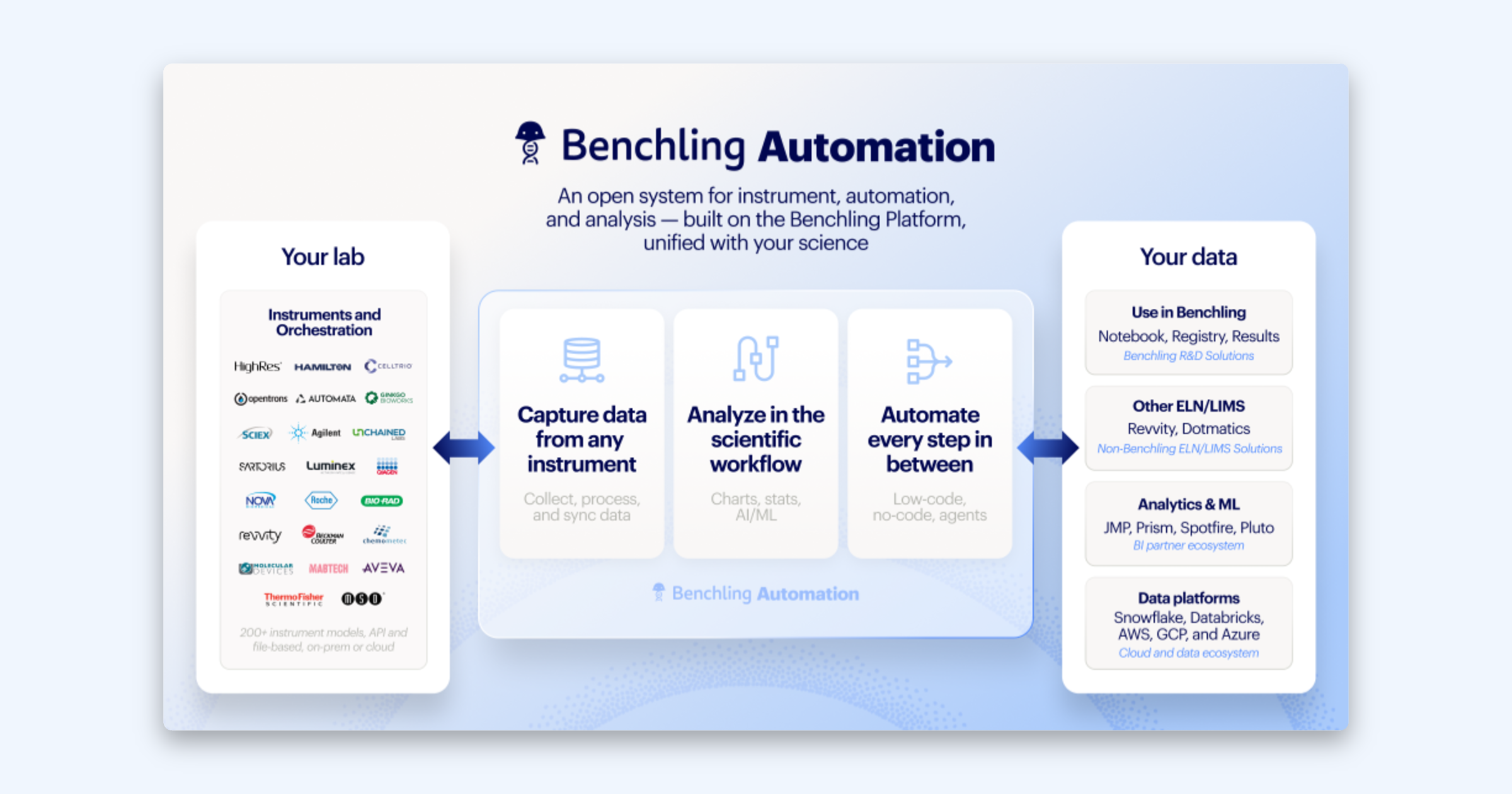
Automation templates make AI-built analysis repeatable
Once something is built, it has to be tested the same way every time, and labs still run on a patchwork of one-off scripts and manual analysis that breaks the moment something changes. With Benchling Automation, agents can now set up a plate of newly synthesized compounds for a biology assay, find the right method, start the run on a Tecan instrument, and send the resulting dose-response data straight into analysis. Once that analysis is right, the agent saves it as a template, so the same run doesn’t have to be rebuilt from scratch next time. These fixed, repeatable templates are also what a foundry calls when an analysis must run the same way every time.
Other key updates include:
Draft and publish: Teams test a draft with dry runs, then publish a locked, trusted version everyone can rely on. Automation and plate templates are now generally available.
Direct SQL queries: Any valid query against the Benchling Warehouse becomes a dataset for transforms, charts, and templates, with no dashboard required.
Register and update entities: Analyses create or update Registry entities in bulk.
Plate transfer: Plates are now a first-class data type, with transfers running to instruments like Tecan and HighRes and concentrations calculated automatically.
See Benchling Automation in action.
v3 APIs and vibe coding extend the Benchling Platform
Getting data in and building on it both get easier too. Scientists can describe a dashboard or tracker in plain language with vibe coding to get a working app on their own Benchling data within hours or days. Those apps use the new v3 REST API, which has more than twice as many endpoints as v2, so your tech stack stays connected. The v3 REST API also adds:
Core Platform APIs: Create and update schemas, work with structured tables, and build custom actions, with broad filter coverage.
Developer Suite: Build with a Python SDK, search across all of Benchling with the Search API, which applies each user’s permissions, and bring AI tools to your data with the AI Agents API and MCP.
Enterprise and Scale: Move data in bulk across all objects, and manage users, teams, projects, collaborations, and policies.
We also launched Direct Data Share with Snowflake, which keeps scientific data continuously connected between Benchling and a company’s Snowflake environment. Browse the new Benchling Directory for the AI connectors, models, and Skills that extend the Benchling platform. Learn more about how Benchling is expanding its platform capabilities.
Rebuild biotech for the AI era with Benchling
For decades, the number of programs a company could run was set by headcount, lab space, and budget. That is changing. Models produce more candidates, and agents work around the clock, so a small team can now have the capacity of a much larger one, but only if they coordinate work with their agents across internal and external labs.
Request a demo to learn more about any of our products.
If you’re already a Benchling customer, talk to your account team or request time with a specialist to set up your first Science Foundry.
Couldn’t make Benchtalk Boston? We’ll be sending recaps of all the event highlights, so sign up here.
Benchtalk continues in London on December 3 and 4. Register now.