Scientific models: free, fast, and for everyone
Today, we’re launching a new way for scientists to run the latest scientific models at scale. On Benchling.ai, any researcher can now sign up and get free predictions, no setup required.
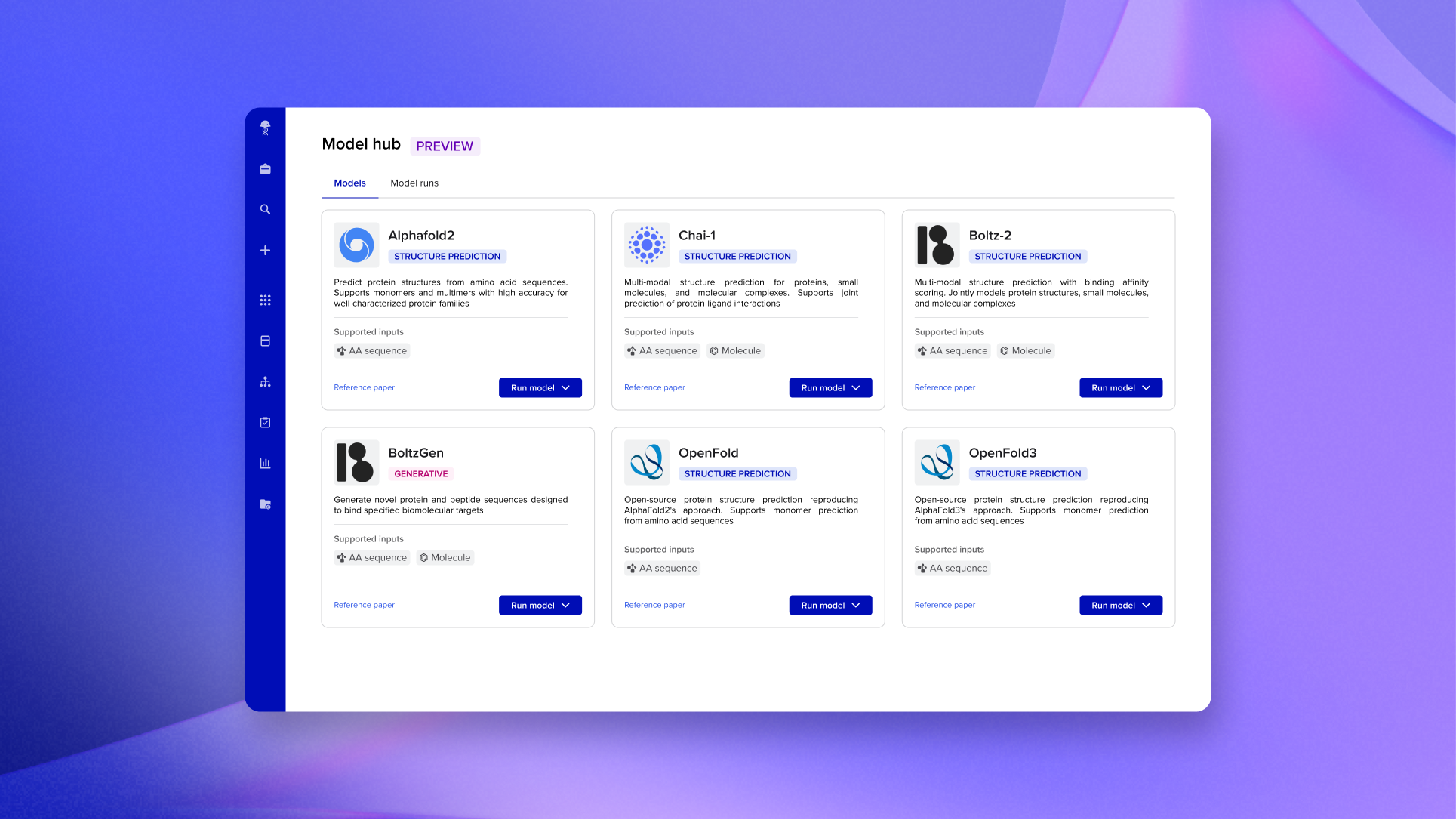
Earlier this year, we launched Model Hub to help scientists run structure prediction and generative models inside Benchling with a single click. We’re seeing adoption grow quickly as scientists incorporate these models into their everyday work. We believe everyone should be able to use scientific models, not just those who are using the broader Benchling platform.
We've spent over a decade making technology accessible and powerful for every scientist. Starting with guide design when CRISPR was an unfamiliar term, to cloud notebooks and molecule registration when science still ran in server closets. Prediction and generative design are next, and we can’t wait to see the future you build.
Open source ≠ easy access
Between 2020 and 2025, the number of new biology AI models released each year grew from 28 to more than 300. Many of the field’s most popular models are open source, including AlphaFold2, OpenFold, and ESMFold2, developed by teams and consortia committed to advancing science. That movement has accelerated progress and put powerful new capabilities within reach of the entire scientific community.
But open source code alone does not give a scientist a working model. Significant infrastructure investments and technical expertise are required to get started. Running the latest structure prediction models, for example, requires configuring expensive GPUs, managing firmware and library versions, building an expensive Multi-Sequence Alignment (MSA) server, writing scripts to transform your data, and then analyzing an array of unstandardized outputs.
Scientists should be able to benefit from these open source models without becoming infrastructure experts. Through partnerships with organizations including CZI Biohub, the OpenFold Consortium, and NVIDIA, Benchling is helping turn the best scientific models into fast, reliable tools that researchers can use directly in their work.
Run a new model in 60 seconds
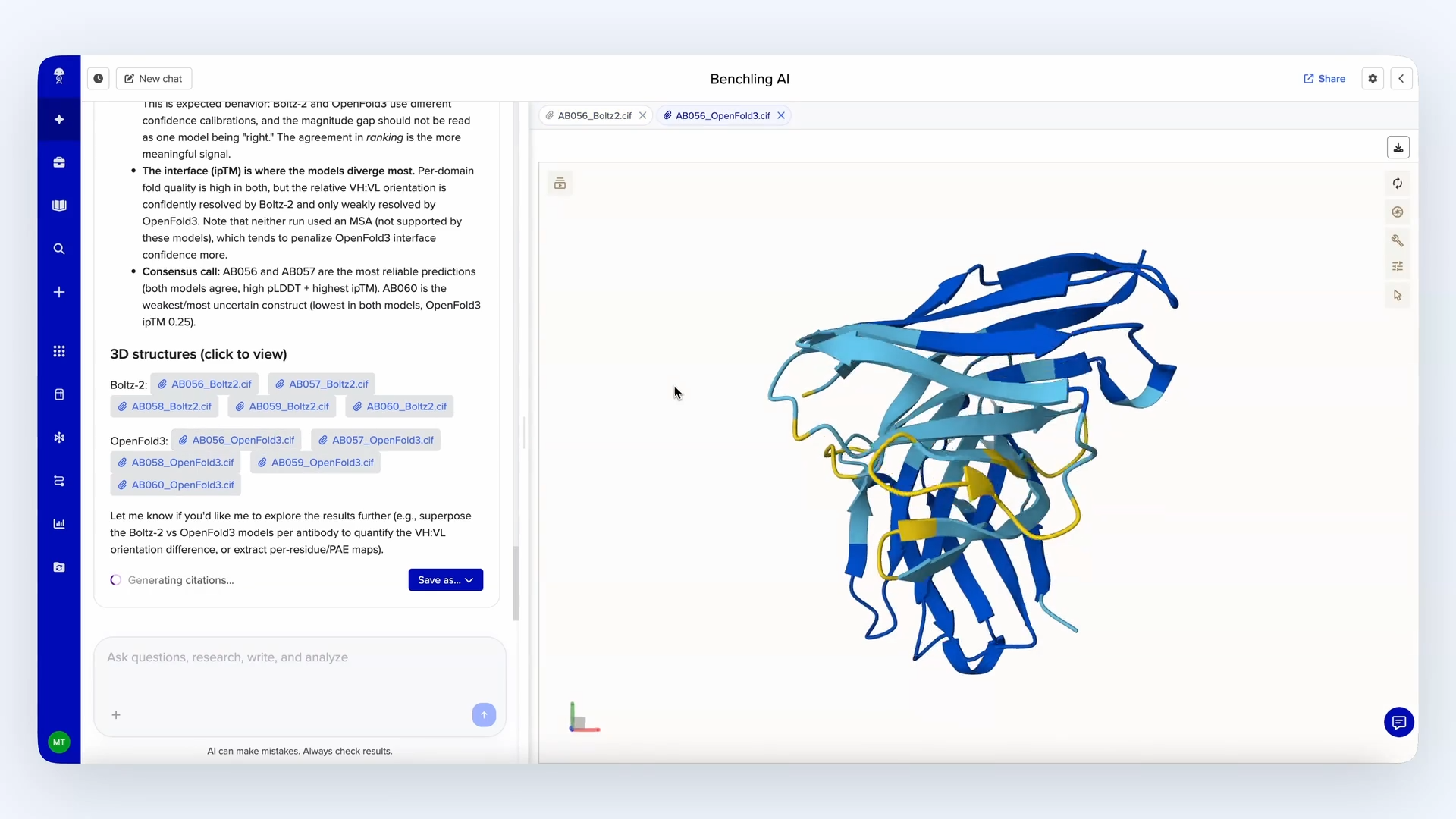
With the new Benchling.ai, you can go from FASTA files to predictions in under a minute.
The infrastructure powering it is the same modern stack used by the most powerful AI models, from LLMs to image generation. Benchling Inference manages GPU capacity, improving speed and scale with the latest GPUs from NVIDIA. Your data stays entirely within Benchling’s infrastructure, including preprocessing steps like our GPU-accelerated MSA.
Work in any ecosystem
Daily scientific progress happens across many tools, technologies, and platforms. The largest R&D organizations operate complex IT environments with hundreds of applications including multiple ELN/LIMS systems. Adopting a new platform is a months-long decision; running a model shouldn't be.
Benchling.ai is independently usable by design. Signing up and running predictions doesn’t require being a Benchling customer. There’s no sales rep to talk to, no implementation time, and no need for a credit card to get started. Bring your data from wherever it lives, run your predictions, and take the outputs with you.
What's next
We're starting with scientific models on Benchling.ai. The agents we’ve built are advancing quickly too: running and interpreting predictions, structuring historical data, generating and testing hypotheses. We plan to bring these capabilities to Benchling.ai as well, making them accessible to every scientist.
Try it now. Sign up at Benchling.ai, and get up to $1,000 in free yearly usage (based on typical usage patterns).
Already a Benchling customer? Model Hub is in your account today. See the Help Center to get started.