Benchling Platform: The infrastructure behind the next era of science
Great platforms allow engineers, scientists, and AI to build new products and experiences. Doing that reliably takes a complete, consistent platform surface, and that's what this year's platform work has been about. The biggest piece of this just landed: the Benchling v3 APIs are now generally available. In this blog, we share major updates we are making to fulfill our commitment to ensuring Benchling is extensible, flexible, and connected.
Benchling v3 APIs now generally available, with full platform coverage
Inconsistent APIs force developers to learn behavior by trial and error like which endpoint to call, what shape the request takes, and whether a handwritten client still works after the next release. As AI makes connectivity more important, the platform underneath has to keep up. Benchling’s v3 APIs are built on one shared schema layer, so the behavior is predictable across the whole surface instead of per-endpoint. v3 more than doubles API endpoint coverage, from 403 to 930, and adds full write coverage across the Benchling Platform. Agents can now take more action and answer more questions about your data.
Capability | v2 | v3 |
Supported objects | 57 | 151 |
API endpoints | 403 | 930 |
Write coverage | Partial | Full |
v3 also ships the functionality developers have requested the most:
Core Platform APIs: Create and update schemas, work with structured tables, and build custom actions, with broad filter coverage.
Developer Suite: Build with a Python SDK, search across all of Benchling with the Search API, which applies each user's permissions, and bring AI tools to your data with the AI Agents API and MCP.
Enterprise and Scale: Move data in bulk across all objects, and manage users, teams, projects, collaborations, and policies.
IT teams spend an average of 36% of their time designing, building, and testing custom integrations, according to MuleSoft's 2026 Connectivity Benchmark Report. The same report found 94% of IT leaders expect AI agents to require more API-driven architecture. With v3's broader coverage and one consistent schema, IT teams can build applications and integrations faster.
The v3 SDK handles the repetitive parts of building on Benchling
The v3 SDK sits between developers and the v3 APIs, handling repetitive tasks. For example:
Async task polling: The SDK waits for long-running jobs, handling status checks, retry backoffs, and execution state.
Multi-step coordination: The SDK collapses multi-step bulk imports into one call instead of a hand-managed sequence.
Webhook verification: The SDK caches JSON Web Key Sets and parses webhook events into typed objects, so secure integrations work out of the box.
The SDK is generated from the API specification, so it updates with every API change. Its typed interfaces also give AI tools a clear contract to follow, which reduces hallucinated requests.
Data Model Explorer: See your data model as you build it
Data Model Explorer shows your schemas and the links between them inside your tenant, so teams can collaborate on the model where it lives. Add or update a schema in the UI or through the v3 schema APIs, and it appears in the Explorer right away.
Direct Data Share enables bidirectional data flow between Benchling and your data lake
Today, getting R&D data into the same place as enterprise data means building a data pipeline and maintaining it. As your data model evolves in Benchling, that requires more changes to your pipeline and the systems downstream of it.
Direct Data Share fixes that with bidirectional sharing between Benchling and your data lake, like Snowflake and Databricks. This means that R&D context and enterprise data sit together and stay current, which allows you to analyze external data in Benchling. Computational teams can also share curated data products back to scientists in Benchling, so everyone works from the same data.
Semantic search helps scientists find the right data faster
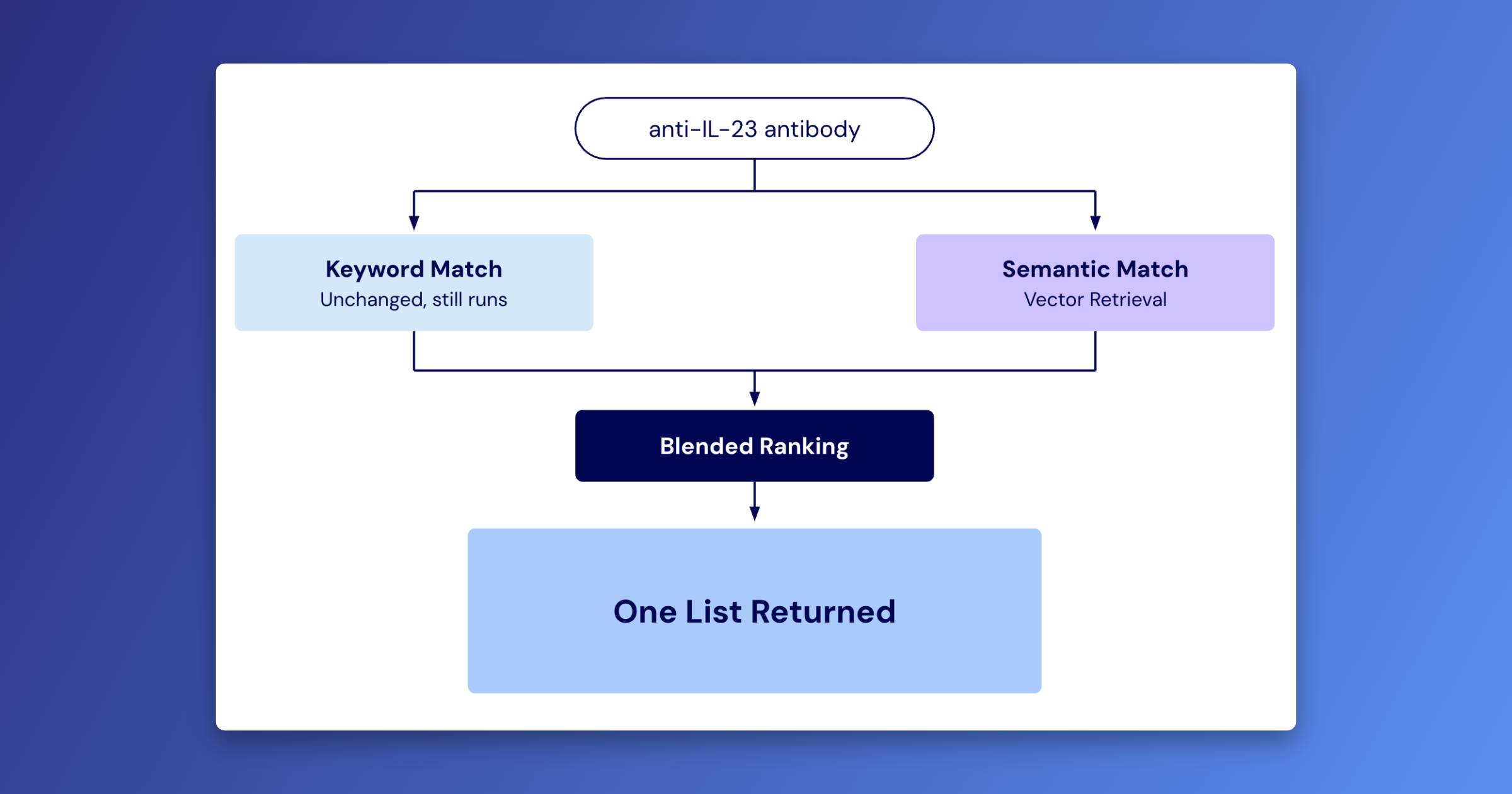
Good data only helps if scientists can find it again. In Benchling, this gap historically showed up in keyword search, where searching an exact program ID pulled up the record, but searching the same program by its code name might not. To help solve this problem, we’ve built out semantic search, which matches on meaning rather than exact characters. The query and your data both get converted into vectors, numeric representations of what the text is about, and the engine returns what's closest in meaning. So a search for a program's mechanism finds the right record whether or not those exact words appear in it.
A platform where data is structured, connected, and AI-ready
For R&D and IT leaders, these changes ensure that data stays updated and connected. That matters most for AI, which is only as useful as the data it can reach. Developers build integrations faster on a complete API surface, and computational and wet-lab teams can spend less time searching through data and more time on the science.
If you're new to Benchling's APIs, start building on v3. If you have v2 integrations, start porting over to v3. To see what’s already available, browse the new Benchling Directory, a live list of integrations you can install directly. For questions or to see what other Benchlings are building, join the community.