An AI-ready multi-modality data foundation built for complex and hybrid molecules
Novel antibody formats are multiplying faster than legacy tools can model them. That leaves antibody data unstructured and sometimes misclassified, and it leaves AI models without the context to learn from it. Molecule data is your competitive advantage, but only if it’s captured completely.
Benchling Biologics closes that gap, giving antibody teams a shared, structured foundation to design, characterize, register, and learn from proteins. It brings a format-aware data model, no-code format configuration, automated sequence characterization, and full candidate lineage that links each sequence to its assay results. With Benchling, wet-lab and dry-lab teams work from the same record, and the data is ready for AI.
But we’re not stopping there. The future of biotherapeutics sits between biology and chemistry, including antibody-drug conjugates (ADCs), chemically modified RNA and oligos, and peptides built from novel amino acids. Capturing them takes a system that can hold a molecule’s biology and chemistry in one record. That’s what Benchling is building toward.
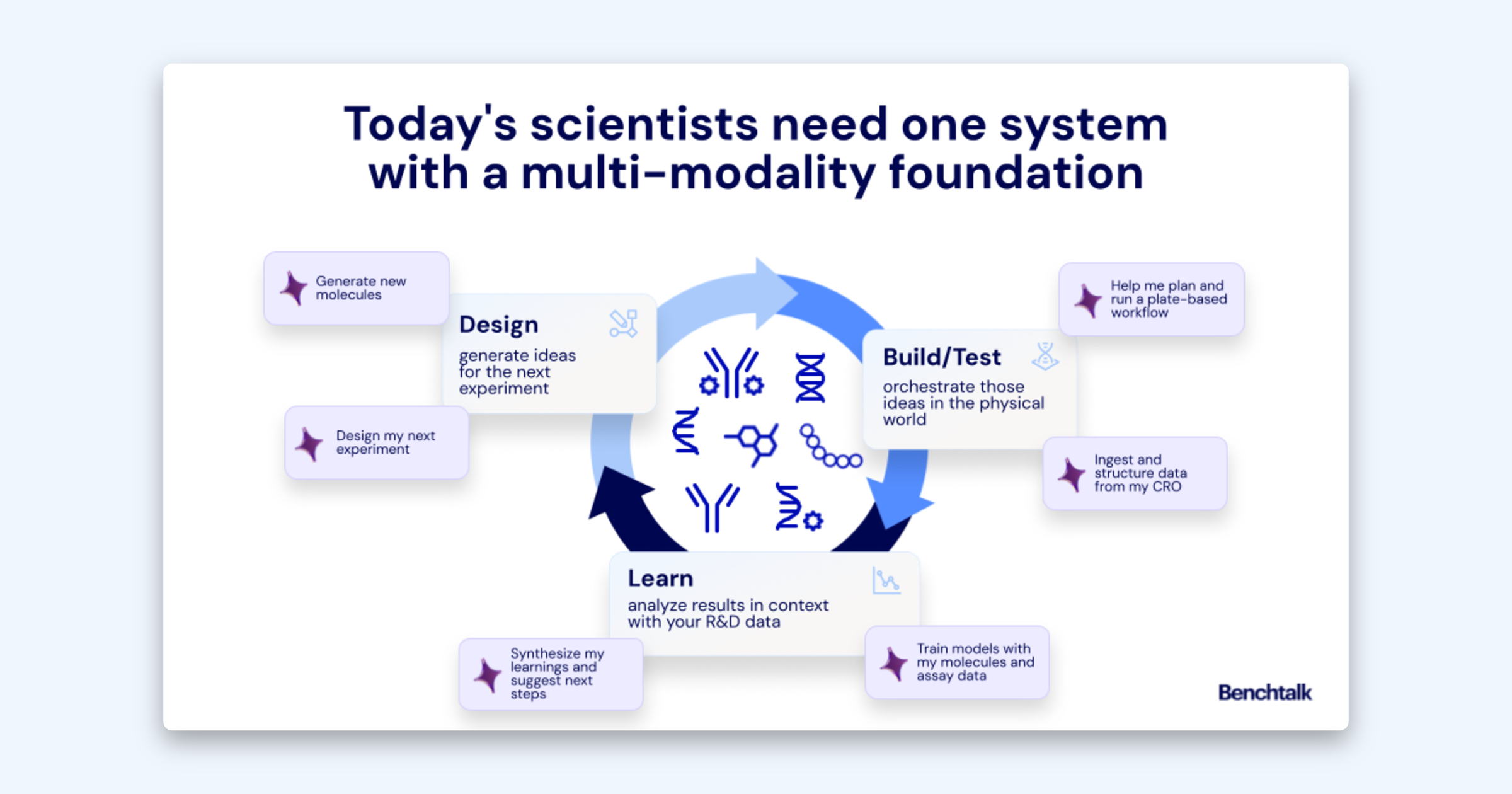
Why the molecule belongs at the center of every design-build-test-learn loop
Whatever the modality, molecule data is your most important data. Much of the AI and machine learning in research focuses on models that generate new molecules and predict their properties. These models run on a breadth of molecule data, from structure to assay results. That data is the IP that shapes your pipeline, but scientific intelligence depends on that data being structured. Structured data trains and fine-tunes those models, and it gives agents the context to act on your science. Getting this right starts at registration, where a molecule gets its identity, including information about its structure, annotations, lineage, and nomenclature.
The stakes rise as more work happens at the intersection of modalities, where a molecule’s biology and chemistry both have to be captured and linked. However, biology and chemistry teams have worked in separate systems for years, and few tools handle both well. When wet-lab and dry-lab teams work from one shared registry, they can collaborate more easily. Without it, an antibody record ends up as an unannotated list of sequences. An ADC record holds only its chemical or biological properties, not both, and a peptide record leaves out its building blocks. Models trained on that incomplete data inherit those gaps.
Our vision gives the molecule one structured record across the design-build-test-learn loop, so teams, models, and agents always have the right data underneath.
Benchling Biologics: An antibody-aware data model for any format
We launched Benchling Biologics earlier this year because antibody programs had outgrown the tools built for them. When a registry designed for IgGs breaks down on bispecifics, multispecifics, and fusion proteins, teams end up storing details in spreadsheets and free text.
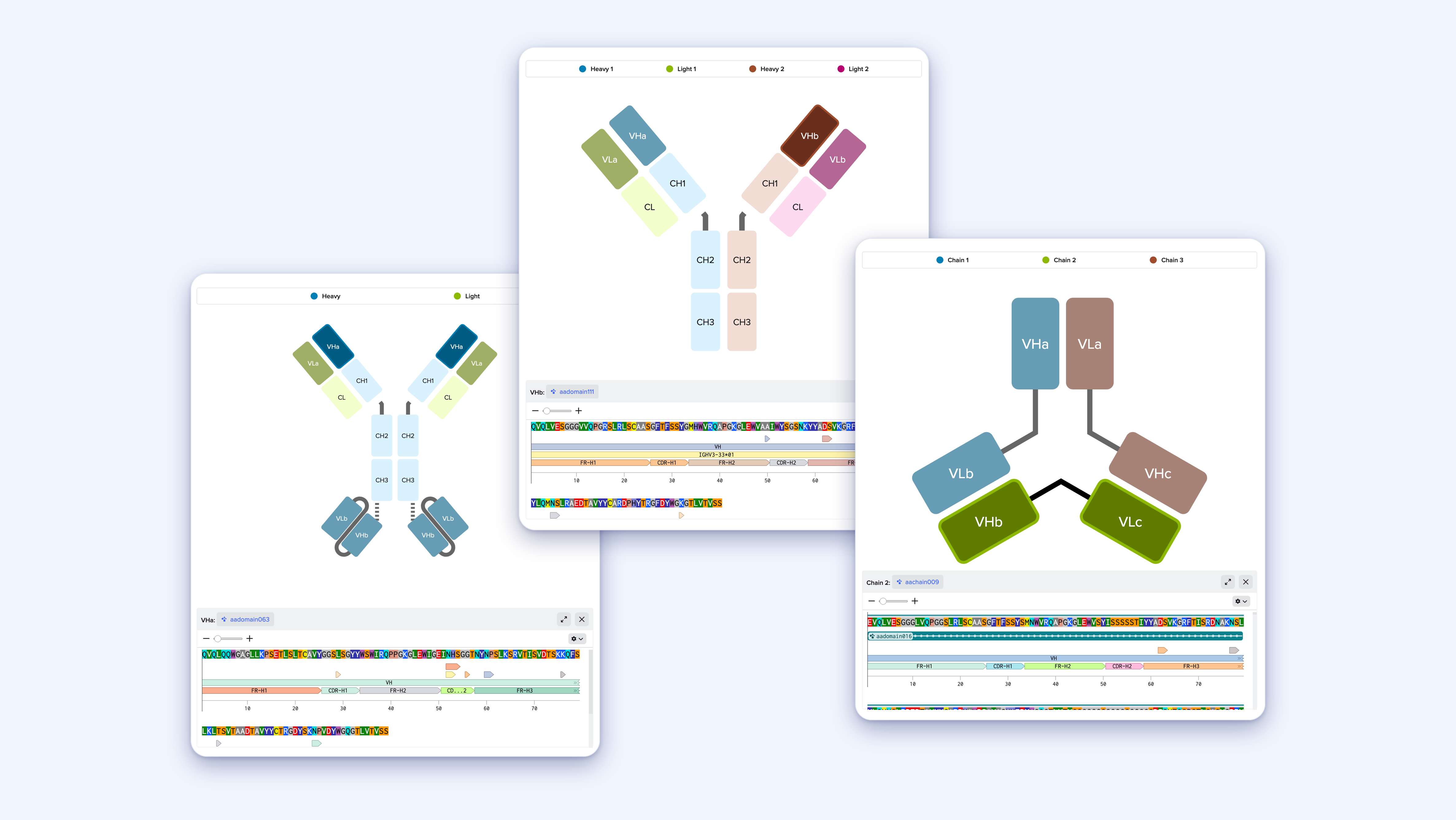
Benchling Biologics starts with the format. Teams configure any antibody format without code using VERITAS nomenclature, and an agent classifies and migrates existing antibody data into it. Each construct is then registered with ordered domains assembled into chains and domain-level metadata on every part, so its complete definition lives as structured data. That structure gives your team richer analysis and feeds your models the complete, labeled inputs they need.
Before registering sequences, computational scientists analyze Sanger and NGS sequences at scale in PipeBio, a Benchling company. They then prioritize hits to pass on to the rest of the research team through Benchling Biologics. With this data registered and formatted, wet-lab teams can fully characterize these antibodies and append experimental context to each record along the way. Every sequence, its metadata, and its assay results stay with the molecule and flow back to PipeBio for the next round of analysis.
Learnings carry from one campaign to the next, and AI works from the same record, so agents can interrogate a whole campaign in context. The next design round starts from what the last one taught you.
Teams across the industry are seeing the impact. More than 20 companies now run antibody pipelines on Benchling Biologics, from five-person startups to large enterprises. Teams like Bristol Myers Squibb choose it because formats, workflows, and assays are configurable to any antibody format without code, so scientists and IT teams can shape the data model together and test it against real workflows. One customer went from six platforms to just one across four sites, with VERITAS naming standardizing more than 250 formats. Whatever the size of the pipeline, it starts with a record that captures each antibody completely.
What’s next: Extending Benchling’s coverage to hybrid modalities
The data problem only compounds with hybrid modalities, and manually force-fitting key information with today’s tools doesn’t work. A conjugate or a peptide is part biology and part chemistry, but existing solutions handle only one. Teams often split each molecule’s context across a biology system and a chemistry system, and the connection between them gets lost. Without a shared language for these molecules, neither people nor AI can learn from the full picture.
Several years ago, we launched support for modified RNA and oligos to model mRNA, ASOs, and siRNA, paving the way for more thorough and complex modality support. Scientists can manage a library of nucleotide monomers, design modified RNA and oligos, and capture ASOs and siRNA together with chemical conjugates, bridging biology and chemistry. We’re taking the same approach to ADCs and peptides. Working with industry leaders, we’ve been extending our multi-modality registry to both, and at Benchtalk, we previewed evolving support for each.
ADCs
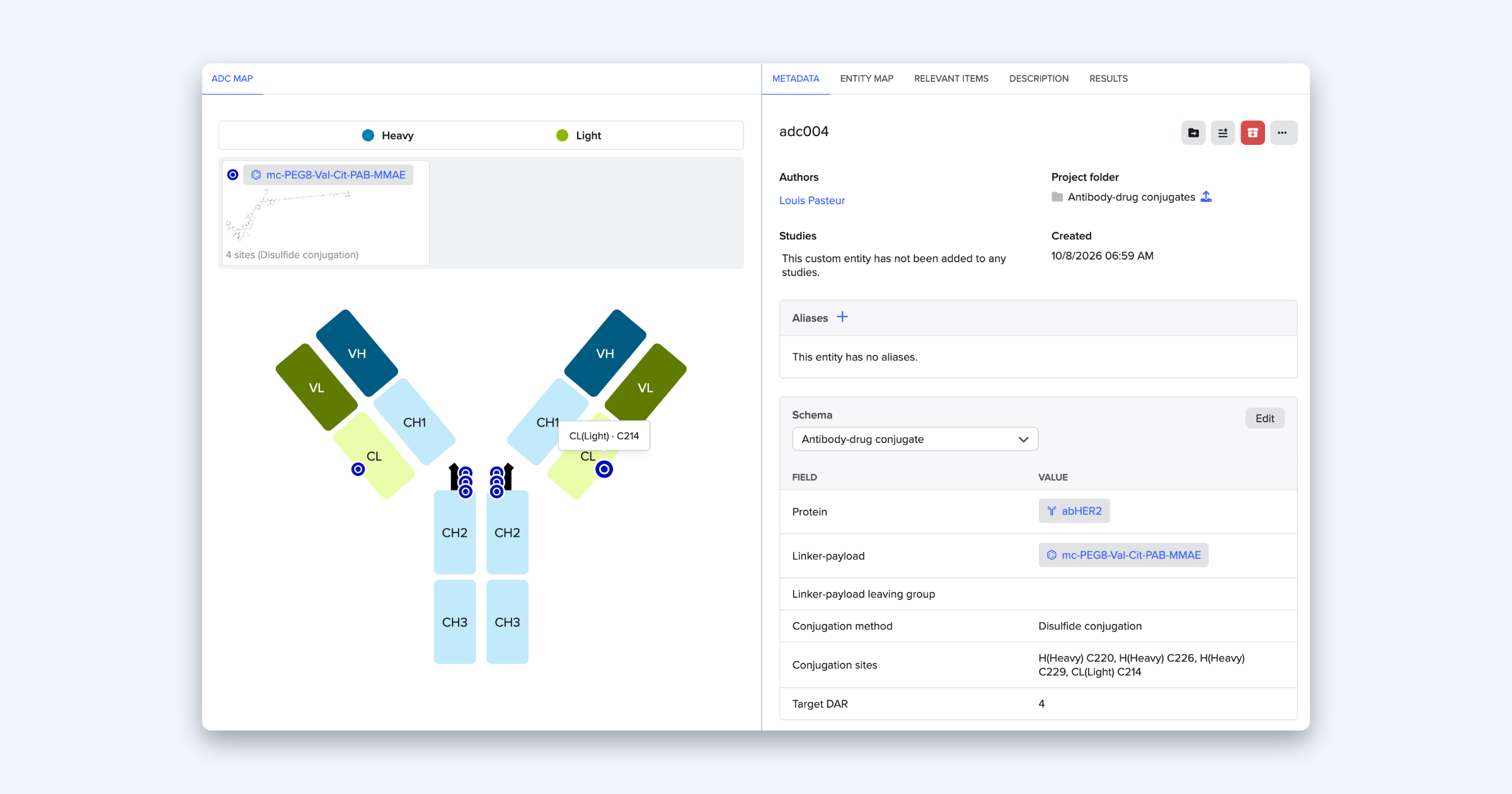
Bioconjugation teams working on ADCs bring together two disciplines that have worked separately. The biologist knows the antibody’s sequence, annotations, and conjugation sites, while the chemist knows the linker-payload and its conjugation chemistry. We’re building a first-class platform for ADCs that holds all of this context in a single record, with an early version coming this fall. In Benchling, scientists will be able to register an ADC from a protein and one or many linker-payloads. Additionally, the conjugation method, sites, and attachment chemistry will be defined as part of the construct, and both the biological and chemical structures will display visually.
Peptides
Peptide teams are often pushed into small molecule registration systems, which capture chemical structures but drop any notion of sequences. What they really need is a foundational system to track the sequence and the molecule at the same time. To kickstart this, we’ve just released an amino acid monomer library, allowing scientists to manage hundreds of natural and non-natural amino acid residues. Using the library, scientists can now register peptides from HELM strings, convert them to molecule entities, and view each one’s chemical structure alongside its sequence.
Get your molecules ready for the models you’re building
Your molecules are your most valuable asset, and the models you build tomorrow depend on how completely you capture them today. Benchling Biologics is here so your antibody pipeline can start with structured, AI-ready data.
Request a demo to see how you can register and structure your antibody data today, and get in touch with our team to get involved in shaping our multi-modality work.