Benchling Chemistry: Building the data foundation for AI-native small molecule R&D
A chemist wants to know whether a colleague has already run a similar amide coupling on a related scaffold, but the answer lives in someone else’s notebook as free text and unsearchable, so the reaction gets run again. This friction happens across most small-molecule groups. Reactions get logged as isolated records, visible only to the person who ran them, making them invisible to any AI agent or model that might otherwise learn from them.
Benchling Chemistry addresses this by building an AI-ready data foundation that lets chemists use their electronic lab notebook, already their core system of record, to generate insights from the data they capture. Chemistry data gets structured at the source, so good structure is built into how chemists already work. Furthermore, Benchling Chemistry runs on the same extensible platform as your biology data, unlocking hybrid modality use cases. The result is a structured, connected, searchable foundation that supports AI-enabled workflows across the design-build-test-learn loop. Scientists can search a molecule’s synthesis history before planning an experiment, predict ADMET properties through models available in Benchling Model Hub, and get support deciding what to make next.
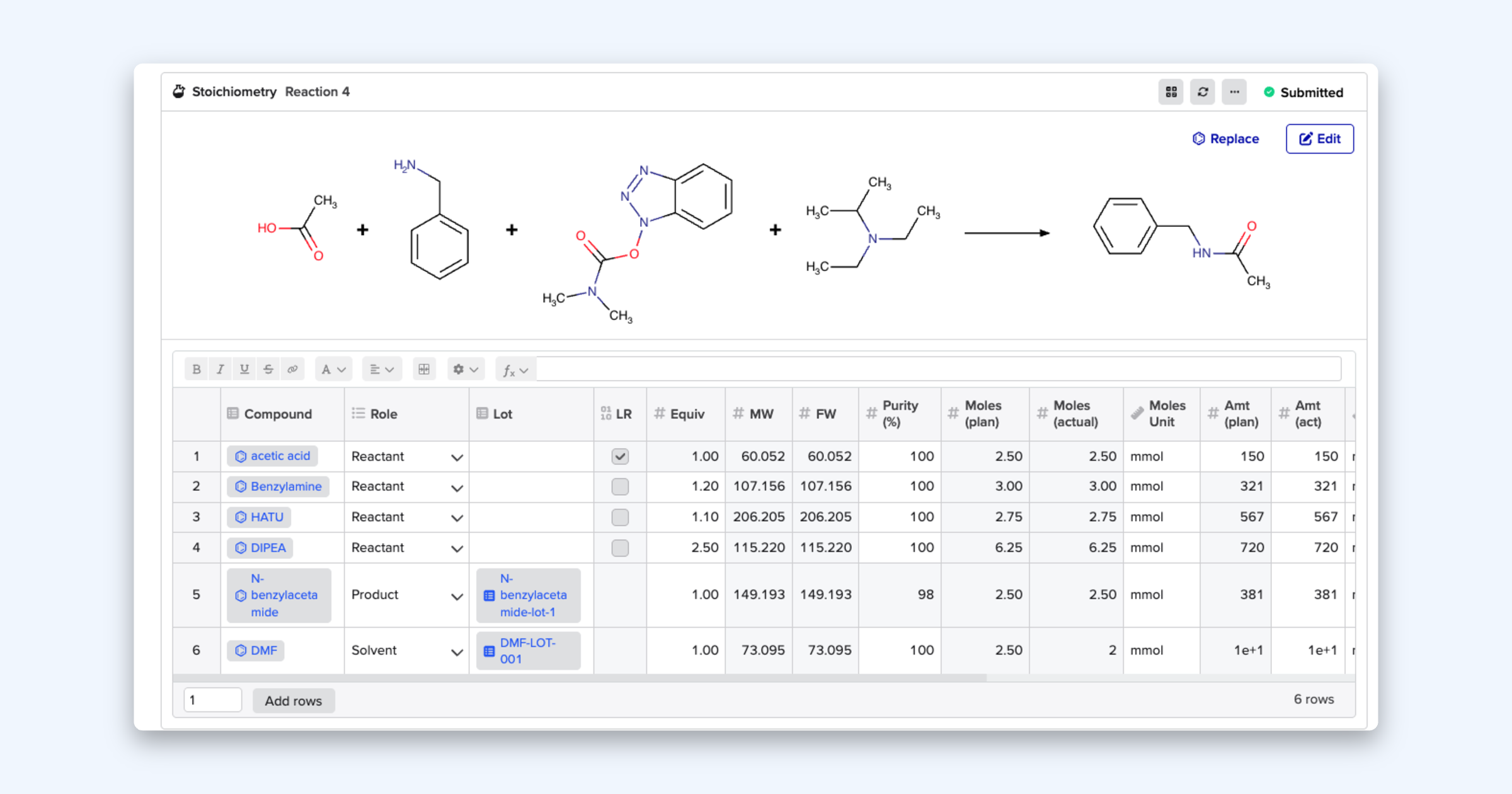
Now generally available, Benchling Chemistry brings foundational medicinal chemistry workflows into Benchling, including structured single-step reaction capture, automatic stoichiometry, salts and solvates, and reaction search by substructure and similarity.
How structured reaction data becomes an AI-ready foundation
The foundation of the whole system is structured capture. When a chemist records a reaction, Benchling stores it as a structured record instead of a block of text, so other teams can search it, connect to it, and build on it at the point of work. That structure is what makes the data usable later, speeding up reaction planning, reducing redundant experiments, simplifying report preparation, and creating an AI-ready data layer for the whole organization.
Search by substructure and similarity to reuse prior work
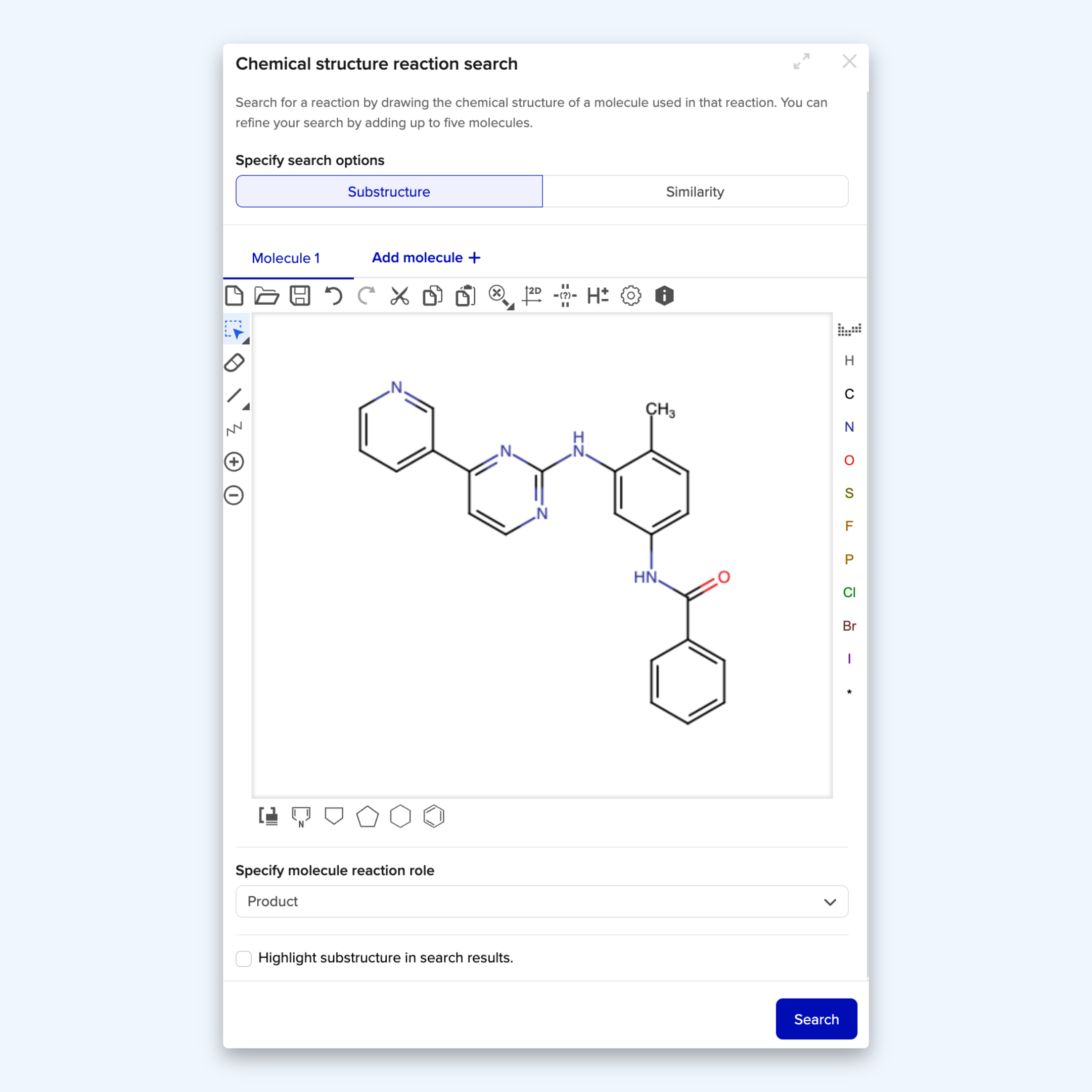
That same structure lets chemists search the full history by substructure or chemical similarity, so someone planning an amide coupling can find what a colleague already ran and reuse proven conditions instead of starting from scratch or repeating work.
Benchling’s research puts the toll of logistical work at about 18 hours a week per scientist, and repeated experiments contribute to that number. Cutting the repeats gives chemists more of their week back for the science only they can do.
Standardized chemistry: Native support for salts, solvates, and molecule lots
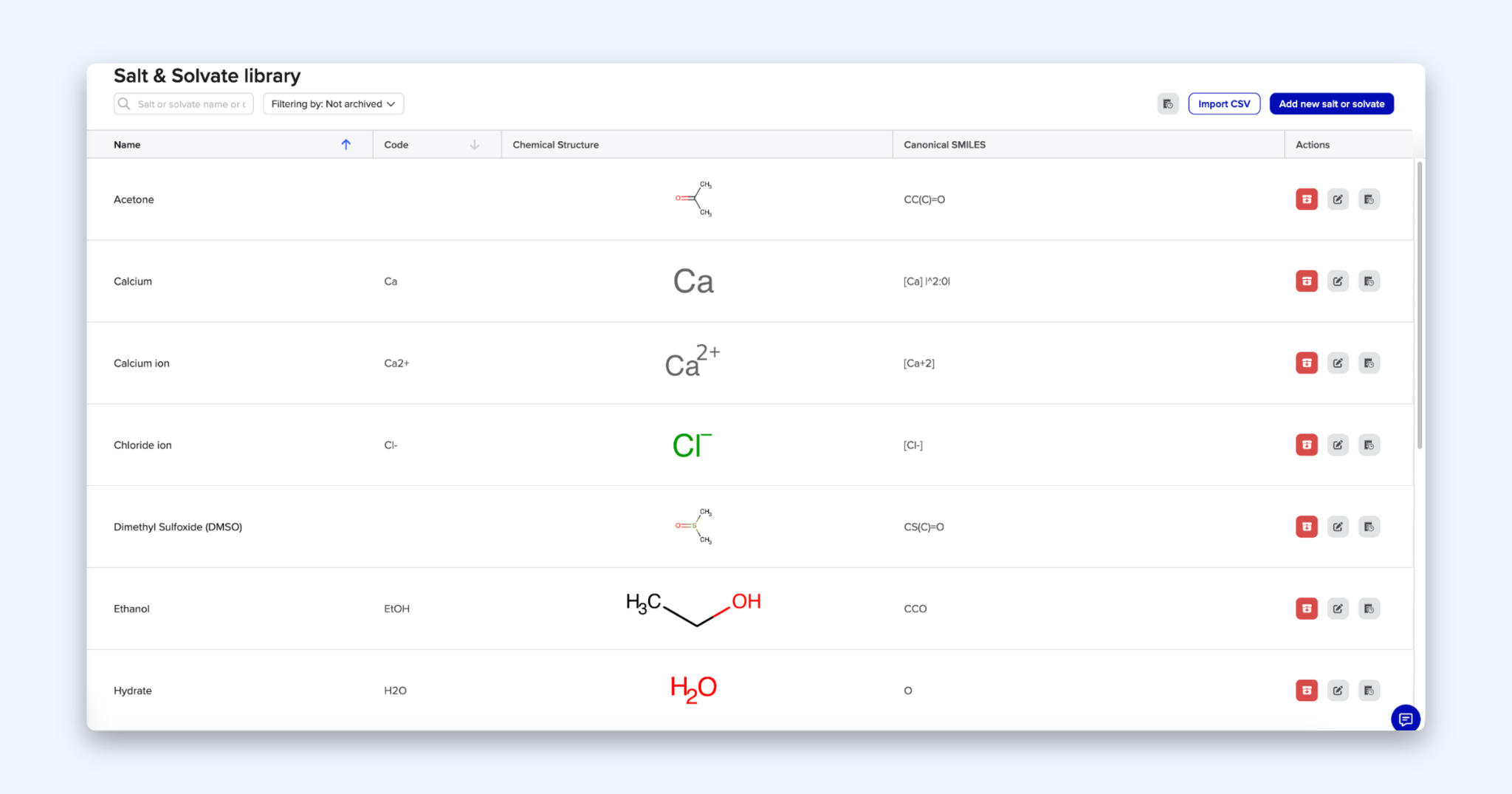
A chemically aware model keeps your chemistry data consistent. Teams manage a shared library of salts and solvates, so everyone references the same materials the same way. Benchling’s data model also captures parent-child relationships between free-form parent molecules and salt forms, as well as molecules and their lots, making it easy to model chemical relationships between molecules.
AI performs better on structured data than on raw files
It’s an open question whether structure actually drives AI accuracy, or whether a bigger model matters more. Benchling ran a test to find out. One drug-discovery dataset was stored three ways: structured and registered, cleaned into standardized files, and left as raw files. The team asked 20 questions of rising difficulty across five models and checked each answer against a known result.
In Benchling’s own benchmark, structured data produced the most accurate answers with the fewest tool calls. Raw files were the slowest, and the models stayed confident even when they were wrong. Data structure, not simply a bigger model, drove better AI performance.
Connecting chemistry and biology accelerates cross-modality programs
Benchling already gives biology teams structured, connected data. Extending that model into small-molecule R&D brings chemistry and biology onto the same connected platform, preserving context from how a molecule was made through the experiments and biological results that follow. That shared foundation supports cross-modality work, like antibody-drug conjugates and hybrid therapeutics, where chemistry and biology have to move together.
See your chemistry data become an asset
With Benchling Chemistry now generally available, chemistry teams can start building that foundation today by capturing reaction data in structured form, making prior chemistry easier to find and reuse, and connecting chemistry with the broader scientific record. As AI becomes a larger part of how R&D teams design and make decisions, the quality and structure of that scientific data can play a larger role in helping scientists make smarter, better decisions.
Benchling is the AI platform for R&D. It supports 1,300+ biotech and pharma companies and more than 200,000 scientists, including more than half of the world’s top 50 biopharma. Request a demo to see structured reaction data in action.