Benchling Development embeds scientific intelligence across the workflow
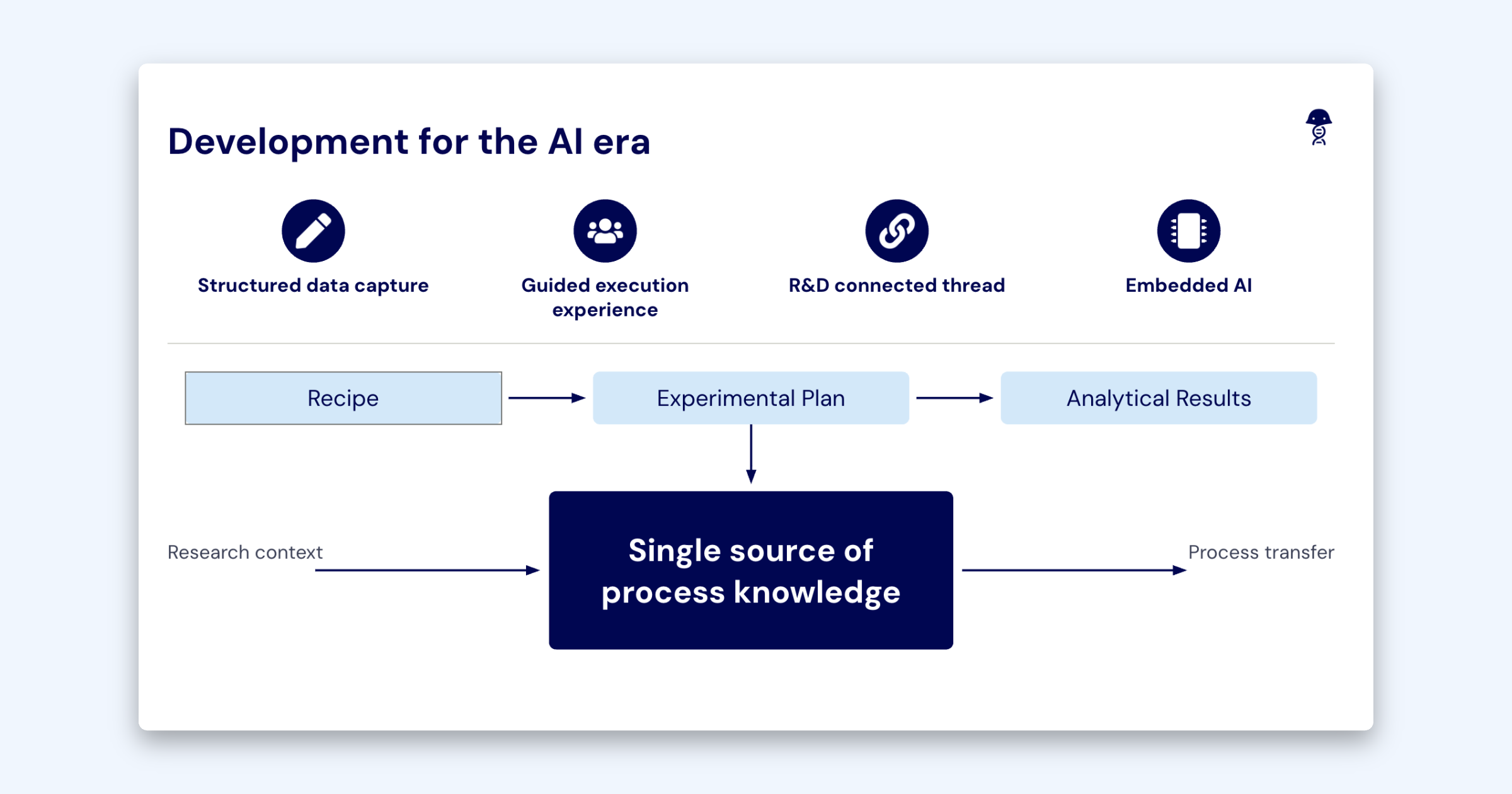
More drug candidates are entering the pipeline, and development teams are under pressure to keep pace. Benchling Development embeds scientific intelligence across the entire workflow, from designing the next run to generating the final tech transfer report.
That starts with the data underneath it. Process development teams sit on years of legacy and external data they can’t easily reuse, so every new plan risks repeating work that’s already done. Benchling Development structures that data, then runs AI agents on it, so each cycle builds on the last.
Activate your legacy data instead of leaving it stranded
Benchling provides an AI-powered legacy data import capability to build a structured scientific memory for the next experimental design. This turns stranded files into a foundation for AI-ready scientific data. On top of that, it makes yesterday’s data actionable within statistical models and AI-generated hypotheses for today’s development cycle, informing the right next step, even for an established program.
Design the next run with Benchling AI
Process development costs time and money to execute. With Benchling's Science Foundries, agents help avoid this by starting from the right place. Instead of hunting through past results by hand, you describe the desired outcome, and they propose how to get there. This gives the next study a smarter, more cost-effective starting point with fewer unnecessary or repeated experiments along the way.
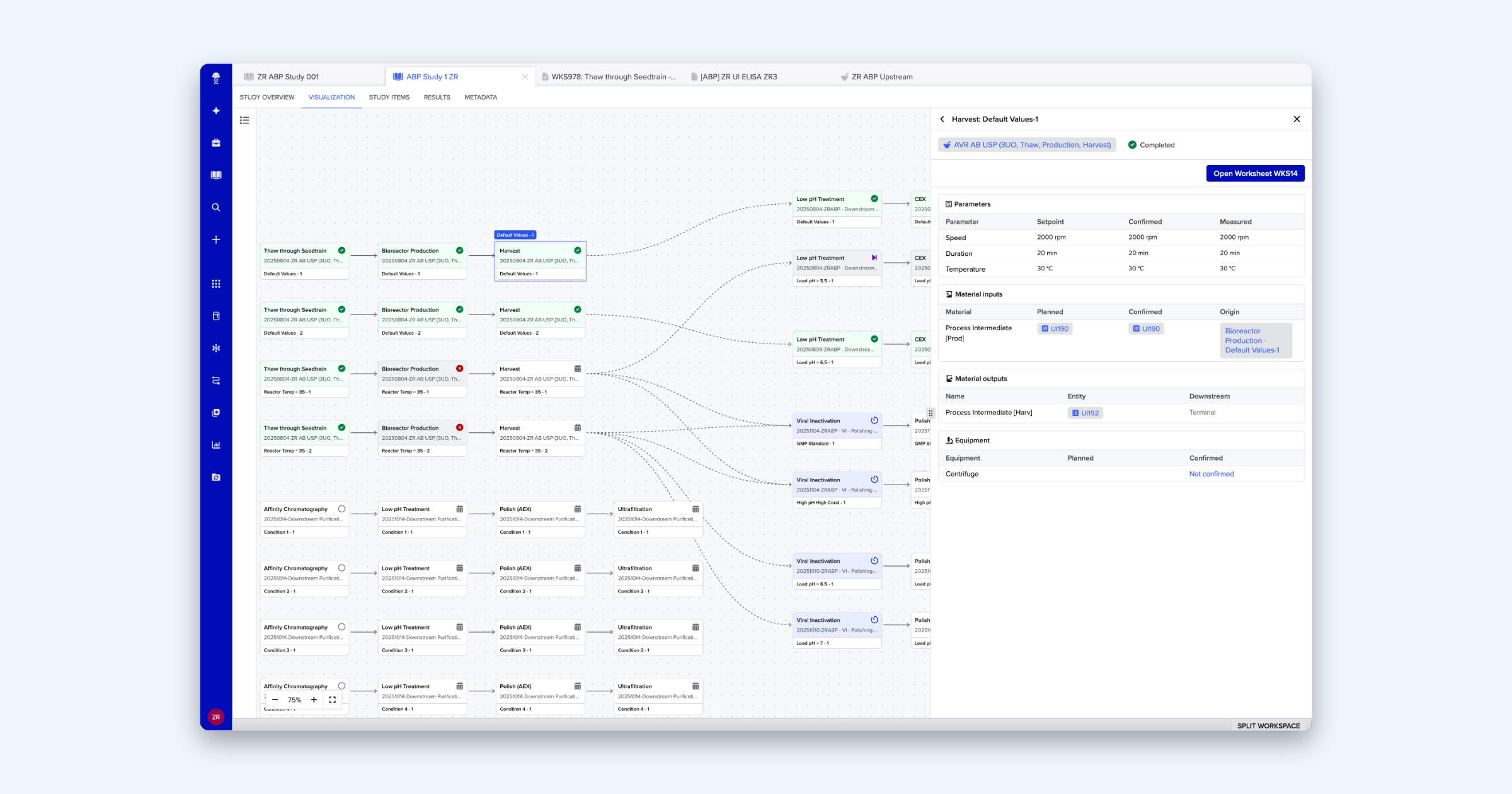
You stay in control throughout, deciding which historical data to include or exclude as the agent works. Reusable parameter and unit operation libraries also give it vetted building blocks to pull from instead of starting from scratch. Grounded in a structured data foundation and purpose-built for R&D, the agent stays focused on the study in front of you.
Adapt mid-run and analyze across studies
Process development runs don’t always go according to plan. Split and pool lets you divide one batch into separate paths, or recombine them, as the science demands. When an outcome forces a change, you adjust the path without losing your data.
Through all of this, wet-lab science still defines and confirms the design space, establishing the critical process parameters and critical quality attributes an experiment stands on. AI then turns that data into insight.
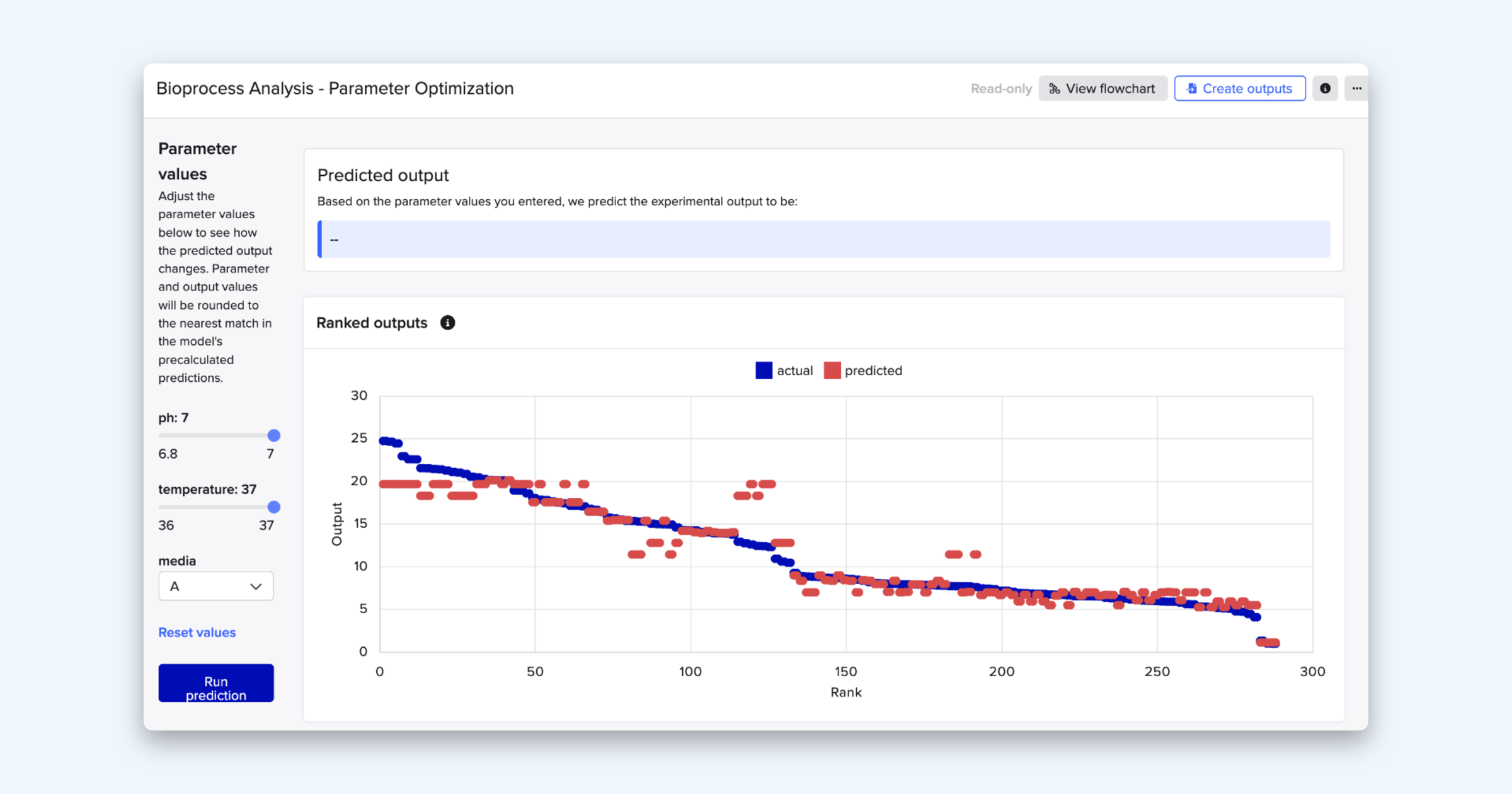
The analysis keeps pace with those changes. It refreshes on its own, spans a single study or many, and includes embedded Bayesian analysis alongside offline results from the latest run, compared back to your original hypothesis. In silico testing found that Bayesian optimization needed about 50% fewer experiments than conventional methods (Claes et al., 2024). The result is updated, cross-study insight without rebuilding anything by hand.
Send testing requests to analytical teams without the handoff
A finished process run still has to go to analytical testing, and someone usually spends time assembling context by hand before the sample even reaches the queue.
Benchling Development builds that request directly from the run. A process scientist submits it, and the run’s process data goes along automatically. The analytical team opens a request that already carries what produced the sample and why it needs testing. Analytical results are automatically delivered to process development teams in the same connected record.
Generate tech transfer reports with a single prompt
Compiling tech transfer documentation by hand at the end of a program is slow and repetitive. A single prompt replaces that manual work, generating the report by pulling data straight from the connected record the platform already captures, so the handoff is faster and easier. Roche reports that a tech transfer normally takes 12 to 18 months. Structured, connected records help you speed up tech transfer and protect the launch date.
For R&D leaders, Benchling Development turns fewer and smarter runs into a shorter path from candidate to clinic, while AI amplifies your team’s capacity. The average molecule still takes years and billions of dollars to reach the market, so cross-program visibility keeps portfolio decisions defensible and data-driven. Benchling’s platform already supports more than 1,300 companies, including more than half of the world’s top 50 biopharma.
Request a demo to explore how Benchling can help you increase capacity and make smarter, better runs.