
Webinar

Plan reactions, capture structured chemistry data, and keep every molecule linked to the experiments and results that follow.
Modern R&D depends on chemistry and biology working together. When reaction data, compounds, experiments, and results live in separate systems, context gets lost and teams spend time reconnecting work instead of building on it.
Benchling Chemistry puts structured chemistry workflows on the same platform as biology, creating a shared record teams can search, reuse, and learn from.

Design reactions visually and capture components like reactants, products, solvents, and catalysts in a structured stoichiometry table
Automatically calculate stoichiometry and quantities, including salts and solvates
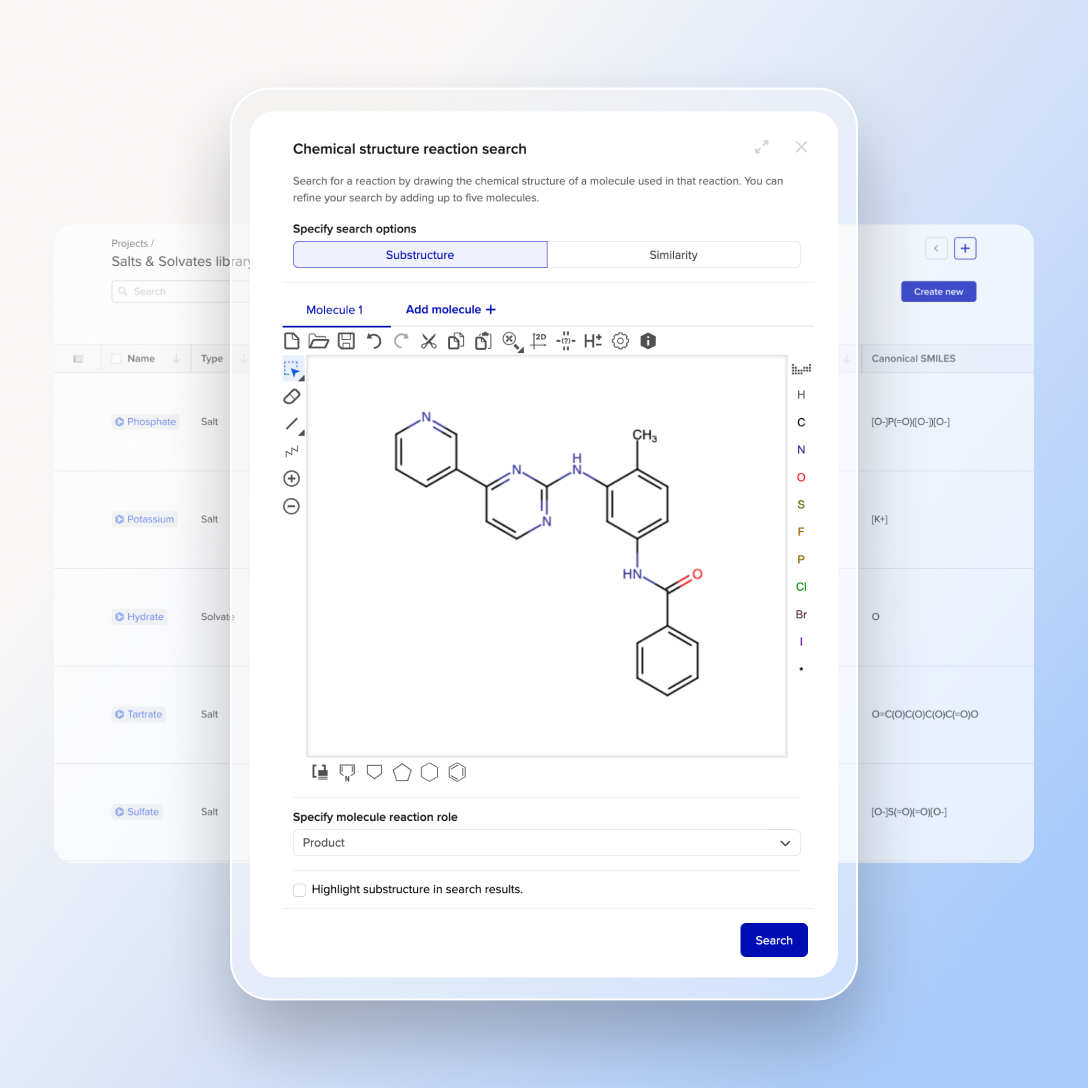
Search past reactions by structure or similarity, then jump straight to the source experiment
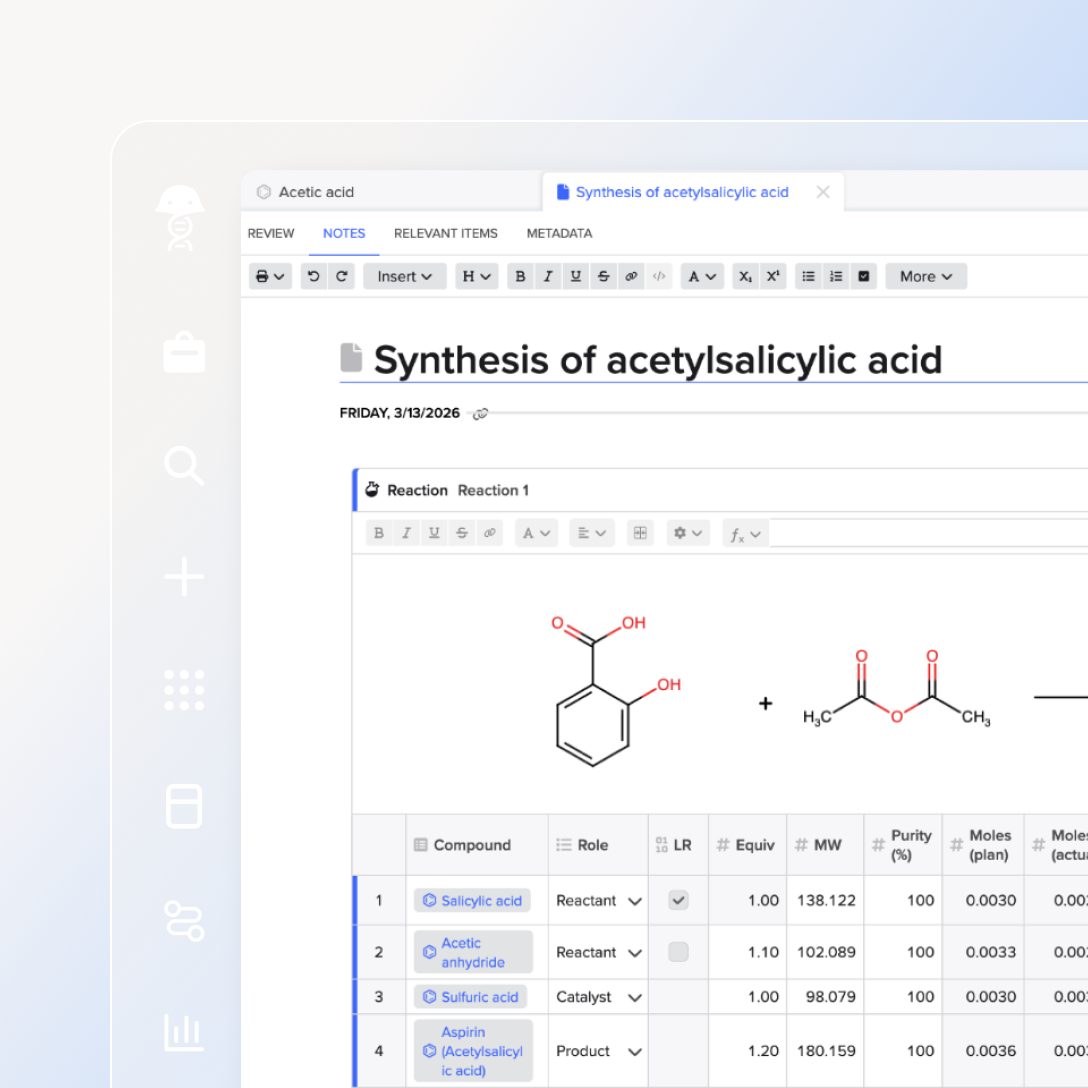
Keep reactions, compounds, experiments, and biological results connected on one R&D platform
Trace a molecule back to how it was made, and forward to how it performed in downstream experiments
Link small molecules, biological data, and hybrid-modality workflows so teams can build on the full scientific record
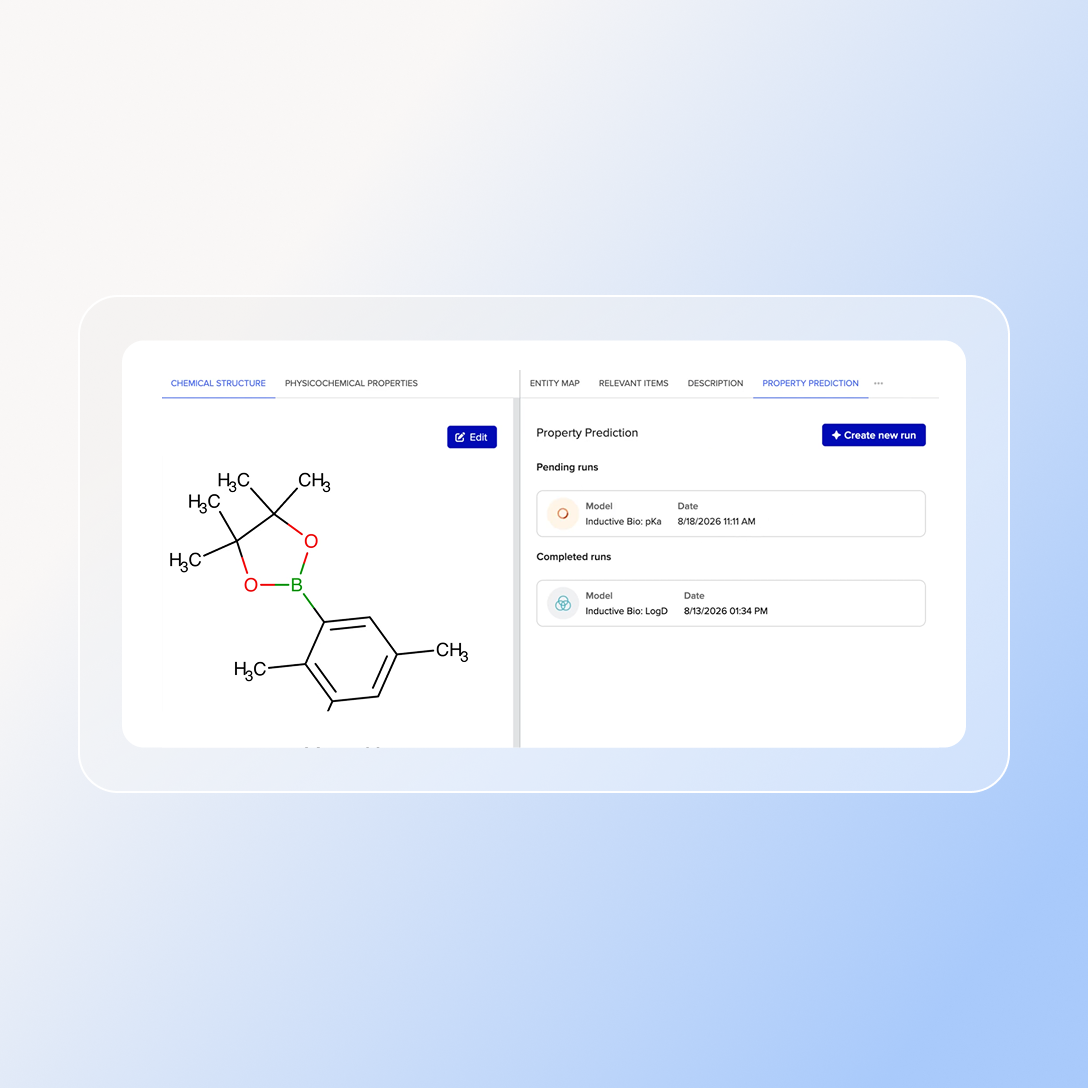
Predict ADMET properties before synthesis with small-molecule models from Inductive Bio and ChemLab on Lilly TuneLab
Use Benchling AI agents to research reaction history and surface relevant context
Accelerate reaction capture and reduce manual work with AI-assisted Notebook workflows
Model single-step reactions visually and capture reaction components and stoichiometry as structured scientific data.
Automatically calculate stoichiometric values and quantities as you design and update reactions.
Register and manage molecules with automatic calculation of physicochemical properties, salt handling, and uniqueness checks.
Find compounds using exact, substructure, or similarity search, so scientists can quickly locate and reuse existing molecules.
Search submitted reactions by substructure or similarity, filter molecules by reaction role, and navigate directly to the experiment where the reaction was performed.
Link reactions with molecules, experiments, lots, biological results, and hybrid-modality conjugates to preserve scientific context across R&D.
Benchling Chemistry brings chemistry workflows onto Benchling’s connected R&D platform. Scientists can register and search molecules, plan and capture reactions as structured scientific data, search previous chemistry, and connect that work with experiments and biological results.
Benchling Chemistry supports foundational medicinal chemistry workflows including molecule registration and structure search, single-step reaction planning and capture, automatic stoichiometry, salts and solvates, and reaction search.
Yes. Benchling supports small-molecule representation, including automatic calculation of physicochemical properties, uniqueness checks, salt handling, and structure search. Scientists can search compounds using exact, substructure, or similarity search.
Yes. Scientists can search submitted reactions using substructure or similarity, filter molecules by reaction role, and navigate back to the originating experiment.
Benchling captures chemistry as structured scientific data and connects it with broader experimental context. This creates reusable datasets that can support computational workflows and AI-driven analysis rather than leaving valuable scientific history trapped in disconnected documents.